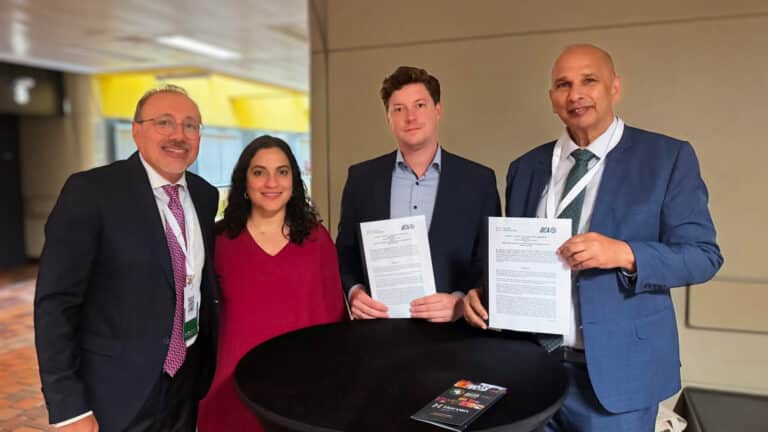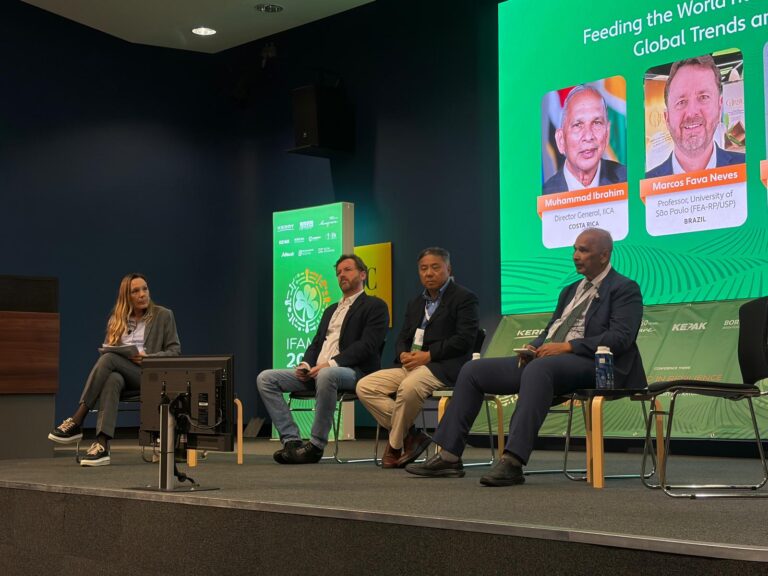

Campo Grande, Brazil, 23 June 2026 (IICA) – With the participation of public officials, academics, business leaders, agricultural attachés, representatives of sectoral associations, and international organizations, the International Agribusiness Forum (FIAP 2026) brought together in the Brazilian city of Campo Grande some of the leading voices in agriculture to discuss Brazil’s role in meeting the growing global demand for food, energy, and sustainable solutions.
Organized by Brazil’s Canal Rural and BR IN Eventos, with the collaboration of the Famasul System, which represents agricultural producers in Mato Grosso do Sul in Brazil’s Central-West region, the event was held under the theme “The Brazilian Recipe: Agriculture’s Response to Global Demand for Food and Energy.”
Within that framework, participants addressed strategic issues such as food security, international trade, biofuels, the so-called Bioceanic Route, the Mercosur-European Union agreement, livestock production, soybean production, and the restoration of degraded areas.
Prominent speakers and participants included former Minister of Agriculture Roberto Rodrigues; President of Aprosoja Brazil, Maurício Buffon; Federal Deputy Arnaldo Jardim; and Andrea Veríssimo, Director of International Relations and Communications at the National Corn Ethanol Union (UNEM), among other sector leaders.
The event also featured authorities and industry leaders such as Marcelo Bertoni, President of Famasul; Maurício Saito, President of Sebrae (Brazilian Micro and Small Business Support Service) in Mato Grosso do Sul; Renato Costa, President of Friboi, one of the world’s largest animal protein companies; and the Governor of the state, Eduardo Riedel. ApexBrasil, the country’s trade and investment promotion agency, the Inter-American Institute for Cooperation on Agriculture (IICA), and FAO were also represented.
The meeting revolved around a central idea: Brazilian agriculture is no longer simply a productive sector, but a strategic player for global economic, food, and energy stability. This vision was summarized by Canal Rural CEO Julio Cargnino, who stated that the forum seeks to reinforce Brazil’s position as a leading player in an international environment that demands productivity, innovation, sustainability, and cooperation.
One of the most significant moments of the event was the intervention of former Minister Roberto Rodrigues, who directly linked food production to global social and geopolitical stability. “Where there is hunger, there can be no peace,” he said, highlighting the responsibility of food-producing countries to ensure global supply and contribute to reducing inequalities.
Energy issues were given a prominent place in the discussions. In this context, Andrea Veríssimo, representing Brazil’s corn ethanol industry, defended the role of biofuels as a tool to address energy, climate, and food challenges simultaneously. “Biofuels can contribute to peace in the world,” she said during her presentation, explaining that corn ethanol production does not compete with food security but rather strengthens it through the generation of coproducts used in animal nutrition.
Veríssimo emphasized that the Brazilian model demonstrates that it is possible to produce renewable energy and food in a complementary manner. “We produce a renewable fuel and, at the same time, a highly nutritious feed ingredient that strengthens protein production,” she noted, referring to distillers dried grains (DDGs) and other coproducts generated by the corn ethanol industry.
She also argued that the growth of this production chain places Brazil in a privileged position within the global energy transition. According to Veríssimo, Brazilian corn ethanol has become “a synonym for sustainability, innovation, and predictability for the planet,” combining emissions reductions, job creation, and regional development.
The panels also highlighted the potential of Mato Grosso do Sul as a strategic platform for South American integration, particularly through the consolidation of the Bioceanic Route, which is seen as an opportunity to expand markets, reduce logistics costs, and strengthen the international integration of Brazilian agricultural production.
The presence of foreign delegations, diplomats, representatives of international organizations—including IICA—and private-sector leaders reinforced the forum’s international character. The event promoted dialogue among producers, governments, companies, academia, and multilateral organizations around a shared challenge: producing more food and energy with sustainability, innovation, and competitiveness.
FIAP 2026 concluded with a clear message: in a world marked by geopolitical uncertainty, climate challenges, and growing demand for resources, Brazil aspires to play an increasingly important role in discussions on food security, energy security, and sustainable development. From Campo Grande, the Brazilian agricultural sector reaffirmed its conviction that a significant part of the solutions to these challenges can emerge from farming, innovation, and cooperation.
More information:
Institutional Communication Division.
comunicacion.institucional@iica.int