Minister Limber Cruz announced a record production of beans, rice, vegetables, tomatoes and onions, as well as cooperation actions with Costa Rica to modernize the coffee industry. “We will be self-sufficient in coffee and we will export this product again,” he said. Major support was also given to the fruit growing sector.
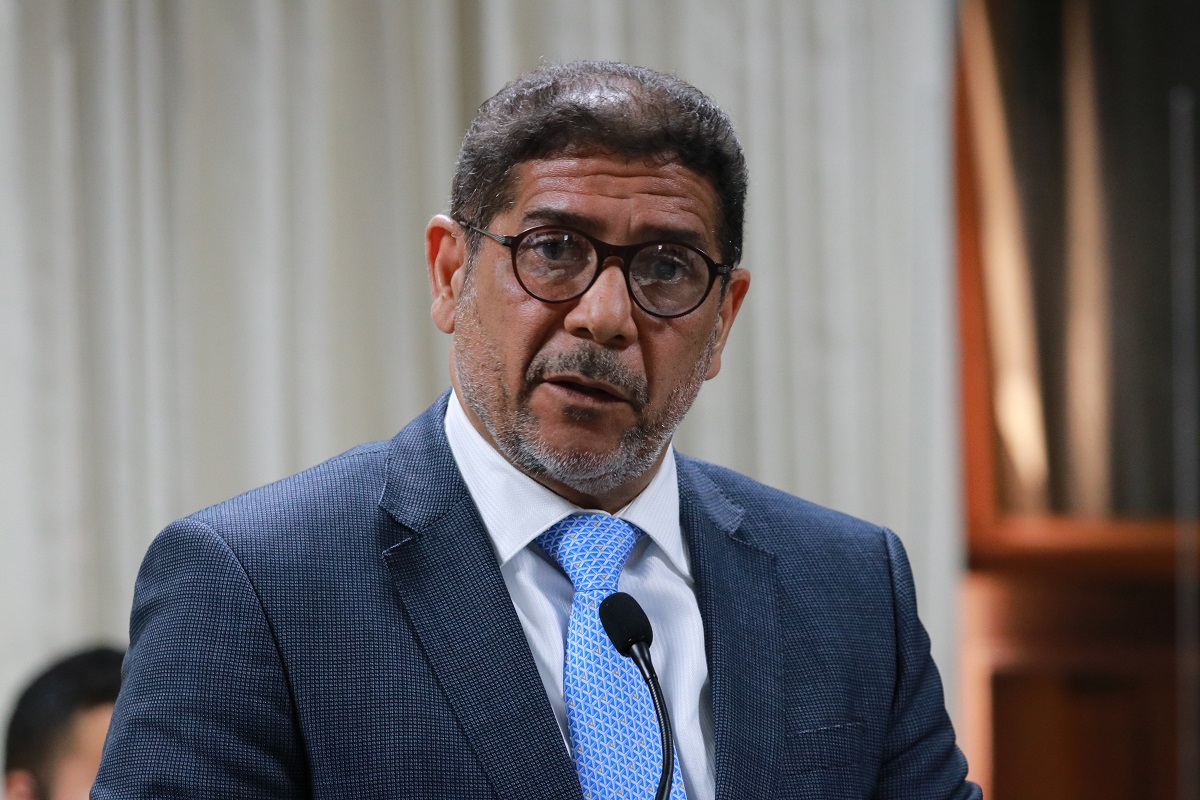
San José, 30 April 2021 (IICA). The Minister of Agriculture of the Dominican Republic, Limber Cruz, presented the eight pillars of the agricultural strategy implemented by President Luis Abinader’s government. This, in his view, is the adequate way to strengthen food security in this country, whose tourism sector, one of the main drivers of the economy, is facing the consequences of the drop in visitors caused by the Covid-19 pandemic.
During the ceremony to bestow the title of Goodwill Ambassador of the Inter-American Institute for Cooperation on Agriculture (IICA) on former president Hipólito Mejía, which was held at the Institute’s headquarters in Costa Rica, Cruz explained that President Luis Abinader “has chosen agriculture as one of the pillars to boost the economy, and we have identified eight lines of action that will allow us to relaunch this long-neglected sector”.
In his overview, the Minister of Agriculture of the Dominican Republic highlighted the efforts of the IICA Delegation in his country and the Institute’s unconditional support from the very beginning of his administration, as well as the rapid responses provided to the countries of the Americas in the current context of the pandemic.
Limber Cruz listed the lines of action of the strategy as follows:
-
“Produce: without production there is no food. Farmers must prepare the land well, work with seeds, seedlings, strains and cuttings, while applying best practices and using top varieties.
-
Water: without water there can be no production. After the government created the Commission on Water to identify medium and long-term solutions including dams, canals, etc., we decided to implement short-term solutions, in accordance with the context of scarcity and drought that we inherited, by initiating the construction of wells and reservoirs and connecting hoses for drip irrigation and microspraying systems.
-
Financing: Our government had to offer solutions that would reach the pockets of local producers in the midst of this pandemic. This is due to the decline it has caused in tourism, one of the main sources of foreign currency and employment, and a sector that has always purchased rural products. We asked the new government to provide 5 billion pesos at zero rate, in addition to offering credits at normal rates. This has been one of the most celebrated measures in the country, benefiting thousands of small- and medium-sized producers.
-
Local roads: the Dominican rural sector has been demanding adequate roads to transport their products to the market for a long time. For this reason, the Government’s program includes the preparation, restoration and completion of 1,000 km of roads connecting neighborhoods and plots of land every year. And this is only for the Ministry of Agriculture; additionally, the Ministry of Public Works and Communications has pledged to complete the same number of km.
-
Training: We strongly believe in training and implementation through technical assistance. We have a wide range of both virtual and face-to-face programs available in the eight regional offices of the Ministry of Agriculture, providing ongoing training twice a week, and supported by a digital platform that connects technical experts and producers with the ministry.
-
Research: we have developed an aggressive recovery plan for our laboratories, both in the animal and plant areas, introducing new resources and expanding the varieties. Similarly, we have dedicated major efforts to embryo production and artificial insemination to ensure the reproduction of the best genetic varieties of milk and beef.
-
Commercialization: the Government has implemented two approaches for the trade in agricultural products. These are the external and internal markets, with a strong focus on agroexports but without neglecting internal trade in hotels, markets, supermarkets, stores and fairs. The platforms developed to this end are the Price Stabilization Institute (INESPRE) and the Merca Santo Domingo, and we are planning to establish two additional ones in the North and East regions of the Dominican Republic.
-
Safety: it is important to produce healthy food, especially in this pandemic, which has taught us that there is a close relationship between eating well and being in good health. For this reason, we believe that safety is more than a necessity, because it also protects and preserves the properties of food”.
According to Minister Limber Cruz, this strategy “has allowed us to achieve record production of beans, rice, vegetables, tomatoes and onions, among other foods, in only eight months.”
He underscored the importance of the program executed by the Ministry in collaboration with coffee production experts from the Dominican Republic and Costa Rica, with a view to modernizing the local industry in the medium and long terms. “We will be self-sufficient in coffee, and we will export this product again”, said Cruz.
He also stated that technical and financial support will be provided to fruit growers, “to continue placing products such as mango, banana, avocado, pineapple, papaya, macadamia and pitahaya in all the major markets”.
More information:
Institutional Communication Division of IICA.
comunicacion.institucional@iica.int