
Buenos Aires, 8 August 2025 (IICA). Agriculture has a crucial role to play in global energy security, and this represents an opportunity for Latin American countries, which have comparative advantages in the field of biofuel production, according to experts taking part in the Congress of the Argentine Association of Direct Seeding Producers (AAPRESID).
The discussion on the contribution of agriculture to energy security was organized in a strategic partnership with the Inter-American Institute for Cooperation on Agriculture (IICA), which, after its successful participation in the Congress in 2024, is once again playing a prominent role, with a special panel of experts session, a photo exhibition, and a side event focused on AgTechs.
AAPRESID is a leading regional and global organization with over 35 years of experience developing production systems that regenerate the soil and the environment. Its congress is a large-scale, annual event that links science and production, with a focus on the transformation of agriculture and innovation scenarios. Leading national and international experts are participating in the three-day event, where they will be drawing attention to and discussing the key issues that will determine the future of the sector.
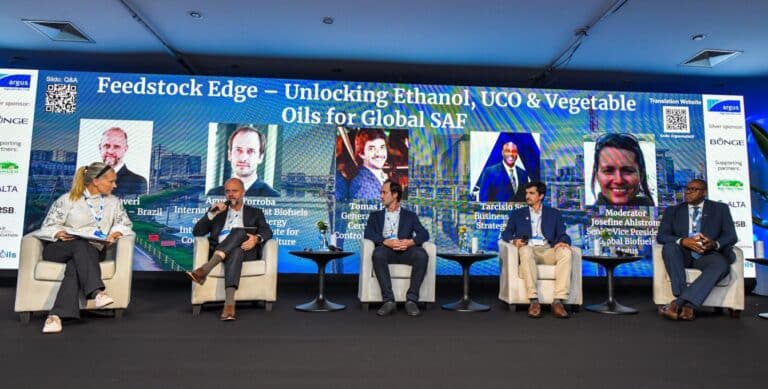
The panel discussion on the strategic role that agriculture can play in the region’s energy plans was moderated by Hugo Chavarría, IICA Manager of Innovation and Bioeconomy, and featured Patrick Adam, from the Corn Bioethanol Chamber of Argentina; Conrado Gattoni, from 2BSvs, which helps fuel and biomass producers and dealers obtain sustainability certification; and Agustín Torroba, International Biofuels Specialist at IICA.
Made from agricultural products, biofuels are intended to replace fossil fuels. Ethanol is produced from sugarcane, corn, or wheat, and blended with gasoline. Biodiesel is made from soybean, rapeseed, and even waste oil, and blended with diesel fuel. Today, the new frontier is sustainable aviation fuel (SAF), which is manufactured from oils, alcohols, or agricultural waste, and is the key to aviation decarbonization.
Ethanol and biodiesel are currently blended with petroleum-based fuels in 60 and 49 countries, respectively.
Low carbon footprint
“Our region has an enormous comparative advantage: our production has a low carbon footprint, we comply with international environmental requirements, and we have plenty of raw materials. If these environmental assets are valued properly—and markets like the EU and the US already do—biofuels can become a strategic source of foreign currency, employment, and innovation”, said Chavarría, who emphasized that Latin American countries must coordinate their strategies together in order to develop their potential.
Torroba spoke about the opportunities created by the demand for SAF, and suggested that the region has a major advantage because it has sustainable value chains and is used to certifying its agricultural products.
“Argentina exports 30 million tons of corn without adding value. This could produce nine times the total SAF produced worldwide today. Furthermore, it meets the sustainability criterion, because the corn produced in Argentina has a carbon footprint 55% below the global average”, added the IICA specialist, who supported the idea of creating a regional SAF production hub.
The speakers also emphasized that biofuels make it possible to create a comprehensive biorefinery, capable of generating other usable products, such as animal feed and additives. In this regard, and in addition to being an excellent tool for tapping market opportunities created by international environmental commitments, biofuels are also a means to achieve greater value added and improved biomass utilization.
More information:
Institutional Communication Division.
comunicacion.institucional@iica.int