San José, Costa Rica, 24 July 2025 (IICA) – Ambassador Kip Tom, a global leader in agribusiness and member of a family dedicated to farming for eight generations in the United States, highlighted the Inter-American Institute for Cooperation on Agriculture (IICA) as the only international organization that is a reliable and relevant ally for the countries of the hemisphere in defending their agricultural interests.
Tom, Vice Chair of Rural Policy at the America First Policy Institute (AFPI) think tank, stated that agricultural development is essential for the countries of the Americas and affirmed that IICA is “a central actor in empowering our farmers, strengthening our food systems, and reducing our dependence on global bureaucracies”.
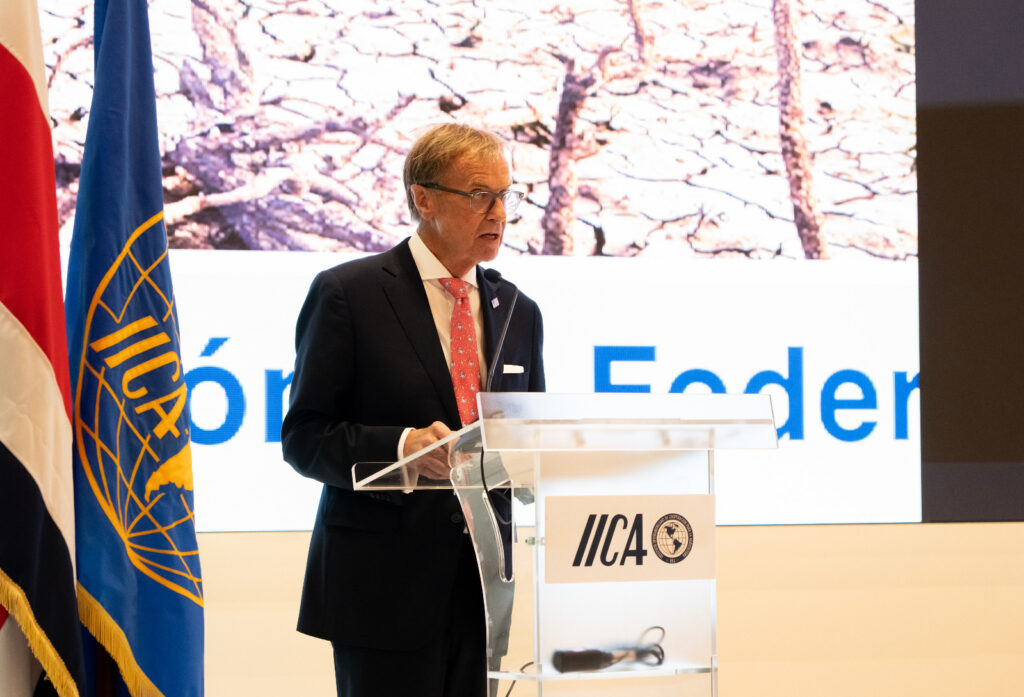
“While others have penalized our farmers, it was IICA that stood up to defend them, recognizing that farmers are the solution, not the problem”, said Tom, former U.S. Ambassador to the UN food and agriculture agencies in Rome, during the Second Meeting of Agricultural Federations of the Americas, held at IICA’s headquarters in San José, Costa Rica.
The meeting brought together around twenty continental agricultural federations, who discussed strategic challenges and opportunities in the sector, in an effort aimed at building a joint proposal with a forward-looking vision. This second meeting followed the first forum held in July 2024, which laid a foundation for cooperation and dialogue among the agricultural federations of the Americas.
The event was opened by José Francisco González, President of FECAGRO; Costa Rica’s Vice Minister of Agriculture and Livestock, Fernando Vargas; and IICA Director General, Manuel Otero.
“We need a strategic and rational defense of the agriculture sector in the Americas, which guarantees global food security and environmental sustainability. Collective construction is the path forward to defend what is vital for the planet and our countries”, said Otero.
Rejecting one-size-fits-all models
As an expert on the relationship between agriculture and national security, Tom delivered a keynote address that drew great interest from producers from across the hemisphere, who emphasized the need to generate concrete proposals that deepen the competitiveness and leadership of the Americas in food production.
Tom elaborated on the importance of IICA as a defender of the continent’s agricultural interests and as a unifier of efforts aimed at making the region’s countries more competitive in global markets. He also addressed the need to confront moves to impose one-size-fits-all production models that fail to respect the productive and cultural characteristics of each country and region.
He specifically praised the role of IICA Director General Manuel Otero.
“I strongly support IICA because I have witnessed Dr. Otero’s leadership in the Americas. He has understood that the continent has the natural resources to be the largest producer of food and energy and has encouraged countries to defend their sovereignty in order to have strong economies. Without a doubt, IICA is the right organization to bring the continent together and ensure a world with food security”, he stated.
“We see IICA as a key ally to ensure the continent remains united and to work together with the United States to promote democracy, the free enterprise system, and guarantee freedom by strengthening the farmers who produce food and energy for the world”.
Reducing dependence
Kip Tom considers himself above all a farmer. His family has farmed in northern Indiana since 1837. Under his leadership, Tom Farms has become one of the largest seed producers in the United States and a leading grain operation, while its expansion into agribusiness ventures like CereServ and GlobalAg has driven innovation in food production and technology.
As a promoter of expanded trade opportunities for farmers in the hemisphere, he spoke during his visit to IICA’s headquarters in Costa Rica about the importance of empowering the one billion people around the world who currently suffer from food insecurity, helping them build the capacity to produce their own food and create economic opportunities.
“To do that”, he said, “we need to reduce our dependence on imported inputs. For example, many of the products we use to fight insects, disease, and weeds come from outside the continent. That has to change so our countries’ economies can grow”.
The ambassador said that each country should choose its own production model, according to its natural resources, infrastructure, knowledge development, and human capital.
“We reject the non-tariff barriers that exist in the world. The Europeans are an example. We’re providing them with top-quality agricultural products, but they want to know what deforestation policies are in place in the rest of the world. The Europeans want to export their policies and claim to know what’s best and most appropriate for everyone. We need to work together to be strong and confront those attitudes”, he asserted.
In his keynote speech, Tom emphasized that the time has come to reduce the Americas’ dependence on external organizations and strengthen regional cooperation.
“The United States”, he stated, “welcomes the role of IICA and the agricultural federations of the Americas in supporting sustainable agriculture and regional food security. IICA is key to advancing policies that empower farmers, promote regional trade, and encourage investment in free agricultural innovation”.
“From the cornfields of the United States”, he added, “to the coffee plantations of Colombia, from Argentina’s cattle ranches to the orchards of Chile, our hemisphere has the ability to feed itself and the world. We cannot remain bound to global institutions that often impose universal policies that undermine our farmers in the Americas and our local economies”.
Tom also called for productivity not to be jeopardized: “We must ensure we reduce our carbon footprint as much as possible. But we must not do it at the expense of consumers around the world by increasing food prices. I’ve seen some private-sector companies in the U.S. approach dairy producers and tell them they have to do things a certain way and bear the cost. Or other companies propose passing the costs on to the consumer. That’s not acceptable. Above all, we must ensure an abundant, nutritious, and affordable food supply”.
More information:
Institutional Communication Division.
comunicacion.institucional@iica.int