San José, 12 March 2026 (IICA). Intensive technical support and coordination with national and international actors in the agriculture sector are among the actions that the Inter-American Institute for Cooperation on Agriculture (IICA) is carrying out to assist Costa Rica’s Ministry of Agriculture and Livestock (MAG) in validating the country’s 2026–2034 National Bio-inputs Strategy.
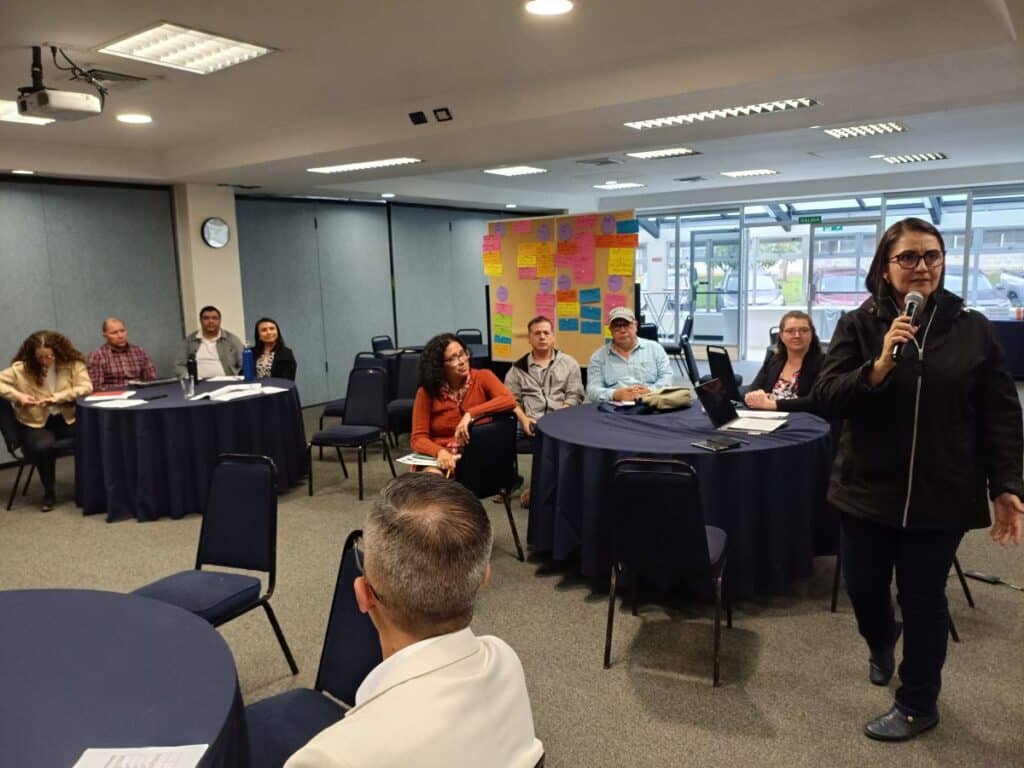
At a workshop held at the Institute’s Headquarters in San José, the Central American nation moved a step closer to implementation of the strategy, which is a public policy instrument designed to organize national actions, coordinate actors and define strategic priorities in order to strengthen bio-input development, use and innovation.
The event brought together representatives from public institutions, academia, research centers, productive organizations and international cooperation, and served as a high-level technical space for validating the strategic focus areas, goals and implementation mechanisms of the proposed roadmap.
The purpose of the 2026-2034 Bio-inputs Strategy is to create enabling conditions with respect to regulatory, scientific, technical and financial issues that will make it possible to scale up biological solutions with regulatory support, scientific evidence and economic viability.
The initiative sets the following objectives:
- Reduce dependence on imported synthetic inputs.
- Strengthen the quality and sustainability of agricultural production.
- Promote production chains and market opportunities.
- Boost applied innovation and technology transfer.
- Consolidate Costa Rica’s position as a regional leader in sustainable agriculture.
“The aim is to consolidate collaborative governance by aligning the work of the public sector, academia, the productive sector, the financial system and international cooperation with the same national vision”, said Marco Zapata, IICA Representative in Costa Rica.
The workshop held at the Institute also included representatives from German cooperation, through the Deutsche Gesellschaft für Internationale Zusammenarbeit (GIZ), under the “From Farm to Fork” program and the “Development and use of bio-inputs for sustainable agriculture in Latin America” project funded by FONTAGRO (co-investment and financing fund for agricultural research, development and innovation) and the National Institute for Agricultural Innovation and Technology Transfer (INTA).
These international cooperation efforts, coordinated with the IICA-led Hemispheric Bio-inputs Platform, are helping to improve the technical quality of the country’s strategy, facilitate the regional sharing of experiences, harmonize approaches, speed up the generation of scientific evidence for scaling up bio-inputs and position Costa Rica within the regional dynamics of agricultural innovation based on biological solutions.
More information:
Institutional Communication Division.
comunicacion.institucional@iica.int