
On this third note, we will share progress on the first suggested strategy, short supply chains.
Short Supply Chains
On this third note related to commercialization strategies that add value and facilitate market access for agricultural producers, we will share progress on the first suggested strategy, short supply chains.
Short supply chains can include unorganized producers, or producers with a certain degree of associativity, offering products that are differentiated by local attributes, even though such differentiation is not explicitly indicated by a brand name, a seal, or certification. In any case, the economic distance between supply and demand is short and predominantly close, in geographical terms, involving in some cases a maximum of one local intermediary, without the existence of prior agreements among the parties, or if such agreements do exist, they are informal.
For the most part, consumers are usually the main drivers of this type of arrangement, with local authorities also being important stakeholders. Proximity to consumers is advantageous since it facilitates a better understanding of consumer preferences and expectations; however, even though third-party certification is not expected, proximity also poses challenges because quality requirements are higher than in a traditional commercialization circuit.
Based on the facts mentioned above, the proposed definition of short supply chain is:
An articulation of individual or informally organized producers of fresh or processed products, differentiated but without certification, with final consumers, involving a maximum of one intermediary, in most cases production agreements are not defined prior to sale, and which includes the development of proximity relationships.
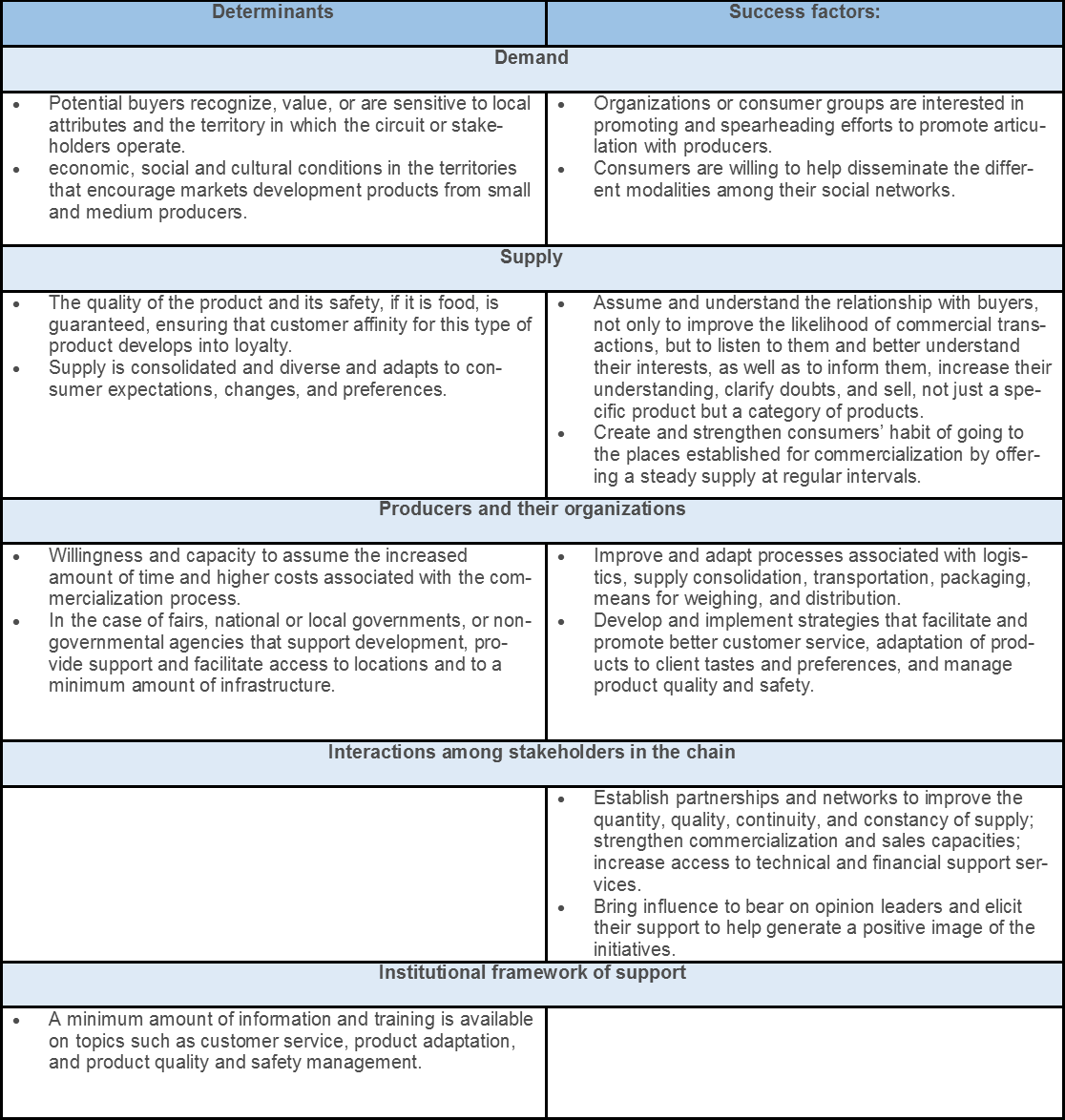
Based on the results of a workshop conducted by IICA in Peru as well as on the analysis of multiple examples a group of determinants and success factors was identified. Determinants are elements that are necessary and essential for implementing a commercialization arrangement and ensuring that it functions correctly: Success factors are good practices that facilitate the proper operation of a commercialization arrangement.
Short Supply Chains, Determinants and Success factors
Then there is potential for growth, for improving supply, and for consolidating forms of organization, the short supply chain can serve as the first step in a process that helps understand the market and identify constraints and opportunities that, once overcome and evaluated, make it possible to continue assuming additional challenges.
On the next bulletin we will address agricultural supply chains linkages followed by commercial linkages of differentiated products.
If you would like to review our previous notes related to this topic you can access them through the following links.
More information: daniel.rodriguez@iica.int
*This post appears in the IICA Delegation in the USA Newsletter – May- June 2016