In Washington, D.C., the Director General of the Inter-American Institute for Cooperation on Agriculture (IICA), Manuel Otero, presented IICA’s 2018 Annual Report to the Permanent Council of the Organization of American States (OAS); the report corresponding to Otero’s first year in office received widespread support from the Ambassadors and Representatives of the Institute’s 34 Member States.
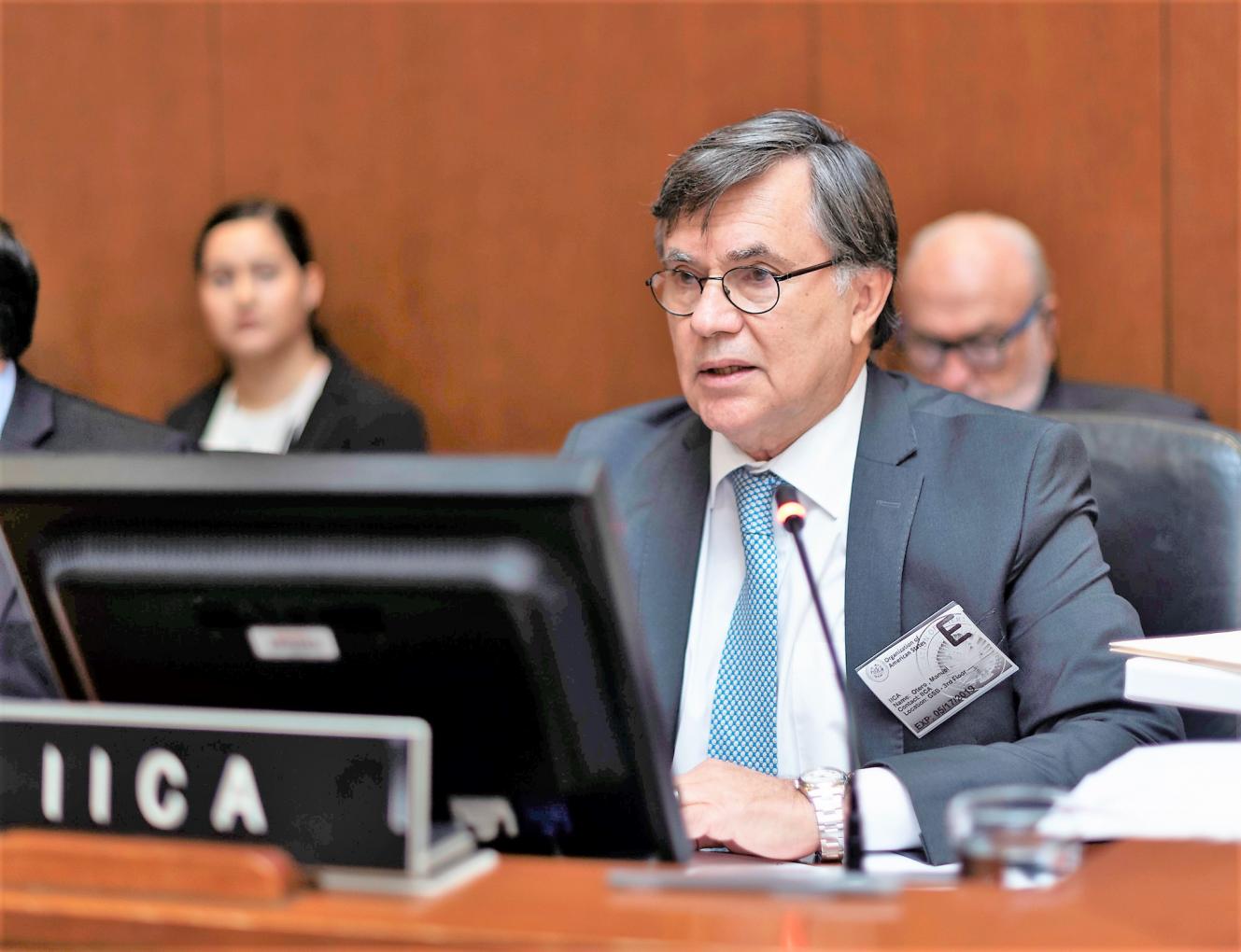
Washington, 15 May 2019 (IICA). The Director General of the Inter-American Institute for Cooperation on Agriculture (IICA), Manuel Otero, presented the Institute’s 2018 Annual Report to the Permanent Council of the Organization of American States (OAS). Otero described the work that the agency specializing in agricultural and rural development has undertaken during his first year in office, and received enthusiastic support from the Ambassadors and Representatives of IICA’s 34 member countries.
During his presentation, Otero outlined the priorities established by his administration to modernize the Institute and its technical cooperation model, which seeks to fully capitalize on the potential of the agriculture sector in the Americas. The Director General also described the Institute’s primary goals and actions in each of the five regions of the hemisphere in which the inter-American organization conducts its work.
“Our greatest mission is to ensure that agriculture in our hemisphere is prepared to capitalize on existing opportunities, which would enable the agriculture sector to serve as a key player in guaranteeing global food security and environmental sustainability on our planet. This potential opens up a world of positive opportunities that we must transform into reality,” stated the Director General of IICA.
In addition to highlighting agriculture’s substantial contribution to the economic activity of Latin American and Caribbean countries, as a sector that generates employment and income while driving innovation, Otero provided information on IICA’s active efforts to identify cooperation opportunities with the private sector. He also emphasized IICA’s role as a knowledge management platform, which seeks to provide rural territories across the Americas with concrete solutions.
“At IICA, we are addressing issues that are relevant to the future of agriculture, focusing on and integrating matters related to competitiveness, sustainability and social inclusion. In this regard, we understand that digital technology is crucial in order to bridge productivity gaps. These are the issues that guide our framework of partnerships, which seek to deliver concrete results to rural populations. We are certain that by utilizing technology and innovations in an intelligent and responsible manner, we will succeed in transforming agriculture in the Americas, and benefitting rural women and youth in particular,” he remarked.
Other topics addressed during the presentation included the approval of IICA’s roadmap, the 2018-2022 Medium-term Plan (MTP); the five hemispheric programs and two cross-cutting issues that guide the Institute’s work; and the Institute’s role as a bridge between countries and regions that drives the transformation of the agriculture sector. Otero also highlighted some of the Institute’s new agreements or rapprochements with various partners such as IDB, the World Bank, CAF, IFAD, FAO, PAHO, UN Women and SICA.
In 2018, IICA funded 67 interventions in 34 countries and implemented 188 initiatives with external resources totaling more than 150 million dollars. Additionally, 15 countries across the hemisphere received IICA resources in the form of rapid response actions. The Institute also enabled a total of 1000 stakeholders, 140 institutions and 34 countries to strengthen their risk management capabilities in agricultural health and food safety, and contributed to improving AHFS systems in Chile, Peru, Mexico and several Caribbean countries.
“We also facilitated training activities in 12 countries—including the Dominican Republic and Guatemala—where 300 professionals and scores of businesses and farmers increased their knowledge of the United States Food Safety Modernization Act. We also assisted Antigua and Barbuda, Guyana, Haiti, Jamaica and Suriname in strengthening capacities and enhancing their knowledge about restoring degraded soils, as just some of the many initiatives spearheaded by IICA,” noted Otero, who also shared information on the creation of a center for resilient agriculture in Dominica, which experienced substantial losses in the aftermath of the 2017 hurricane season.
“On the one hand, we must capitalize on the opportunities arising from increasing world food demand; on the other hand, we must redefine the role of rural areas as major green factories and suppliers of food, energy, ecosystem services, and inputs for industry. For all of these reasons, agriculture is our passport to the future,” concluded the Director General.
More information:
Institutional Communication Division
comunicacion.institucional@iica.int