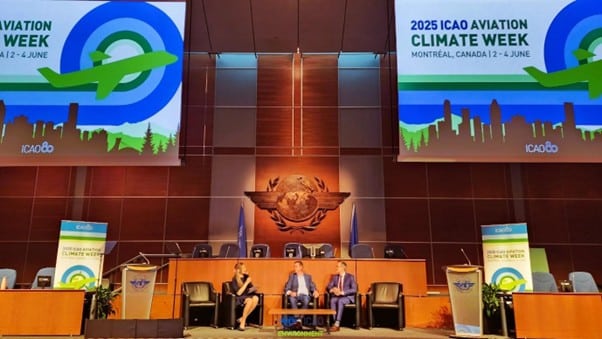
Montreal, Canada, 26 June 2025 – The Pan American Coalition on Liquid Biofuels (CPBIO) had a prominent role at the Aviation Climate Week of the International Civil Aviation Organization (ICAO), held in Montreal (Canada), with the participation of leading actors in the sector who discussed the latest developments in environmental matters.
During the event, the Coalition—made up of the main business and industry associations across the Americas dedicated to the production and processing of sugar, alcohol, corn, sorghum, soy, vegetable oil, and grains, among other agri-food products—advanced efforts to position the region as a global supplier of sustainable aviation fuels (SAF) within the context of the energy transition. The Inter-American Institute for Cooperation on Agriculture (IICA) serves as the technical secretariat of the Coalition, which was created in 2023 in San José, Costa Rica.
Carlos Mateus, Secretary General and Legal Director of the Colombian Federation of Biofuels (Fedebiocombustibles), explained that, with the goal of creating opportunities for countries in the region to actively participate in the production, distribution, and use of SAF and maritime fuels, a task force was established within the Coalition. “This initiative seeks to position our countries in the main international decision-making forums,” said Mateus.
“The overall outcome of our participation in Aviation Climate Week is highly positive. Key contacts were made and progress was achieved on an agenda that will allow us to seek observer status in bodies such as the Committee on Aviation Environmental Protection (CAEP) and the Technical Advisory Body (TAB), with the aim of identifying common lines of action for member countries in these and other international decision-making forums,” Mateus added.
In Montreal, discussions focused on ICAO’s achievements in meteorology and environment since the adoption of the Long-Term Aspirational Goal (LTAG) of net-zero carbon emissions for international aviation by 2050. Topics also included the Carbon Offsetting and Reduction Scheme for International Aviation (CORSIA), non-CO2 emissions from aviation, green airports, biodiversity, circular economy, adaptation to extreme weather events, and infrastructure resilience.
IICA and the promotion of sustainable aviation fuels
Agustín Torroba, IICA’s International Specialist in Biofuels and Renewable Energy and Executive Secretary of CPBIO, held strategic meetings alongside Mateus with ICAO’s general secretariat—including the Director of the Environment Office and her team—as well as with delegations from various countries in the region. Meetings were also held with representatives of key bodies such as CAEP, where crucial decisions are made regarding the eligibility of feedstocks and technological pathways for global SAF production.

Agustín Torroba (IICA-CPBIO) and Carlos Mateus (Fedebiocombustibles) with ICAO Director General Juan Carlos Salazar during the International Civil Aviation Organization’s Climate Week held in Montreal.
Torroba was also a speaker in the session titled “Accelerating the Aviation Cleaner Energy Transition – Taking Stock of Increased SAF Production.”
“Agriculture is a strategic ally for the decarbonization of the aviation sector through SAF, because, thanks to the power of biomass photosynthesis, it allows us to use atmospheric CO₂ to produce the biological feedstock that will later be transformed into biofuels or SAF to decarbonize aviation,” Torroba stated during his presentation.
As Executive Secretary of CPBIO, Torroba emphasized the need to work on closing productivity gaps in the six main crops currently used to produce biofuels: sugarcane, corn, wheat, soy, palm, and canola.
According to an IICA study, closing these productivity gaps could yield enough feedstock to produce 500 million cubic meters of SAF—without expanding a single hectare of cropland—thus meeting nearly all SAF consumption scenarios for decarbonization.
“One lesson we’ve learned from traditional biofuels is that feedstocks must be abundant, affordable, and sustainable, and we already know which feedstocks work. The six mentioned feedstocks are linked to highly developed, cost-effective value chains, with low carbon footprints in many parts of the world, and are associated with two of the most technologically advanced production pathways: hydroprocessed esters and fatty acids (HEFA) and alcohol-to-jet (AtJ),” Torroba added.
CPBIO strongly supports having a single global sustainability standard. Its members therefore emphasize the importance of aligning all public policies with CORSIA guidelines, which presents a major advantage for traditional biofuels, as they already have developed value chains and are accustomed to sustainability certifications.
As part of the Hemispheric Fund for Agricultural Resilience and Sustainability (FOHRSA), IICA has provided catalytic financing to mobilize and align strategic resources for seven key initiatives that address critical climate vulnerabilities in the region. Among these is the promotion of SAFs, aimed at boosting the biofuels market as part of a comprehensive strategy for decarbonizing the aviation industry in the Americas.
More information:
Institutional Communication Division.
comunicacion.institucional@iica.int