This is the conclusion of the document entitled “Decarbonizing the skies: Sustainable aviation biofuels” presented by IICA at the Pan-American Liquid Biofuels Summit.
San José, 31 March 2023 (IICA). Sustainable aviation fuels are at the top of the list for decarbonizing international air transport, representing a savings of 65% in terms of greenhouse gas emissions (GHGs) by 2050.
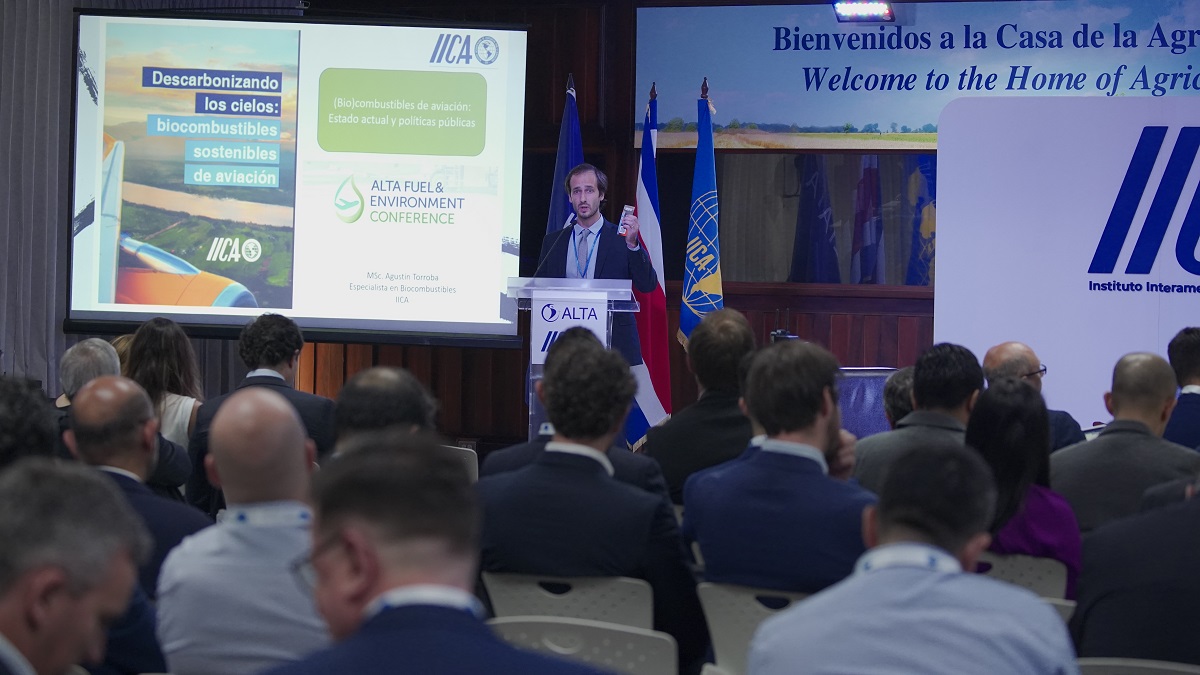
This is the conclusion of the document entitled Descarbonizando los cielos: biocombustibles sostenibles de aviación, [Decarbonizing the skies: Sustainable aviation biofuels] presented by the Inter-American Institute for Cooperation on Agriculture (IICA) during the Fuel and Environment Conference of the Latin American and Caribbean Air Transport Association (ALTA, for its acronym in Spanish), one of the main events of the Pan-American Liquid Fuels Summit being held at IICA headquarters in San Jose, Costa Rica.
The 115-page publication, written by Agustín Torroba, Biofuels Specialist at IICA, comprises four chapters: Introduction to sustainable aviation fuels: Technical aspects; The role of sustainable aviation biofuels in decarbonizing the sector; Economic aspects of aviation biofuels; and Institutional aspects and public policy.
According to the document, the aviation sector established measures to reduce emissions, striving for carbon neutrality as of 2020 and aiming to reach net-zero CO2 emissions by 2050, which is feasible with the production and consumption of sustainable aviation fuels.
“Sustainable aviation fuels derived from biological or non-fossil feedstocks, known as biojet, can replace or supplement conventional aviation fuels, reducing greenhouse gas emissions across the product life cycle”, explained Torroba.
The document also highlights that agriculture can play a key role in providing the feedstock necessary to produce biojet.
“The agriculture sector of the Americas currently has sufficient vegetable oils, animal fats, sugars and starches, alcohols and lignocellulosic materials that constitute the large families of feedstock that can be used in the production of biojet, so the continent is very well positioned to be a supplier of energy diversification by producing sustainable aviation fuels to supply this new market”, expressed Torroba.
Sustainable aviation fuels could also prevent the early obsolescence of older aircraft by allowing all aircraft to reduce their net carbon footprint without the need for technical changes, the publication explains.
Moreover, depending on the region, technology and type of feedstock, sustainable aviation fuels could offer other benefits beyond reducing emissions, such as generating thousands of jobs, creating positive linkages with the agriculture sector and using waste as an input in the production process, among others.
However, in order to optimize their productive development and use and to expand new markets, the publication stresses that public policies at the regional and global levels are essential.
“Establishing institutions and formulating public policies are necessary conditions for developing the production and consumption of sustainable aviation fuels”, it says.
Several countries have already started developing policies to incentivize the use of so-called SAF and other low-carbon aviation fuels. Legislation has already been passed in Norway, the United Kingdom, Indonesia and the states of California and Oregon in the United States, while in Germany, France, Spain, Portugal, Finland, the rest of the USA, Brazil and Belgium, legislation is under development.
The document states that by 2050 it is estimated that sustainable aviation fuels will represent 63% of all fuels used in aviation in the European Union.
The publication is available for download free of charge (in Spanish only) from IICA’s institutional repository at: https://repositorio.iica.int/handle/11324/21441.
More information:
Institutional Communication Division.
comunicacion.institucional@iica.int