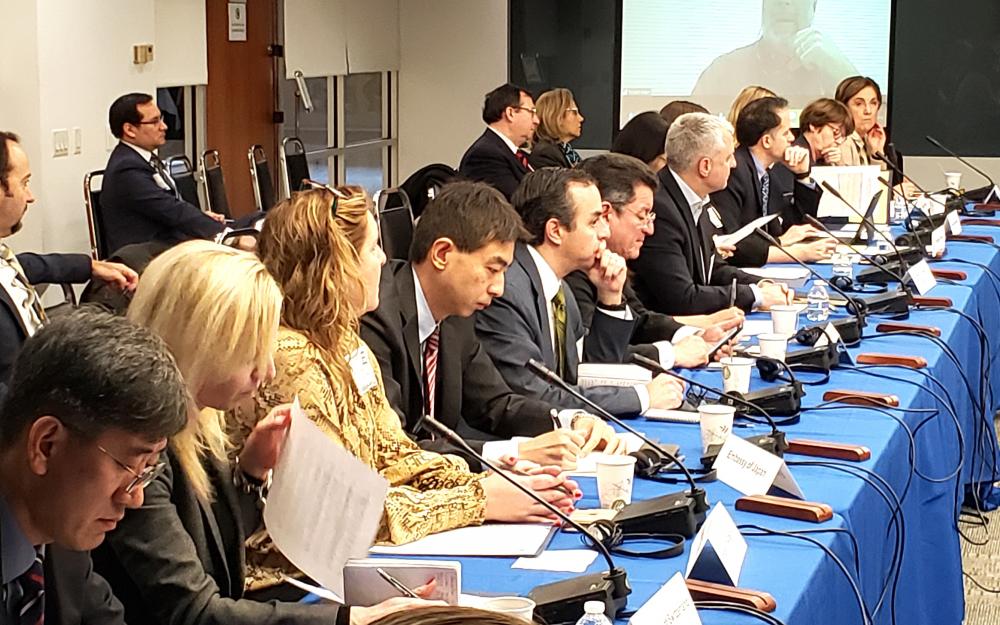
The United States’ Chief Agricultural Trade Negotiator Ambassador Gregg Doud and his top agriculture trade team discuss key trade issues with agricultural attaches and representatives of International Organizations during IICA’s high-level trade meeting hosted in Washington DC
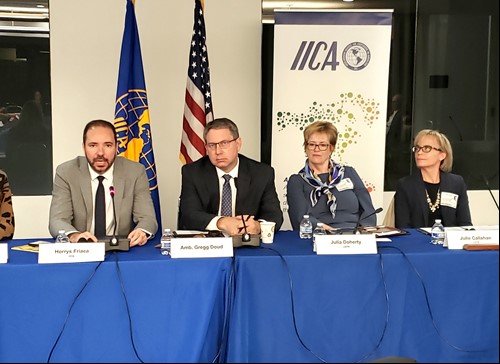
Washington D.C., 5 December 2019 (IICA). The Inter-American Institute for Cooperation on Agriculture (IICA) convened over 40 representatives of diplomatic missions and international organizations in a rare candid exchange with USTR’s top agricultural trade negotiator Ambassador Gregg Doud and his two senior official agricultural trade experts (Julia Doherty and Julie Callahan).
The USTR Officials briefed IICA’s guests on critical agricultural trade issues ranging from the International Standards of Codex Alimentarius to the importance of the Congressional ratification of the US-Mexico-Canada Agreement (USMCA), the US state of play of bilateral and multilateral negotiations, and touched on the globally sensitive China-US agriculture negotiations and their escalating tariff war.
Ambassador Doud noted that the United States considers the adoption of new technologies to be its primary competitive advantage in agricultural production, and encouraged his country’s trade partners to move in the same direction.
USTR senior officials Julie Callahan and Julia Doherty also briefed U.S. trade priorities within the framework of Codex Alimentarius and the SPS Committee of the World Trade Organization (WTO).
“IICA was very honored and proud to host USTR’s Chief Agricultural Negotiator and his team at this briefing with our agricultural colleagues from the Washington DC’s Embassies,” stated IICA Director General Manuel Otero.
“IICA has held this series of global agricultural roundtables all year with the goal of reaching a better understanding of critical issues affecting our IICA Member States’ agricultural sector” added Horrys Friaca, IICA International Specialist in Animal Health and Plant Safety.
“This exercise has led us to conclude we have more in common than not and of the core importance of science-based decision making in agricultural policies. A key example of this commonality is the fact that during IICA’s Inter-American Board of Agricultural Ministers Meeting this year, our Members unanimously adopted a Resolution on the importance of sound science when setting Maximum Residue Limits”, said Friaca.
IICA’s first roundtable discussion convened in December 2018 focused on international requirements for importing products of animal origin. In July of this year, IICA’s roundtable delved into antimicrobial resistance and its impact on trade.
As the recognized agricultural agency in the Hemisphere, IICA has long been a leading nexus for agricultural trade, production, and policy. Along with the U.S. Department of Agriculture and the USTR, IICA brought together experts from 19 Latin American and Caribbean countries in mid-October to discuss a joint strategy for ensuring that SPS measures applied in international food trade are based on sound science.
About IICA
IICA is the specialized agency for agriculture in the Inter-American system, with a mission to encourage, promote and support its 34 Member States in their efforts to achieve agricultural development and rural well-being through international technical cooperation of excellence.
More information:
Horrys Friaca, IICA Delegation in the United States.
horrys.friaca@iica.int