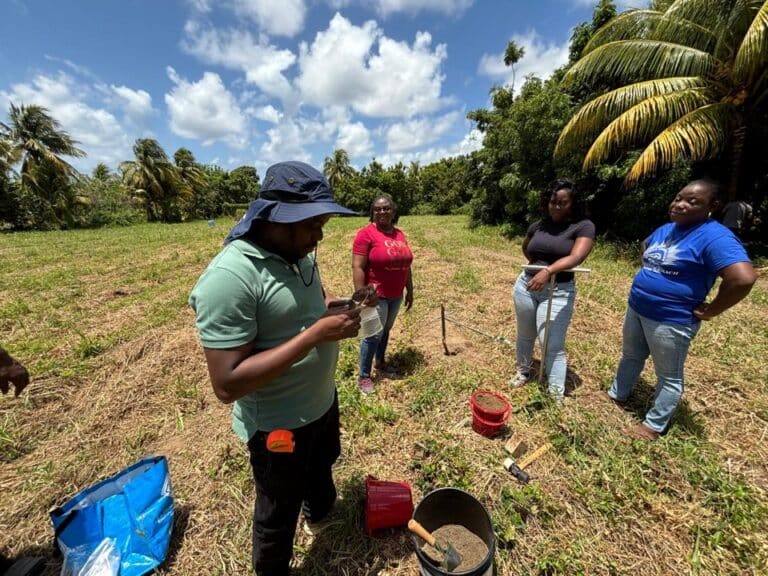
The first major eruption of La Soufriere Volcano was last April and since then there have been thirty-two others. Approximately 20,000 people were evacuated from their homes, most of whom were farmers, given that the lands adjoining the volcano are used primarily for agriculture.
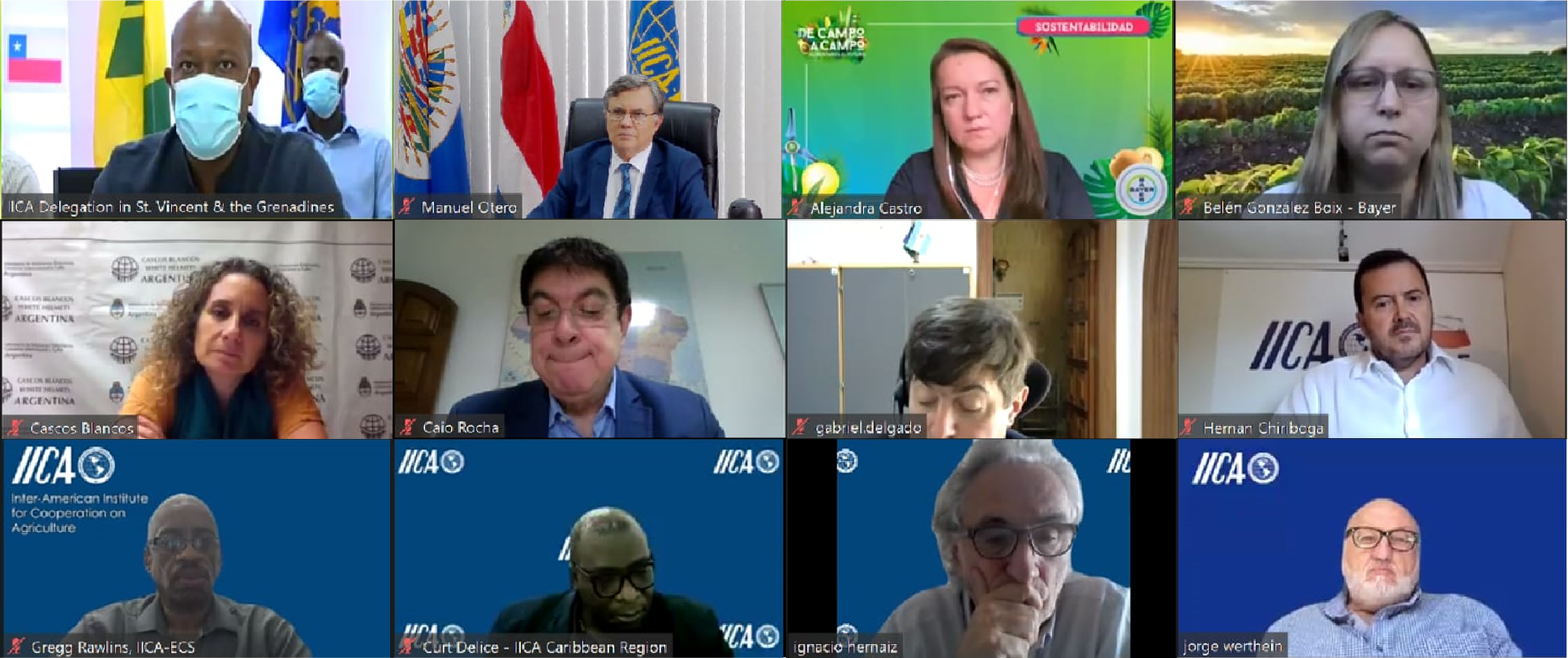
San Jose, 26 November 2021 (IICA) – St. Vincent and the Grenadines received a new donation of seeds, this time from Bayer AG, in a drive to fuel the recovery of the country’s production sector following the volcano eruptions that since April have devastated agricultural production and left food security hanging in the balance.
Apart from the Bayer donation, the Caribbean nation received donations of various types of vegetable seeds from Argentina, Brazil and Chile, under the technical coordination of the Inter-American Institute for Cooperation on Agriculture (IICA).
The first major eruption of La Soufriere Volcano was last April and since then there have been thirty-two others. Approximately 20,000 people were evacuated from their homes, most of whom were farmers, given that the lands adjoining the volcano are used primarily for agriculture.
Speaking at the official handover ceremony, Saboto Caesar, Minister of Agriculture, Forestry, Fisheries, Rural Transformation, Industry and Labor of St. Vincent and the Grenadines, remarked that, “We are working assiduously to boost our production and increase productivity. We are grateful for all the contributions received just at the right time to enable our family farmers to reap significant benefits, thus reducing our food imports”.
Caesar explained that, “This donation will allow us to ensure the food supply for our people in the upcoming months and to continue on the path to a more resilient agriculture sector in 2022. These actions should be recognized as a gesture of solidarity that should be followed and I thank IICA, because a friend in need is a friend indeed”.
In addition to the Bayer AG donation, the Caribbean country received cantaloupe and watermelon seeds, as well as an assortment of vegetables seeds, namely lettuce, broccoli, Swiss chard, carrot, cucumber, corn and tomato, among others. These were supplied by the Argentinian Seed Producers’ Association (ASA) and Plantec de Chile, in coordination with the White Helmets Commission—an agency under Argentina’s Ministry of Foreign Affairs—and IICA.
White Helmets Vice-President, Mariana Galvani, remarked that, “The seeds will guarantee the recovery and continued functioning of agricultural production in this Caribbean nation”, and expressed a willingness to send a mission to provide technical support in areas such as water quality and the rehabilitation of livelihoods.
Data from the local Ministry of Agriculture reveals that the eruptions destroyed 100% of the country’s vegetable crops.
“We believe situations like this one call for urgent and pointed actions to immediately assist those who are most in need and to support long-term actions that contribute to building a more competitive and efficient agriculture sector”, said IICA Director General, Manuel Otero.
He further added that, “We trust that these donations coupled with human support will provide a critical boost to offer relief to farmers and to strengthen the pivotal role of the Ministry of Agriculture in the recovery efforts”.
Alejandra Castro, Head of Legal, Patents and Compliance at Bayer AG, thanked IICA for serving as a bridge to facilitate the organization of the donations and for contributing to agriculture and rural development in the Americas.
In total, the value of the seeds donated to the Caribbean country was calculated to be about 300,000 dollars.
The seeds will support the rehabilitation of agriculture, which is key to food and nutritional security, given that the heaviest ashfall and most severe impact affected the part of the island devoted to production activity.
More information:
Institutional Communication Division
comunicacion.institucional@iica.int