Buenos Aires, 9 December 2025 (IICA) – The Inter-American Institute for Cooperation on Agriculture (IICA) participated in Argentina’s 2025 National Congress on Agricultural Education, organized by the government with the objective of updating educational practices and strengthening their connection with the technological advances that are transforming agriculture.
More than 1,800 principals, students and teachers from agricultural technical schools across the country took part in the Congress through meetings held in different regions over the course of the year, with the aim of promoting and enhancing the exchange of knowledge and best practices.
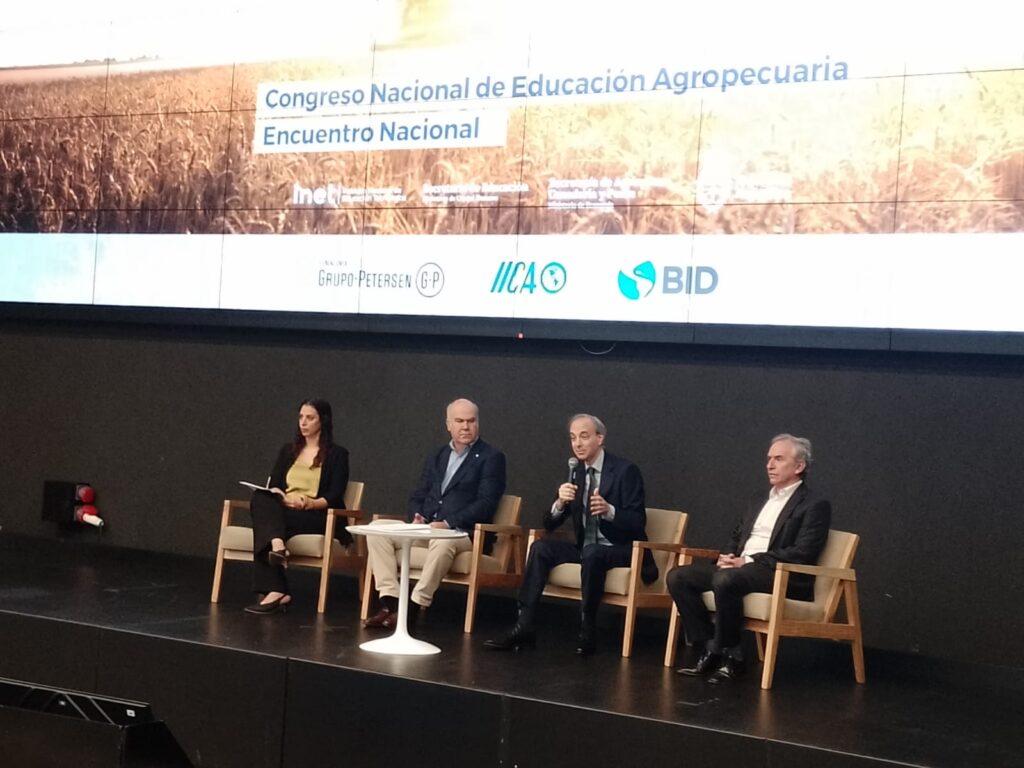
The Congress concluded with a working session in Buenos Aires attended by the Secretary of Agriculture, Livestock and Fisheries, Sergio Iraeta; the Secretary of Education, Carlos Torrendell; and IICA’s Representative in Argentina, Fernando Camargo, together with ministers and vice ministers of Education from various provinces. Also participating were Ludovico Grillo, Director of the National Institute of Technological Education (INET), and Tamara Vinacur, Education Specialist at the Inter-American Development Bank (IDB).
Mario Anastasio, Carolina Pivetta and Sandra Ziegler were the IICA specialists who conducted the working sessions at the Congress, together with invited experts.
The National Congress on Agricultural Education was organized by INET, and some of its thematic areas included technological innovation in agricultural, agri-food and service production, as well as strengthening linkages between schools and productive, scientific and technological sectors. INET is the agency within the Secretariat of Education responsible for coordinating the implementation of public policies related to technical education.
Together with IICA, INET has been working on a project to strengthen agricultural technical schools, aimed at promoting a renewed vision of rural realities and building bridges between rural areas and cities through tools such as digital agriculture, the bioeconomy, value addition in agricultural production and technological innovation.
Connection between theory and practice
Iraeta explained that it is essential for Argentina to promote and modernize agricultural technical education to ensure the country remains an agroindustrial powerhouse. “Agricultural schools have been at the forefront of connecting theory with productive practice; promoting that symbiosis is fundamental”, he stated.
IICA conducted workshops during the regional meetings of the Congress, engaging more than 400 teachers, focusing on AgTechs and digital agriculture, on the one hand, and project design—including financing—on the other.
Among the conclusions, IICA noted that the Congress made clear that agricultural technical schools face challenges in keeping pace with the technological transformation of the agriculture sector, and that it is necessary to foster sustained investment strategies involving the State, the private sector and international cooperation, supported by continuous training for teachers and technicians to ensure an updated educational offer.
“This is a process we consider strategic for the development of the countries. It represents an invaluable opportunity to build bridges with actors from agrotechnical education across the country. The agriculture sector needs to accelerate the training of new talent, because the challenge is to ensure generational renewal in rural areas and avoid the loss of human capital”, Camargo explained.
IICA’s Representative in Argentina explained that the accelerated pace of global technological change must be connected with the pace of educational institutions, which need to incorporate infrastructure, knowledge and capacities to accompany these changes.
“Agrotechnical education has enormous potential but also major challenges. The digitalization of agriculture is already well established and will continue to grow. In this context, teacher training is essential. IICA is committed to deepening its work in technical support for digitalization, capacity-building for the design of productive projects, institutional modernization and the exchange of experiences and good practices, based on the conviction that agrotechnical education is not an isolated subsystem, but a strategic policy for the country’s economic, environmental and social development”, said Camargo.
More information:
Institutional Communication Division.
comunicacion.institucional@iica.int