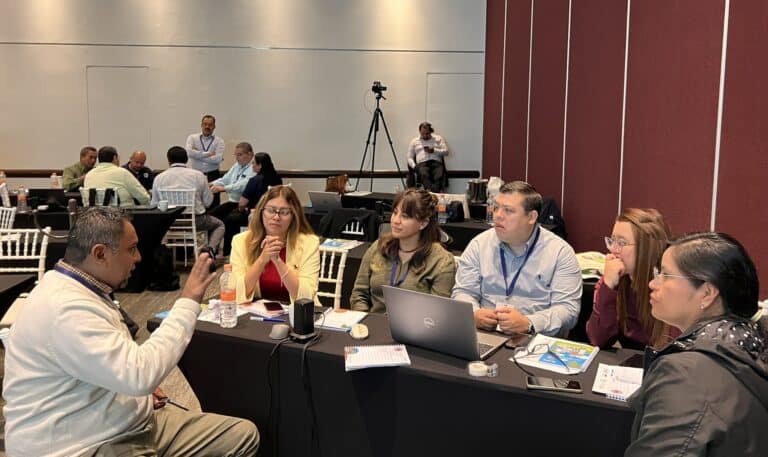
This took place at the 23rd DATAGRO International Conference on Sugar and Ethanol, a traditional and highly relevant event linked to the promotion of liquid biofuels.
San Jose, 6 November 2023 (IICA) – Officials and representatives of the global ethanol and sugar industry gathered in Sao Paulo, the largest city in Brazil, to participate in the 23rd DATAGRO International Conference on Sugar and Ethanol, a traditional and highly relevant event linked to the promotion of liquid biofuels.
The last edition of the conference brought together international experts in different economic, technical and cooperation topics.
The DATAGRO International Conference, which had its first edition in 2000, has been the technical support event for the Sugar & Ethanol Dinner Brazil, promoted by the local Sugar Club.
The meeting featured ten different panels and simultaneous sessions that provided useful material and information for the consolidation of present and future efforts aimed at the development of the sugar and ethanol sector.
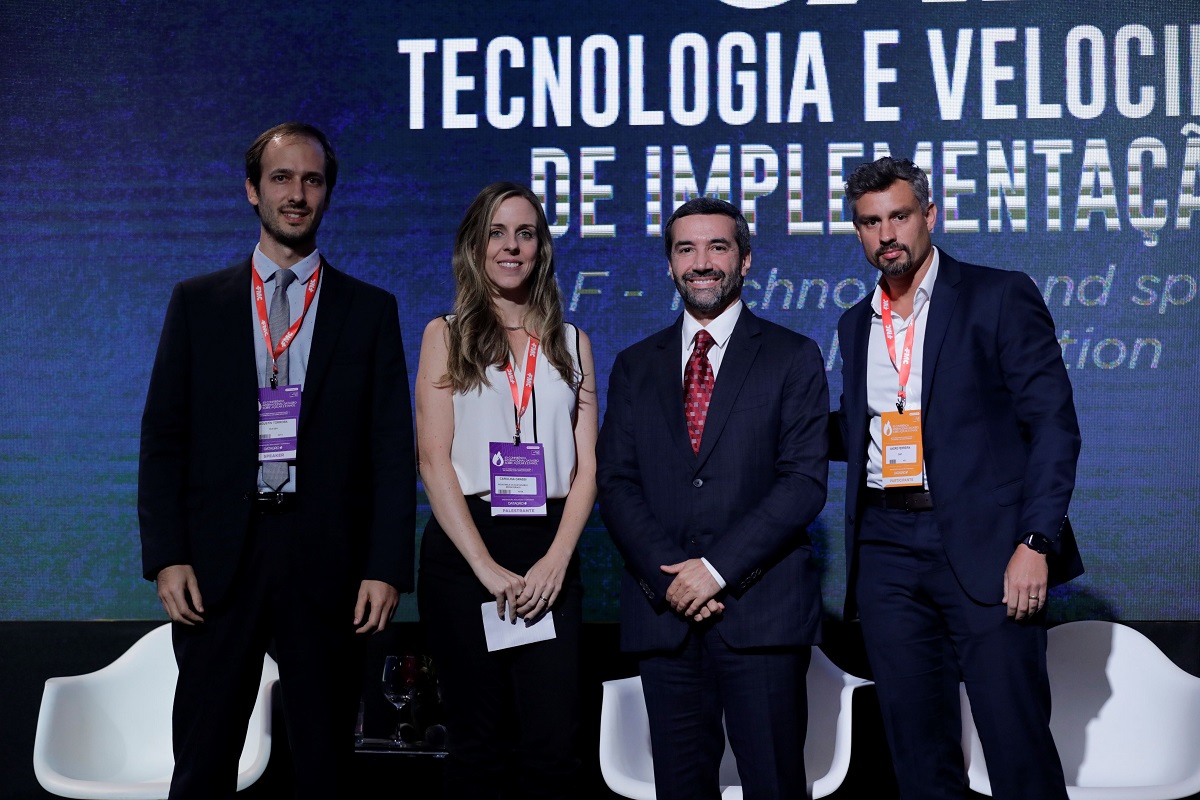
An emerging and promising associated topic is sustainable aviation fuels (SAF). In this context, the Inter-American Institute for Cooperation on Agriculture (IICA) was represented by its biofuels specialist, Agustín Torroba, who participated in the panel “SAF – Technology and Speed of Implementation”, together with other specialists in the field.
In this panel, the expert provided a general overview of Sustainable Aviation Biofuels (SAF) as a new mobility paradigm in the decarbonization agendas of the transportation sector, which holds great development potential for the region of the Americas.
The “Alcohol to Jet” (ATJ) technological pathway makes it possible to industrialize the ethanol that is currently produced in the world and convert it into sustainable aviation fuel. This technological pathway, together with the hydrogenation of fatty acids (HEFA) are the two most developed pathways to produce SAF”, said Torroba, who stressed that the region of Latin America and the Caribbean “has remarkable comparative advantages with respect to the rest of the world due to the abundance of raw materials and inputs to produce oils and fats for the HEFA pathway and a lot of biomass rich in sugars and starches to produce ATJ”.
He went on to add that “the region has highly developed and competitive value chains to provide intermediate inputs, in the sense that it has large production hubs for oils and alcohols”.
For the expert, the American continent “can be the world’s largest supplier of sustainable aviation fuel, a product that will represent 65% of the reduction of greenhouse gas emissions from the commercial aviation sector by 2050, in keeping with the sector’s commitment to reach net zero emissions”.
The vice president of Brazil, Geraldo Alckmin, who was present at the event, highlighted that the sugar energy sector is crucial for the beginning of a new industrialization in the country, because the segment generates employment, income and consequently sustainable development, as it is anchored in the economy of green products.
Alckmin mentioned that Brazil has the cleanest energy matrix in the world and that the government is working to gradually increase the percentage of biodiesel mixed with diesel and ethanol with gasoline.
Brazilian federal deputy Arnaldo Jardim, who was also present at the opening ceremony, stated that Brazilian agriculture has an unwavering commitment to sustainability, which was seconded by the Secretary of Commerce and International Relations of the Ministry of Agriculture and Livestock, Roberto Perosa.
Among other authorities, the opening ceremony also featured the participation of the new Secretary of Agriculture of São Paulo, Guilherme Piai , who announced that the richest, most densely inhabited state in Brazil will have an exclusive Harvest Plan starting in 2024.
Other important representatives of the sector also participated, such as Cesario Ramalho, from the Agribusiness Council of the Commercial Association of São Paulo (ACSP); Sergio Bortolozzo , from the Brazilian Rural Society (SRB); and Evander Gussi, from the Union of the Sugarcane and Bioenergy Industry (UNICA).
More information:
Institutional Communication Division.
comunicacion.institucional@iica.int