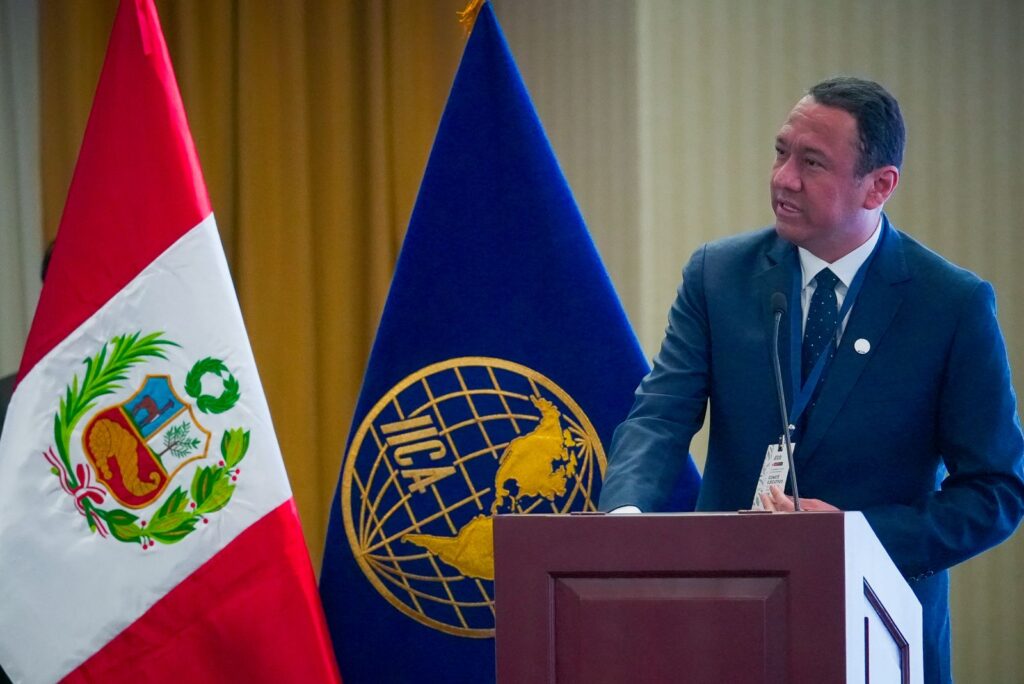
Lima, 22 August 2025 (IICA) – “Innovation, the biomass industry and biotechnology afford valuable opportunities for our small-scale farmers. One of the benefits of being part of IICA is being able to access these opportunities and to learn from the experiences of other countries in the region”, stated Ángel Manero Campos, Minister of Agricultural Development and Irrigation of Peru.
Manero Campos was the host of the 45th Regular Meeting of the Executive Committee of the Inter-American Institute for Cooperation on Agriculture (IICA), which brought together the ministers of Agriculture and senior officials of the Americas in Lima, Peru for two days of joint work. The Peruvian minister opened the meeting alongside Manuel Otero, Director General of IICA, who presented the achievements of his term in office. The government representatives, in turn, voiced their support for Otero’s efforts to position agriculture as part of the solution to the challenges facing the global population.
“Peru clearly has two types of agriculture. One is commercial agriculture, which is quite competitive and primarily carried out on the coast, which has enabled us to become the world’s leading exporter of blueberries and table grapes, and to rank first and second in asparagus exportation, second in avocado exportation, and third in mango exportation. But the Andean and Amazon regions also carry out small-scale agriculture, which has undoubtedly struggled in recent decades. Our great challenge is making it competitive and sustainable”, remarked Manero Campos.
The head of MIDAGRI considered that biotechnology, through products such as adapted seeds, and the biomass industry are tools that can help improve the situation of small-scale farmers. “One of the benefits of being part of IICA is that we can learn from other countries’ experiences. For instance, we will be visiting Costa Rica in the coming weeks to learn about regenerative agriculture, livestock farming methodologies and the sale of carbon credits to the market. Although countries of the Americas differ greatly, we have many common opportunities and challenges. We must work together and jointly defend agriculture, as we will at this year’s COP30 in Brazil, alongside IICA”, he noted.

During the Institute’s Executive Committee Meeting in Lima, Ángel Manero Campos, Minister of Agricultural Development and Irrigation of Peru, presented an award to Manuel Otero, Director General of IICA, in recognition of his contributions to agricultural productivity and sustainability and rural retention.
Presence in Lima
Manero Campos highlighted the broad participation at this year’s IICA Executive Committee Meeting, which was attended by ministers and delegations from 23 countries in the region, in addition to private sector representatives, agricultural research institutions, observer countries, members of other international agencies and the diplomatic corps accredited to Peru.
“There is extraordinary enthusiasm to assist IICA in taking its next steps. We will soon have a new Director General, and just as we have commended Manuel Otero on his successful term in office, we are also hopeful about the work that will be carried out by his successor”, he added.
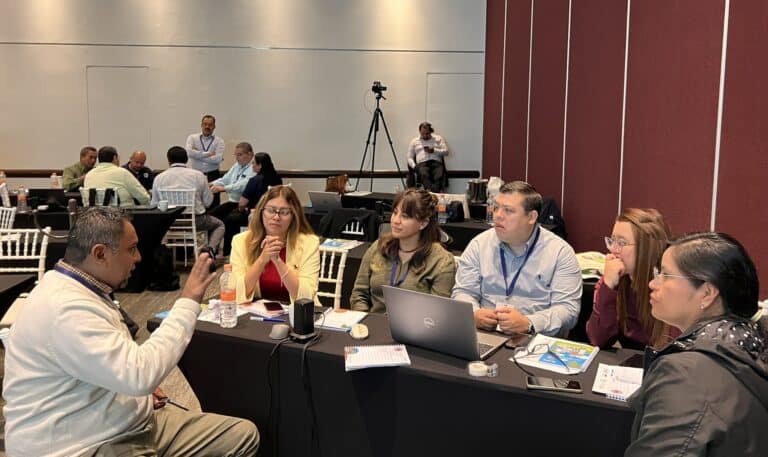
Manero Campos also underscored the value of the workshop on animal production that was carried out within the framework of the Executive Committee, and which resulted in a joint message on behalf of the ministers regarding the importance of this activity for the region’s economic development and global food security.
“Livestock farming is sometimes unjustly questioned”, he said, “because it can very well be sustainable. We want a livestock sector that can guarantee food for Peruvians but also enable us to capitalize on opportunities in global markets. Our technical specialists have learned a great deal from the experiences of countries that are livestock powerhouses, such as Brazil, Argentina, Uruguay and Paraguay. The workshop has also allowed for building consensus and uniting our region’s voice, which we will take to COP30. I believe this Executive Committee achieved a great deal of progress”, he said.
Lastly, the Peruvian minister referred to the opportunities available to his country’s production and industrial sectors in relatively uncharted areas: “The future ahead could be very interesting. We have already consolidated our fruit and vegetable production, and up ahead are biofuels—ethanol, in our case, given that Peru is a major sugarcane producer and has a fairly positive energy balance. The biomass industry also affords opportunities for small-scale farmers, who can use plant waste to produce bioplastics to replace products derived from petroleum”.
More information:
Institutional Communication Division.
comunicacion.institucional@iica.int