Officials, experts and academics from 12 countries are attending the Forum, which Colombia is hosting for the first time. It will seek to develop concrete proposals on how to successfully tackle the challenges of rural development, with a territorial focus, and also to expand knowledge networks in Latin America.
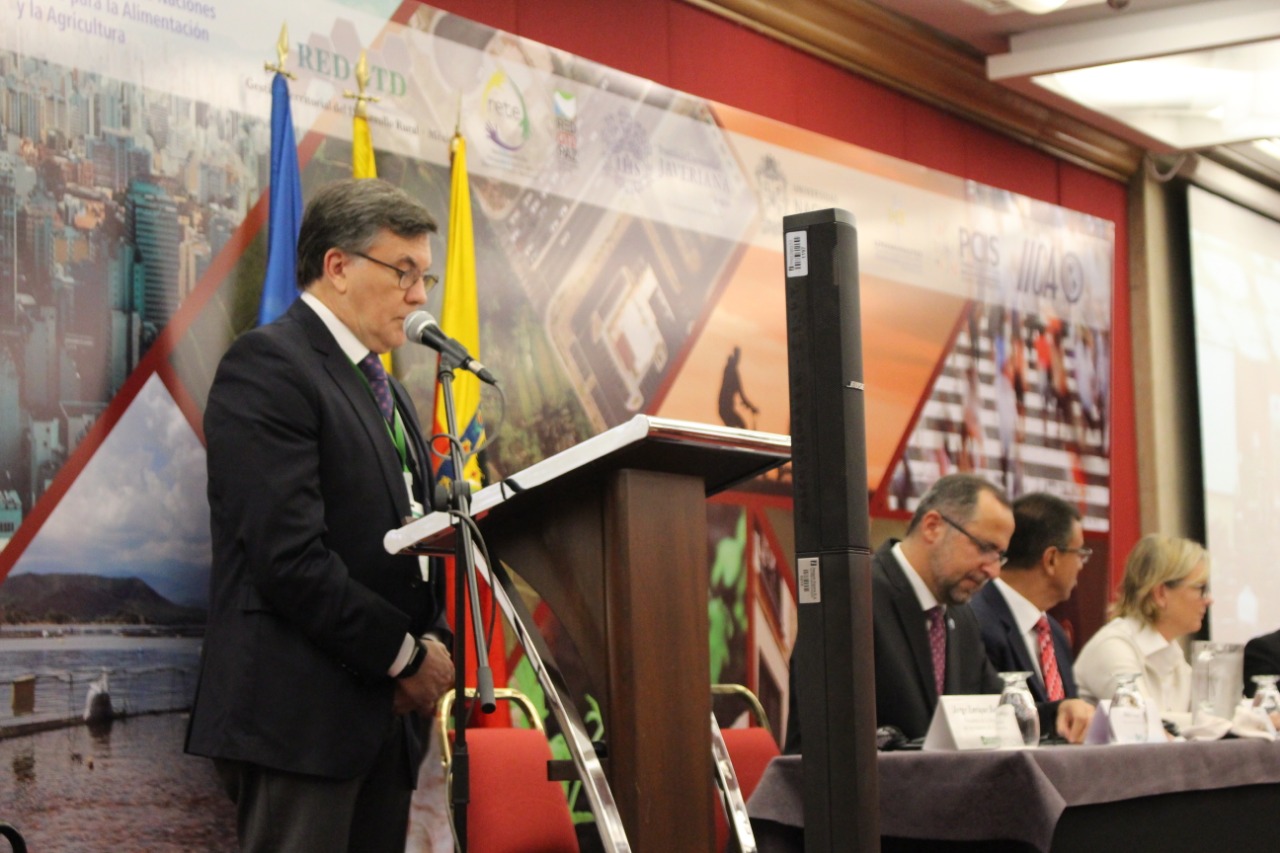
Bogotá, 7 November 2018 (IICA). The pivotal role of rural areas in development processes; the strengthening of the agriculture sector as an instrument for social cohesion; and the urgent need for improvements in infrastructure, the value added component and policies governing land regularization in rural territories, were the main topics of discussion at the first day of the XII International Forum on Territorial Development in Bogota. The meeting was declared open by Manuel Otero, Director General of the Inter-American Institute for Cooperation on Agriculture.
The Forum, a carbon neutral event, which will offset its carbon dioxide emissions by planting 30 trees in the town of Armero (Colombia), will continue until November 9, with officials, politicians, academics and experts from 12 countries in attendance.
Taking place for the first time in Colombia, the event has been held on 11 previous occasions in Brazil. It will seek to develop concrete proposals to successfully tackle the challenges of rural development with a territorial focus, and also to expand knowledge networks in Latin America.
In opening the event, IICA’s Director General highlighted the capacities of this agency of the Inter-American system specializing in agricultural development and rural-well-being, and also its commonality of interests with the Colombian Government. He also issued an appeal for agriculture to be given priority in national public agendas.
Otero gave his assurance that, “With its stock of knowledge, human resources and renewed capacity to work closely with countries, IICA stands ready to support and bolster Colombia’s official policies in the areas of agricultural health and safety, and programs to formalize and regularize land ownership.
Also in attendance at the Forum’s opening were Juan Diego Gómez, Colombian Senator; Patricia Llombart Cussac, Ambassador of the European Union (EU) to Colombia; Rafael Zavala, FAO Representative in Colombia; Aníbal Herrera, Dean of the University of Colombia’s Faculty of Agricultural Sciences; Jorge Enrique Bedoya, President of the Colombian Agriculture Society; Maria Adelaida Farah Quijano, Dean of the Faculty of Environmental and Rural Studies at the Pontifical Javeriana University; Juan Fernando Pacheco, Manager of the Social Innovation Science Park of the Uniminuto University Corporation; and Diego Fernando Trujillo, Deputy Attorney General for Agricultural and Environmental Affairs in the Attorney General’s Office.
Ambassador Llombart Cussac, stressed the importance of rural communities to Colombia, not only for agricultural but also for economic development, social inclusion and peace-building. On the other hand, Senator Juan Diego Gómez called attention to those rural areas that were hard hit by the Colombian conflict and pledged to work “very closely with IICA and the EU to devise legislative and public policy tools to develop rural areas”.
During the Forum, IICA’s Director General also presided over a round table discussion with Mexican Senator, Beatriz Paredes, who is President of the Mexican Senate’s Commission on Science and Technology; Giancarlo Canzanelli, President of ILS LEDA (Italy’s Local Economic Development Agencies); and Mercedes Peña Domingo, Spanish Political Scientist and Associate Specialist of the Extreme Events Institute of the International University of Florida (United States).
During the discussion, Senator Paredes stressed that agriculture should be given priority in public agendas and encouraged participants to reflect on the unbridled growth of cities in Latin America, a region, she said, that has not managed its water resources intelligently. She decried the region’s failure to plan and to maintain reserves that would allow it to preserve and restore its ecosystems. On the other hand, Mercedes Peña Domingo made reference to the “Tejiendo Desarrollo” program, which was instituted in Costa Rica by President Luis Guillermo Solís’ Government to foster associativity, improve infrastructure and to enable small farmers to access markets.
The Forum was organized by IICA, in collaboration with the European Union, the Food and Agriculture Organization of the United Nations (FAO), the Uniminuto University Corporation, the Pontifical Javeriana University of Bogota, the National University of Colombia, the Red Brasileña de la Investigación y Gestión en Desarrollo Territorial – RETE (Brazilian Network of Research and Management for Territorial Development), la Red de Gestión Territorial de Desarrollo Rural de México – Red GTD (Network for the Territorial Management of Rural Development in Mexico), and the Red para la Gestión Territorial de Desarrollo Rural Sustentable – Red GTD PAZ (Network for Territorial Management of Sustainable Rural Development).
More information:
Institutional Communication Division, IICA