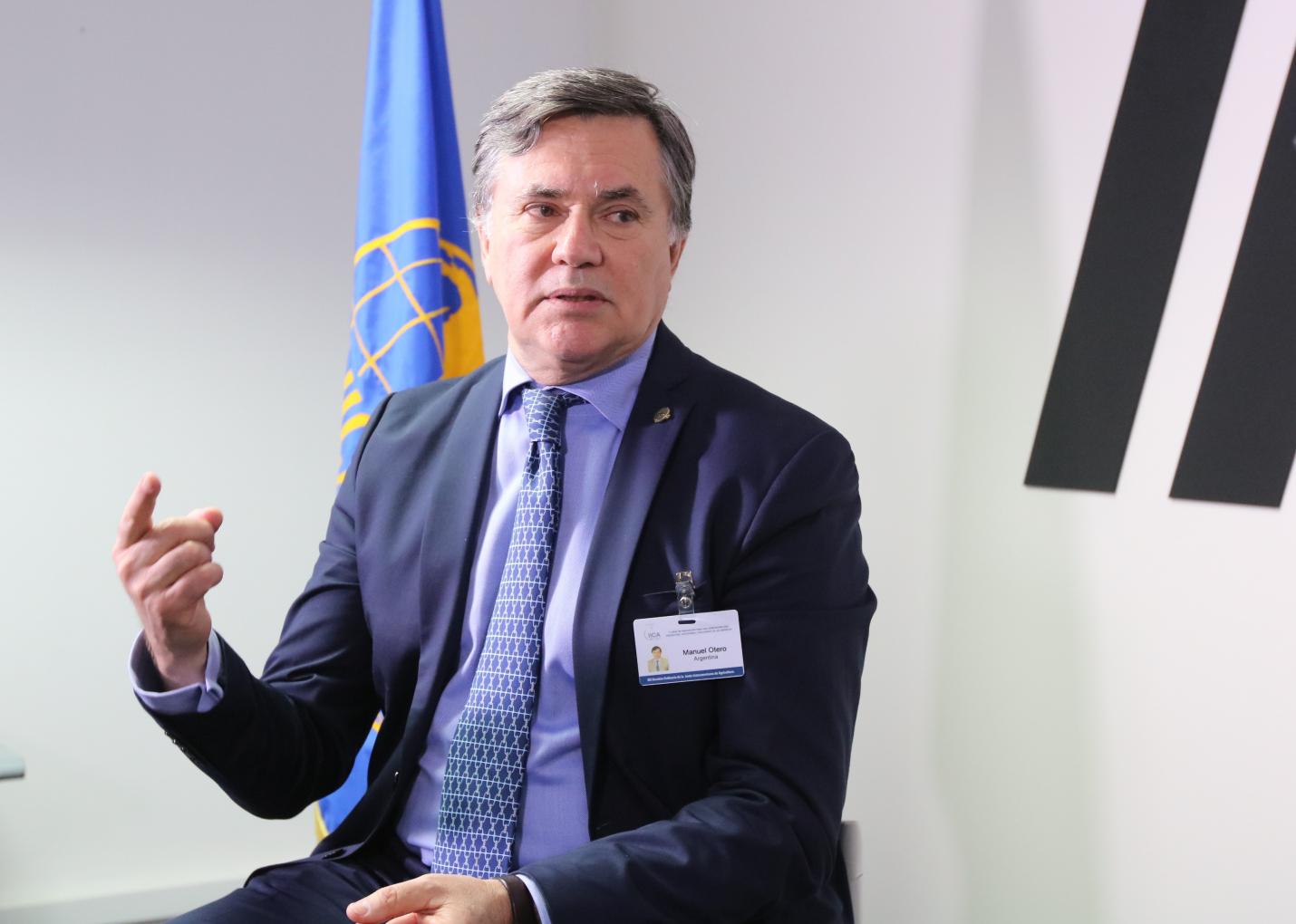
San Jose, Costa Rica, 26 October 2017 (IICA). Manuel Otero, a citizen of Argentina, was elected Director General of the Inter-American Institute for Cooperation on Agriculture (IICA) for the period 2018-2022, by the Heads of Delegation attending the Nineteenth Regular Meeting of the Inter-American Board of Agriculture (IABA), the Institute’s highest governing body.
San Jose, Costa Rica, 26 October 2017 (IICA). Manuel Otero, a citizen of Argentina, was elected Director General of the Inter-American Institute for Cooperation on Agriculture (IICA) for the period 2018-2022, by the Heads of Delegation attending the Nineteenth Regular Meeting of the Inter-American Board of Agriculture (IABA), the Institute’s highest governing body.
Otero will replace Víctor M. Villalobos Arámbula, a citizen of Mexico who has been at the helm of IICA for eight years, having assumed office in 2009. He will be sworn in at an official ceremony on 15 January 2018, at IICA Headquarters in Costa Rica.
Following the second and final round of voting, Carlos Furche withdrew his candidacy and Otero was elected by acclamation by the 32 Heads of Delegation of the Ministries of Agriculture in attendance.
“I am grateful to the governments of IICA’s member countries. I will do my best to honor this position and to lead IICA throughout this new phase, with everyone and for everyone. I will work to preserve the best aspects of every phase of IICA’s history. We must look to the future and strive to be innovative and creative, because these are difficult times,” stated the newly elected Director General.
Otero, who is 66 years old, was born in Buenos Aires. His broad experience covers a number of topics including science and technology, agricultural trade and health, institutional strengthening and international cooperation. He has displayed great interest in projects related to area-based development and family farming, which demonstrates his profound commitment to development based on social inclusion.
Otero was employed in Argentina’s public sector for 10 years, serving as an agricultural attaché in Washington D.C., and subsequently as vice-president of the National Institute of Agricultural Technology.
His career at IICA spans 25 years, during which he held a number of distinguished positions. He believes that now is the time to give back all of his experience and knowledge to this international organization, while guiding it toward a new hemispheric leadership.
Cautiously optimistic, Otero believes that America can position itself as a key stakeholder in facing the challenges of global food security and environmental sustainability. However, he also acknowledges the urgency of redesigning traditional cooperation strategies in order to address these monumental challenges.
“IICA has a historical commitment to improve the situation of rural areas, and I will fulfill this mandate. I will work with the most under-developed countries to alleviate inequality on our continent,” stated Otero.
Otero will replace Víctor M. Villalobos Arámbula, a citizen of Mexico who has been at the helm of IICA for eight years, having assumed office in 2009. He will be sworn in at an official ceremony on 15 January 2018, at IICA Headquarters in Costa Rica.
More information