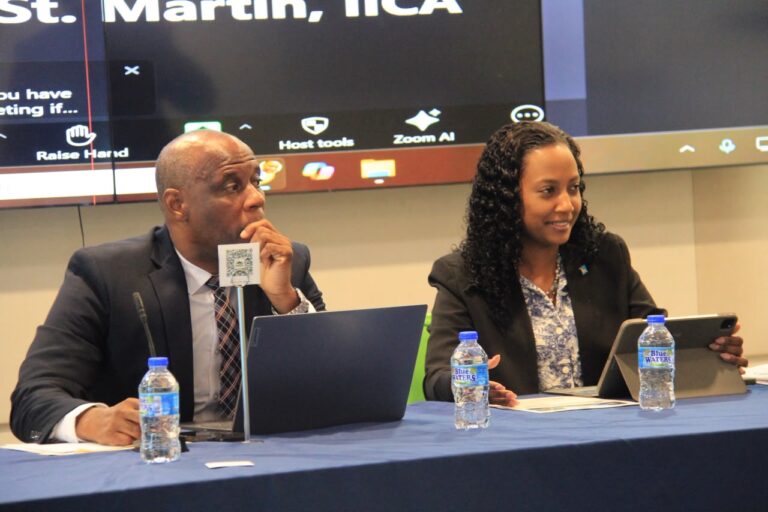

CASTRIES, ST. LUCIA, 11 December 2025 (IICA ECS) – The Inter-American Institute for Cooperation on Agriculture (IICA), in partnership with regional and international agencies, convened a white potato capacity building workshop with over thirty stakeholders from across the OECS subregion, in Dominica over the period December 01-03, 2025.
Participants included farmers, technical officers from the Ministries of Agriculture, IICA, OECS, CARDI and FAO personnel representative and other agencies interested in supporting the commercialization of white potatoes. These participants were drawn from across six countries/territories who have indicated an interest in advancing domestic cultivation including, the British Virgin Islands, Dominica, Grenada, St. Kitts and Nevis, St. Lucia, St. Vincent and the Grenadines.
The white potato workshop formed part of a broader regional effort to reduce dependence on imported white potatoes – an item for which OECS countries imported 8,890 tons valued at US$7.6 million in 2024, according to ITC data.
Hosted in Dominica, the only OECS Member State with more than 40 consecutive years of commercial white potato production, the training featured technical sessions, field visits, and planning exercises that allowed participants to study Dominica’s long-standing production model while examining opportunities for regional scaling.
The workshop was jointly delivered by IICA, the Food and Agriculture Organization (FAO) the OECS Commission, the Ministry of Agriculture, Fisheries, Blue and Green Economy of Dominica, the Caribbean Agricultural Research and Development Institute (CARDI), and WUSC-Caribbean.
IICA Representative in the Eastern Caribbean States, Gregg Rawlins, in addressing the opening ceremony emphasized the purpose and importance of the regional gathering, noting that white potatoes represent a major imported staple in the OECS.
“OECS countries import thousands of tons of white potatoes each year, and the figures continue to rise. The region must begin moving toward structured and coordinated production if we are to strengthen food security and reduce import dependence.” He added that Dominica’s example proves that “the OECS has the capacity to produce white potato, especially in countries with the right elevations and microclimates.”
Mr. Rawlins also pointed to the technical challenges of the crop, encouraging countries to remain practical and informed. “White potato cultivation comes with its own agronomic risks, including disease management and elevation requirements. There is room for import substitution, but not wholesale replacement, so we must be realistic and strategic.”
Speaking on behalf of FAO Subregional Coordinator, Dr. Renata Clarke, Value Chain Development Expert, Vermaran Extavour, said the workshop directly supports regional policy priorities, noting that it aligns with CARICOM’s 25 by 2025 +5 initiative and the OECS FAST Strategy.
Ms. Extavour said that Dominica’s model serves as an important reference point for the region.
“The country’s decades of experience provide a solid foundation for OECS Member States seeking to build their own industries,” she explained. She added that FAO is committed to ensuring that white potato development “creates opportunities for women, youth, and communities, while promoting climate-smart production practices and strengthening resilience.”
Director General of the OECS, Dr. Didacus Jules, described the workshop as a meaningful shift from planning to implementation under the OECS FAST Strategy.
Dr. Jules noted that agricultural transformation requires strong regional cooperation and that white potato development “is the perfect intersection of climate-smart agriculture, value chain strengthening, and private–public collaboration.”
He highlighted progress already made across the region. “Grenada and St. Vincent and the Grenadines have established trial plots with support from CARDI, and other OECS countries are expressing growing interest. This momentum tells us the region is ready for a coordinated strategy.”
Dr. Jules urged participants to adopt a systems-based approach, stating that food security alone is not enough. “Food security allows us to survive, but food sovereignty allows us to thrive. Potatoes may seem humble, but they hold tremendous potential – from reducing import bills to supporting youth entrepreneurs and strengthening local economies.”
Minister of State in the Ministry of Agriculture, Fisheries, Blue and Green Economy, Jullan Defoe, underscored Dominica’s strong commitment to advancing white potato development as part of the region’s broader food security agenda.
“As Minister, I wish to affirm Dominica’s commitment to regional cooperation and to the vision under the OECS FAST Strategy and the CARICOM goal of reducing food imports. The work you build here will contribute to a more food-secure, climate-resilient and economically viable OECS.”
Defoe also reiterated the Government of Dominica’s continued support to farmers, stating that the Ministry remains committed to enabling a thriving industry through improved financing, land preparation support, technical extension services, and deeper collaboration with partners such as CARDI, IICA, FAO and WUSC-Caribbean to advance research, new varieties, and strengthened production systems.
The outcomes of the workshop will guide the development of a strategic regional framework for white potato research and development, production, and marketing within the OECS. This framework will support countries in expanding production capacity, improving postharvest systems, and strengthening market access, while helping the region contribute to CARICOM’s food-import reduction goals.
IICA reaffirmed its commitment to ongoing technical support, noting that sustained partnership across institutions will be essential as OECS countries work to build a viable, competitive white potato subsector.
More information:
Institutional Communication Division.
comunicacion.institucional@iica.int