Director General of IICA, Manuel Otero, described the challenges that the region must surmount on the path towards Agriculture 4.0 and in its quest for innovation.
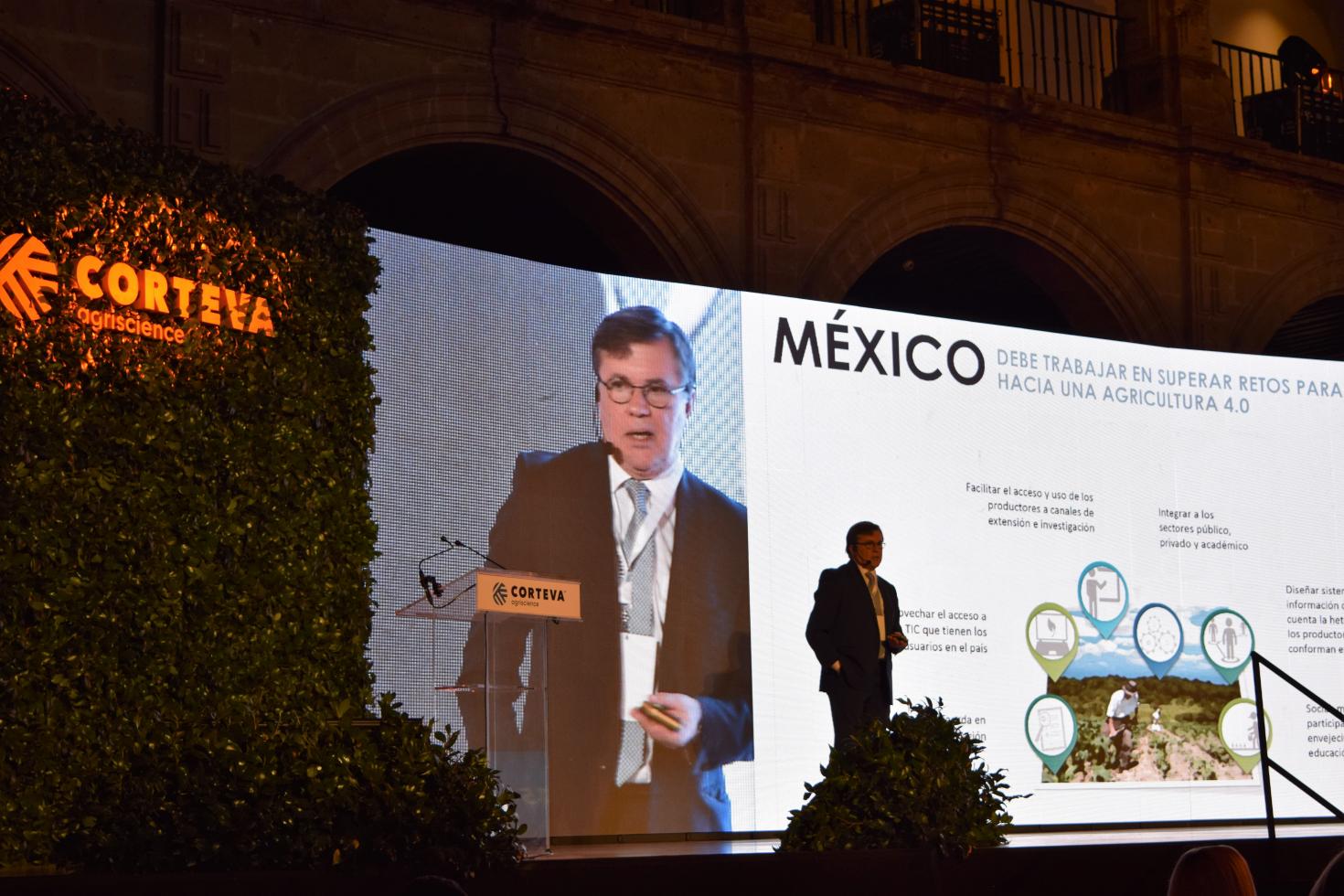
Mexico City, 5 September 2019 (IICA). According to Manuel Otero, the Director General of the Inter-American Institute for Cooperation on Agriculture (IICA), Latin America and the Caribbean must overcome obstacles in order to achieve Agriculture 4.0 and to foster innovation in the sector for improved productivity.
The head of the hemispheric organization was participating in a presentation by the agricultural chemical and seed company, Corteva Agriscience, during the event, “Challenges and Opportunities for Agricultural Innovation in LAC: Outlook for Rural Mexico – Mexico and Latin America”.
Otero stressed the importance of fostering trade, improving infrastructure, tackling soil degradation and reducing the vulnerability of natural resources as some of the challenges to improving productivity.
He also highlighted the need to maximize the use of resources and waste and to implement policies to discourage migration, reverse the trend towards an aging population, as well as to support rural women.
Otero maintained that, “The Latin American agriculture sector is at the forefront of the world agrifood market, as it produces 13.7% of global agrifood exports, accounted for an average of 4.6% of the region’s GDP in 2018 and is a leader in international markets for products such as oilseeds, chicken, coffee and fruits”.
He added that LAC should foster innovation and create public policies to enable access to data and information and support for entrepreneurship, as key ingredients for this push towards development. This includes the need to restructure the region’s intellectual property, research, education and training systems, in order to develop competitive, collaborative and inclusive ecosystems.
“Achieving Agriculture 4.0”, said IICA’s head, “will require us to involve the public, private and academic sectors, to develop systems that take into account the heterogeneity of producers, and to facilitate producers’ access to and use of extension services, research, and a solid foundation of data and information for agricultural production”.
Ana Claudia Cerosoli, President of Corteva’s Meso-Andean Region, explained that the company places particular emphasis on its growth in the Latin American market. With a presence in 140 countries, Corteva boasts net sales of USD 14,000 million, 20% of which comes from Latin America.
In keeping with its current policy to collaborate with the private sector, IICA has forged a solid partnership with Corteva, focusing on issues such as gender, youth, pastures and export products.
On the other hand, in speaking at the event, Miguel García Winder, Mexico’s Undersecretary of Agriculture, remarked that the Mexican government has adopted a strategy to increase annual productivity in rural areas by 2.1% within the next five years.
He also mentioned that between four and eight million of the 26 million hectares of land devoted to agriculture consist of degraded soils and that the formation of one centimeter of soil can take 100 years.
In concluding, García Winder indicated that, “The objective is to improve the productivity of the entire agriculture sector. Mexico is facing a serious soil and water problem. If we fail to acknowledge it, we will endanger the future of agriculture”.
More information:
Institutional Communication Division.
comunicacion.institucional@iica.int