It presents the main indicators with respect to agricultural activity in the hemisphere and is available in print or on the web at atlas.iica.int. The ebook version will be launched in the next few days.
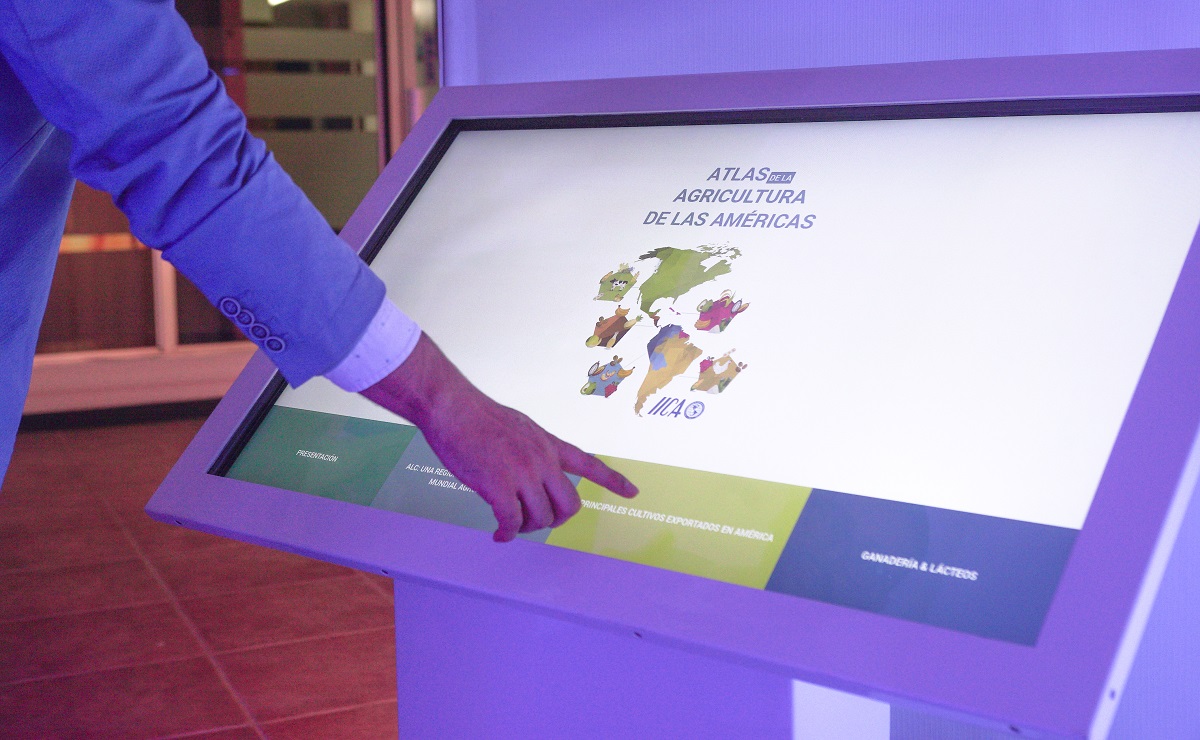
San Jose, 1 November 2019 (IICA). The Inter-American Institute for Cooperation on Agriculture (IICA) launched the Atlas for Agriculture in the Americas, an attractive and modern-looking publication that compiles agricultural indicators such as income generation, employment and food. It also contains accurate data on the sector’s impact on the economy and trade in the region.
The Atlas was presented during the 2019 Conference of Ministers of Agriculture of the Americas, hosted by IICA this week in Costa Rica.
The brainchild of the Institute’s Directorate of Technical Cooperation, the publication was presented to the main agricultural authorities of the Americas, who took part in a two-day discussion on the economic, social, environmental and demographic challenges being experienced by the sector.
This first edition of the Atlas provides an overview of the situation in the Americas, as a leading player in the world agrifood market, and systematizes information about its main crops, according to area under cultivation and the volume of exports of each country in the Andean, Central, Southern, Caribbean and Northern Regions.
It also includes important information about the meat and dairy export market for Latin America and the Caribbean (LAC), as well as information related to sustainable agriculture.
Manuel Otero, the Director General of IICA, explained that, “The Atlas attempts to illustrate the important share of the world agrifood market that the region enjoys. This one publication—the first of its kind—collates current data and useful information for decision-making by the agricultural authorities of our Americas”.
The publication is available at atlas.iica.int. There is also a print version of more than 60 pages, featuring iconography, illustrations, photographs, graphics and other elements. Coming soon is an ebook version, which will be available for download.
According to IICA Economics Specialist, Eugenia Salazar, the information in the Atlas will be periodically updated, and the aim is to ensure that it is easy to digest and understand.
According to data from the Atlas, LAC currently accounts for close to 14% of total global agrifood exports. During 2017, net exports from the region amounted to USD 148 billion, which is equivalent to 2.6 dollars exported for each dollar imported.
Today, the region’s countries lead the international market in tropical fruit, coffee, roots and tubers, oilseeds and cereals, among other products.
Moreover, last year, the agriculture sector generated 4.6% of LAC’s GDP and 14% of total employment in the region.
More information:
Eugenia Salazar, Economics Specialist, IICA.
eugenia.salazar@iica.int