Inter-American Institute for Cooperation on Agriculture

Productivity

Productivity and rural inclusion will guide the dialogue of the Ministers of Agriculture

Tiempo de lectura: 3 mins.

Costa Rica is one of the countries participating in the most important agricultural ministerial meeting of the Americas.

San Jose, 8 October 2015 (IICA). From October 19 to 23, the Ministers of Agriculture of the Americas will be meeting on the Riviera Maya, Mexico, to discuss the region’s alternatives for driving its agricultural productivity and the development of its rural territories.
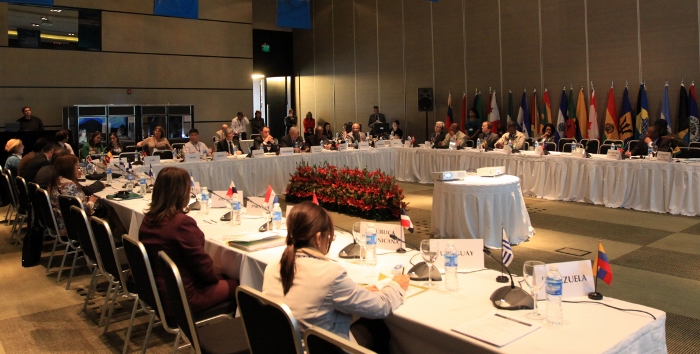
The Inter-American Board of Agriculture, made up of the ministers of agriculture of IICA’s 34 member countries, will also be meeting during the event in order to decide on ways to offer a more robust technical cooperation.

Organized by the Secretariat of Agriculture, Livestock, Rural Development, Fisheries and Food (SAGARPA) of Mexico and the Inter-American Institute for Cooperation on Agriculture (IICA), the ministerial meeting will focus on the topic of “Sustainable Agricultural Productivity and Rural Inclusion.”

The technical forum will bring together ministers, experts, and representatives of international organizations to discuss ways in which the hemisphere can foster productivity and inclusion in agriculture.

Additionally, during the meeting, IICA will present the main achievements resulting from the implementation of its 2014-2018 Medium-term Plan (MTP), an evolution of the Institute’s cooperation model, which seeks to take full advantage of all institutional capacities in order to achieve results.

The Inter-American Board of Agriculture (IABA), made up of the ministers of agriculture of IICA’s 34 member countries, will also be meeting during the event in order to decide on ways to offer a more robust technical cooperation and improve responses to each nation’s requests for support.

The slogan of the meeting is “Grow better, produce more, feed everyone.” “Nowadays, our region must produce more, either for its own consumption or for export. It is therefore critical to innovate in technology and drive investments, policies and partnerships to gain efficiency in productivity, which generates wealth and rural prosperity,” stated Villalobos.

Yum Kax, the god of agriculture or maize god, is the graphic element being used to represent and exalt Mayan culture and the region in which the ministerial meeting will be taking place.

Photos

More information: 

evangelina.beltran@iica.int  

gloria.abraham@iica.int

Share

Related news​

San José, Costa Rica

May 29, 2026

IICA Director General receives overwhelming support in presenting the key pillars of the Institute’s work for the next four years, with a focus on strengthening the agriculture sector of the Americas

Member countries of the Inter-American Institute for Cooperation on Agriculture (IICA) expressed support for a presentation by Director General Muhammad Ibrahim during a meeting of the Special Advisory Commission on Management Issues (SACMI), where he outlined the key areas of focus of the organization’s work from now until 2030.

Tiempo de lectura: 3mins

San José, Costa Rica

May 28, 2026

Latin America and the Caribbean develop shared agenda for sustainable dairy farming with support from IICA, CAF, and regional partners

Producers, technical specialists, and institutions in different areas of Latin America and the Caribbean are taking part in a coordinated effort to develop a regional agenda for sustainable dairy farming. The initiative is spearheaded by the Inter-American Institute for Cooperation on Agriculture (IICA), CAF-Development Bank of Latin America and the Caribbean, the Pan-American Dairy Farming Federation (FEPALE) and Chile’s Dairy Consortium.

Tiempo de lectura: 3mins

San José

May 27, 2026

IICA and CIRAD renew strategic partnership to promote agroecological innovation and more sustainable agrifood systems in Latin America and the Caribbean

The work will prioritize initiatives that form part of a comprehensive approach to agroecological transition and agricultural health in areas such as agroforestry and forest management, resilient and competitive tropical agriculture, science, technology and innovation, bioinputs that reduce dependence on agrochemicals, integrated crop management and regenerative agriculture, precision agriculture, animal and plant health, soils and ecosystems, public policies for sustainable agrifood systems, governance, and institutional coordination.

Tiempo de lectura: 3mins