Inter-American Institute for Cooperation on Agriculture

Agricultural Health Agricultural markets Food safety Trade

Second Roundtable on International SPS Negotiations – Anti Microbial Resistance and trade implications

Tiempo de lectura: 3 mins.
IICA USA hosts the Second SPS Roundtable on SPS Negotiations

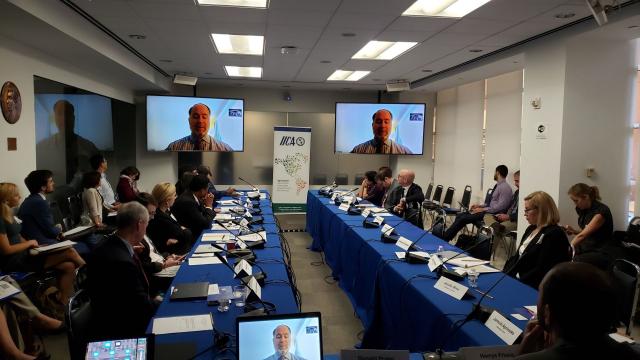
Welcome to the Second Edition of the Roundtable on Sanitary and Phytosanitary (SPS) Negotiations organized by the Inter-American Institute for Cooperation on Agriculture (IICA). 

IICA USA hosts the Second SPS Roundtable on SPS Negotiations

Welcome to the Second Edition of the Roundtable on Sanitary and Phytosanitary (SPS) Negotiations organized by the Inter-American Institute for Cooperation on Agriculture (IICA). 

This is an event the IICA Delegation in the USA has been hosting for the international agri-food community based in Washington, DC. The first edition of the roundtable was held in December last year and was attended by approximately 40 representatives of diplomatic missions and international organizations from the DC area.

This second edition addressed the antimicrobial resistance (AMR) policy matters and possible impact on trade.

Representatives of major agri-food importers (Canada, European Union and the United States) presented the main aspects of their antimicrobial resistance policies and addressed potential impact on trade. The Pan American Health Organization (PAHO) provided an update on the status of AMR policies implementation in the Latin America and the Caribbean Regions. The U.S. Delegate for the Ad hoc Codex Intergovernmental Task Force on AMR (TFAMR) provided an update on the current discussion in the Codex Alimentarius. At the closing of our program, Dr. Stacy Sneeringer from the ERS/USDA presented her most recent AMR study – “The U.S. and EU Animal Pharmaceutical Industries in the Age of Antibiotic Resistance”.

We invited all the agriculture and/or trade attachés based in Washington D.C., especially the ones from IICA member countries and some key partners in the private sector and international organizations (IADB, World Bank, PAHO).

Besides the high level and interesting discussions, the event was a great opportunity to get together and celebrate with our agri-food community friends.

More information:  horrys.friaca@iica.int
Share

Related news​

Grupo de participantes del proyecto regional PIVOT reunidos en la sede del IICA, en una iniciativa que promueve la prevención y preparación frente a riesgos sanitarios con potencial epidémico y pandémico en América Latina y el Caribe, mediante el enfoque Una Salud, que integra la salud humana, animal y ambiental.

San José, Costa Rica

May 12, 2026

IICA and international partners activate the PIVOT project to strengthen preparedness for avian influenza and other diseases of animal origin in the region

The Inter-American Institute for Cooperation on Agriculture (IICA) is forging ahead with the planning of the regional project Prevention of Infections through Surveillance at the Source of Transmission in Latin America and the Caribbean (PIVOT), aimed at strengthening the prevention of health risks with epidemic and pandemic potential in Latin America and the Caribbean, adopting the One Health approach that integrates human, animal and environmental health.

Tiempo de lectura: 3mins

Valparaíso, Chile

May 12, 2026

From erosion to harvest: an experience in soil recovery and productive diversification in Chile’s coastal drylands

IICA is working together with the Cuncumén Peasant Agricultural Cooperative on a 17.3-hectare farm, with funding from the Foundation for Agricultural Innovation (FIA), in a project called “Silvoagricultural Diversification as a Productive Methodology and Strategy and Optimization of On-Farm Irrigation in the Dryland Conversion Area of Cuncumén, San Antonio Province”.

Tiempo de lectura: 3mins

Tapachula, México

May 8, 2026

Without smart financing, there is no transformation: the other side of tropical agriculture

Behind many of the current debates on tropical agriculture —regarding productivity, sustainability, innovation— there is a variable that is becoming increasingly important, although it does not always feature prominently in the discussions: financing. Factors such as the way in which it is allocated, and the incentives and conditions involved, are becoming crucial.

Tiempo de lectura: 3mins