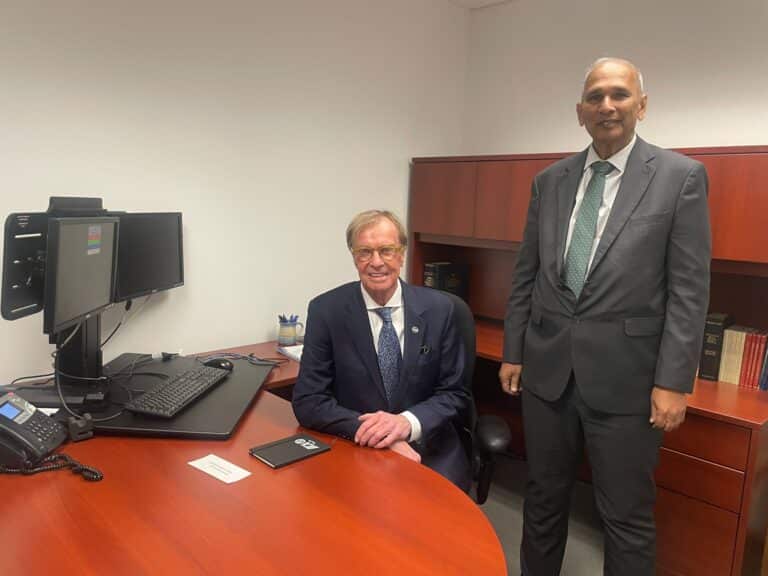
Washington D.C., 13 April 2026 (IICA) – Global food, energy, and environmental security will be impossible without agriculture of the Americas, according to the Director General of the Inter-American Institute for Cooperation on Agriculture (IICA), Muhammad Ibrahim, who was invited by the Inter-American Development Bank (IDB) to deliver an address on the role that agriculture must play in the development agenda of the region.
Ibrahim held a discussion in Washington with Pedro Martel, Chief of the Agriculture and Rural Development Division of the multilateral financial agency, which was attended by approximately 240 participants, both in-person and virtual, who posed questions and offered valuable insights.
Martel and Ibrahim agreed on the need to focus on the strategic global importance of agriculture in the Americas, a region that is the world’s leading net food exporter, while accounting for 22% of global food production.
Yet, the IDB executive also pointed out that, despite these statistics, 28% of the region’s rural population is experiencing food insecurity.
He explained that, “At IDB, we have analyzed agricultural productivity in Latin America and the Caribbean over the last sixty years. Despite significant growth during this period, there was a sharp decline in the pace of growth between 2010 and 2020, primarily due to gaps in technical efficiency. The major challenge we face today is to reactivate productivity and growth, while also protecting natural resources.”
Both Martel and Ibrahim highlighted the importance of the IICA-IDB partnership—with the former providing technical expertise, a capacity for regional coordination and field work, and the latter offering an extensive range of financial instruments for development projects in Latin America and the Caribbean.
The joint IDB-IICA agenda includes medium-term projects aimed at reducing structural vulnerabilities, in areas such as food infrastructure and logistics, production inclusion, and animal and plant health.The long-term initiatives are premised on the development of the bioeconomy as a central strategy for production transformation in rural areas of the hemisphere.
Ibrahim argued that, “IICA and the IDB have a unique opportunity to intensify their joint work and to assist the countries to establish a more competitive and resilient productive base. The sheer scale, resources and capacities of agriculture of the Americas equips it to lead the future of global agrifood systems. However, this leadership is not guaranteed; it will depend on the decisions that we make today.”
Vulnerabilities and transformation
In analyzing the region’s situation with respect to the geopolitical and market shocks that are currently impacting agrifood systems, the IICA Director General noted that an effective response is not sufficient without a structural transformation that builds resilience and competitiveness.
Indeed, he pointed out that, “Global agrifood systems are increasingly subject to more frequent climate, geopolitical, logistical, and market shocks, which are often simultaneous and interconnected. We cannot consider these events as isolated but must recognize that they are redefining conditions for production, trade, and food security.”
Ibrahim warned that external shocks do not affect everyone in the same way, as this depends on pre-existing inequalities: “Impact and response capacities vary tremendously. Small farmers suffer the most, and at the country level, technological gaps enhance inequalities. Countries that are the most advanced in science and technology applied to productivity and resilience are in a much better position to respond.”
“Therefore”, he explained, “IICA plays an essential role in helping to transfer knowledge between the countries, to support those who need it most. We have set ourselves this goal and we are ready to achieve it.”
Ibrahim also raised the matter of dependence on strategic external agricultural inputs as a source of vulnerability, emphasizing fertilizers and energy, in particular.
He warned that, “In Latin America and the Caribbean, there is an excessive dependence on imported fertilizers. Even a global agrifood power, like Brazil, imports more than 80% of its fertilizers. Inputs in general impact agricultural costs and in mechanized systems can account for as much as 70% of expenses. As such, the production model defines a system’s vulnerability: the greater the dependence on imported strategic inputs, the greater exposure to external shocks.”
Nonetheless, the IICA Director General noted that competitiveness and resilience do not depend solely on one factor, but on the interaction between productivity, inputs, diversification, and logistics.
In closing, he maintained that, “Our agrifood systems will reduce their structural vulnerabilities by transforming their fundamental aspects to increase their productivity and reduce dependence on strategic external inputs. This in turn will result in increased income for farmers and more accessible and nutritious food for all.”

During his address in Washington D.C., Muhammad Ibrahim stressed the urgency of transforming the agrifood systems of the Americas to make them more resilient and productive.
More information:
Institutional Communication Division.
comunicacion.institucional@iica.int