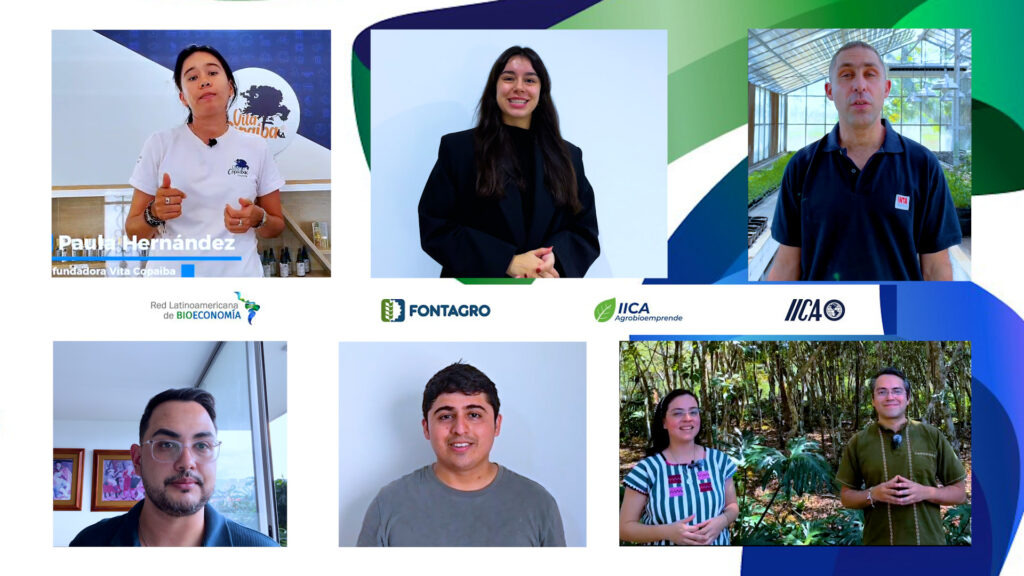
San Jose, 8 April 2026 (IICA) – A competition that attracted more than 1,100 applicants and demonstrated the extraordinary potential of the region’s agricultural innovation ecosystems, culminated in the selection of the leading bioeconomy-based businesses in Latin America and the Caribbean—recognizing them for their positive environmental, social, and economic impact.
The “LATAM 2025 Agro-bioentrepreneurship with Impact” competition was spearheaded by the Innovation and Bioeconomy program of the Inter-American Institute for Cooperation on Agriculture (IICA), in conjunction with FONTAGRO, the Latin American Bioeconomy Network, and strategic regional partners.
The initiative, which attracted more than twice the number of applicants that the organizers had anticipated, was a regional platform to identify, highlight, and strengthen bioeconomy businesses. The winning candidates—in the view of the judging panel—were entities that had developed the most innovative solutions in the areas of sustainable bioinputs, biomaterials, bioenergy, bioservices, and new bioproducts for food, cosmetics, health, and well-being in Latin America and the Caribbean.
After three phases of evaluation by the judging panel, 108 initiatives advanced to the stage of in-depth evaluation and the thirty most outstanding ones were selected as the Top 30 LATAM 2025 entities. Of this group, the six businesses with the highest regional score were chosen.
The six winning agrobiobusinesses were SOS Biotech, from the Dominican Republic; BSF Logistics, from Peru; Carbonlytics Agro, from Colombia; 3R Biotec, from Mexico; Prix Biotech, from Argentina; and Vita Copaiba, from Colombia.
The virtual awards ceremony featured the participation of the IICA Director General, Muhammad Ibrahim; the Chairman of FONTAGRO’s Board of Directors, Jorge Ganoza Roncal; the Manager of the IICA Innovation and Bioeconomy Program, Hugo Chavarría; and the Executive Secretary of FONTAGRO, Eugenia Saini, along with the heads of the winning companies and many of the other participants.
The selected businesses have a significant impact on the circular economy, sustainable bioinputs, carbon sequestration, agricultural biotechnology, and the responsible use of biodiversity.
Overall, 1,111 applications from 20 countries were received, primarily from Colombia, Ecuador, Argentina, Peru, Costa Rica, and Mexico. With respect to technology readiness levels (TRL), 244 projects are in the early stages of development, 453 in the intermediary phase, and 413 in the advanced phase.
The competition grouped the entities into four categories: 385 projects in bioinputs and sustainable agrifood technologies, 299 in biomaterials and bioenergy, 272 in new bioproducts, and 155 in bioservices and nature-based solutions.
The process was governed by rigorous criteria of technical admissibility and evidence of innovation. The judging panel in this joint regional process included technical partners, mentors, coordinators, or potential financiers from various institutions, including CIEIA3 (Spain); the Ministry of the Environment of Peru; Corporación Biotec (Colombia); SILAB ESPOL (Ecuador); Biomatec, Activa Catie, the Ministry of Science, Innovation and Technology (MICITT), and Promotora de Innovación (Costa Rica); and Aceleradora Litoral (Argentina).
Concrete benefits
Muhammad Ibrahim stressed how important IICA agrobiobusiness promotion is to IICA, stating that, “We are working to build an innovation ecosystem in rural areas that will facilitate the increasing integration of more youth and women in the sustainable use of biodiversity. This competition seeks to contribute to scaling up initiatives that create a nexus between agriculture, energy, health, and the environment. We are demonstrating that bioeconomy is not only a theoretical concept, but a field that creates concrete products that benefit people.”
Currently, the IICA Director General is developing the organization’s 2026-2030 Medium-term Plan (MTP), which is the roadmap for the organization’s cooperation actions, which will intensify science, technology, and innovation actions to promote greater bioeconomy development in the region. “The knowledge-based transformation frontier, which includes local expertise, facilitates the transformation of biomass for multiple purposes in our region,” he added.
Jorge Ganoza, Executive President of the National Agricultural Innovation Institute (INIA) of Peru, highlighted the “extraordinary response” of bioeconomy entrepreneurs in the region, noting that it demonstrated the immense creativity and talent existing among agricultural innovators. “The bioeconomy—he said—provides a concrete opportunity to generate economic development, a positive environmental impact, and opportunities for farmers. This competition proves that cooperation at the regional level can strengthen agriculture and help to develop sustainable ecosystems.”
Hugo Chavarría explained that the competition was a mechanism to identify the agrobusinesses in the hemisphere and to contribute to their growth. As such, he noted that the thirty winning businesses will commence an incubation and acceleration program to acquire concrete and specific skills that will contribute to their scaling up process. Moreover, the 100 businesses from the first cut will be included in a catalog that will be made available to stakeholders throughout the hemisphere, providing immense visibility.
On the other hand, Eugenia Saini, stressed the value of all the proposals that had been presented: “Underlying these ideas are talents that will provide new opportunities to innovate in rural areas in the region, add value, develop businesses, and generate benefits for people. These entities strengthen us as a region and enhance our comparative advantages.”
More information:
Institutional Communication Division.
comunicacion.institucional@iica.int