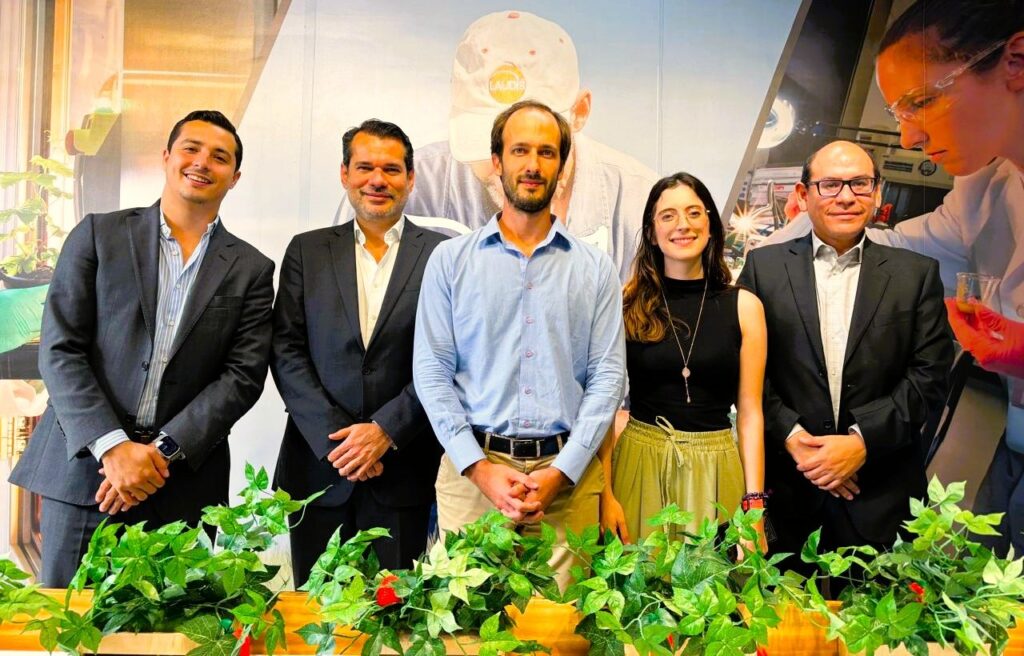
San José, Costa Rica, 9 June 2025 (IICA) – Producers and representatives of the sugarcane value chain from the Americas visited the headquarters of the Inter-American Institute for Cooperation on Agriculture (IICA), where they met with Director General Manuel Otero and Director of Technical Cooperation Muhammad Ibrahim to discuss the formation of new alliances, technological advancements, and opportunities for the region.
Oscar Moreno, Legal and Government Affairs Coordinator of the Sugar Producers Association of Honduras (APAH); Juan Carlos Fernández, Executive Director of the Central American Isthmus Sugar Producers Association (AICA); and Carlos Castro, General Manager of the Peruvian Association of Agro-Industrialists for Sugar and Derivatives– Perúcaña, joined Otero and Ibrahim in emphasizing that partnerships between international organizations like IICA and the private sector can generate tangible impacts in countries.
The dialogue also addressed the technological pathways driving the production of liquid biofuels, which are considered a key option for energy decarbonization and job creation.
The experts also stated that technical cooperation, in addition to facilitating projects, plays a crucial role in advising public and private sector stakeholders, policy formulation, and training in specialized areas.
As part of its technical cooperation work, the Pan American Coalition on Liquid Biofuels (CPBIO) was recognized as a mechanism that gives the region a voice and helps bring these issues to the global agenda.
“CPBIO is a space for the private sector in different countries to share experiences, deepen technical knowledge, and develop a future vision for the development of our economies. All of this helps showcase the potential our countries have on the global decarbonization agenda”, said Castro.
“We greatly value the visit to IICA as an opportunity to engage in dialogue with the regional sugar sector. This visit allowed us to learn more about IICA’s structure, its areas of cooperation, and its renewed interest in connecting with productive sectors and society. There are areas where we can explore synergies to jointly advance toward a more sustainable, inclusive, and forward-looking agri-industry”, added Fernández.
“APAH—on behalf of the Honduran sugar agroindustrial sector—took part in the official visit to IICA following the ISO Sugar event, seizing this valuable opportunity to strengthen institutional ties and explore new avenues for technical cooperation on sustainability, biofuels, and agricultural innovation in the region”, concluded Moreno.
The International Sugar Organization supports liquid biofuels
The visit to IICA took place within the framework of the ISO Sugar Congress organized by the International Sugar Organization (ISO), the only intergovernmental body dedicated to improving the global sugar market.
With a proactive approach to including sugar-based ethanol, the ISO has been helping promote the growing role of biofuels in the future global energy mix since the mid-1990s. The ISO has 85 member states which, according to 2023 data, represent 87% of global sugar production, 64% of global sugar consumption, 37% of global imports, and 92% of global exports.
The ISO’s mission is to promote international cooperation on sugar-related issues, provide a forum for intergovernmental consultations on ways to improve the global sugar economy, and foster greater demand for sugar, especially for non-traditional uses.
The ethanol opportunity: diversification and energy
Agustín Torroba, IICA’s international biofuels expert and Executive Secretary of CPBIO, participated in the ISO Sugar Congress in a panel called “The Ethanol Opportunity: Diversification and Energy”, where he explained that CPBIO is an IICA-led initiative bringing together the biofuels chambers and value chains across the Americas, which produce 87% of the world’s ethanol.
“In the past 60 years, the global population has grown by 164%, while sugarcane production has increased by 352%. We had to start finding alternative uses for sugarcane, and that’s how ethanol was born”, said Torroba.
“Today, the world is in a long race toward decarbonization. We’re seeing two types of markets for ethanol: 88% of global ethanol consumption is covered by legislation with various sustainability criteria, all of which focus on the carbon footprint. Biofuels play a key role in achieving carbon neutrality in the energy sector, according to roadmaps from international organizations such as the International Energy Agency. However, current production and consumption levels fall short of what the world needs in order to decarbonize”, he added.
Sugarcane has one of the best profiles for bioethanol production, and ethanol is crucial for both sugarcane and agriculture overall, as 30% of the world’s sugarcane goes toward ethanol production.
Brazil is a key player, thanks to its flex-fuel engine industry that runs on pure hydrated ethanol or any blend with gasoline—since all gasoline in Brazil is blended with 30% ethanol.
India is the latest major adopter of ethanol, currently blending at 18% and operating a total of 270 distilleries nationwide. Panama is on the verge of implementing a 10% ethanol blending program, opening up a range of possibilities for expanding the industry—whether in boilers, bagasse processing, or other areas.
One of the most promising new uses for bioethanol is in the production of sustainable aviation fuels (SAF), in a sector aiming to be carbon neutral by 2050.
Meeting that target would require nearly 450 million m³ of SAF by 2050—almost triple the current installed capacity of land-based biofuels. There are currently 11 approved technological pathways to produce SAF, with the most advanced being HEFA (from oils and fats) and Alcohol-to-Jet.
“Ethanol is an excellent business opportunity for countries that have public policies to support its development, and it’s also a great opportunity for sugarcane due to its strong environmental profile. Looking ahead, ethanol paves the way for new businesses such as SAF, bioplastics, and sustainable fuels for maritime navigation”, Torroba concluded.
Luis Fernando Salazar, Executive Director of the Latin American Sugar Producers Union (UNALA), noted that biofuels are important not only for transport and health but also for decarbonizing economies.
“The Latin American sugarcane sector produces 30% of the world’s ethanol and generates enough renewable energy each year to match six years’ worth of electricity consumption in the city of San José, Costa Rica”, he added.
More information:
Institutional Communication Division.
comunicacion.institucional@iica.int