
Kingston, Jamaica, 5 May 2026 (IICA) – The AgriConnect initiative, designed by the World Bank Group (WBG) to expand rural connectivity, digital inclusion, and the integration of family farmers into markets, was launched in Jamaica with the support of the Inter-American Institute for Cooperation on Agriculture (IICA).
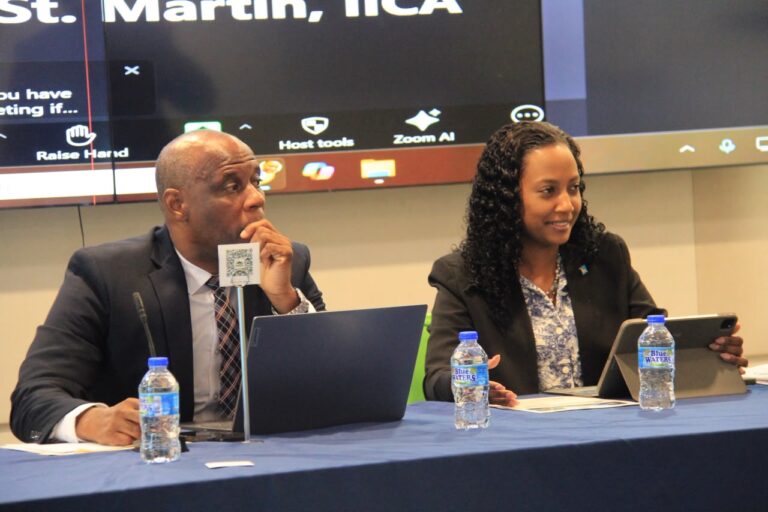
The presentation took place in the city of Kingston, with the participation of Jamaica’s Minister of Agriculture, Fisheries and Mining, Floyd Green, and strong attendance by stakeholders from the country’s food sector, where family farming is essential for bringing food to people’s tables every day and faces significant challenges.
Also participating in the launch event were Lilia Burunciuc, World Bank Director for Caribbean countries, and Kent Coipel, IICA Representative in Jamaica, who reaffirmed the alliance between the hemispheric organization and the World Bank and its commitment to strengthening Caribbean agriculture.
Also in attendance were Benoît Bosquet, Director for Sustainable Development for Latin America and the Caribbean at the World Bank, and Diego Arias, Agriculture and Food Practice Manager for Latin America and the Caribbean at the multilateral organization.
The implementation of the project in Jamaica is part of a global strategy by the World Bank Group to drive the transformation of the agrifood sector.
Worldwide, the initiative aims to support up to 300 million smallholder farmers by 2030, promoting the transition from subsistence models to more productive agricultural enterprises.
Minister Green highlighted the launch of AgriConnect as a major opportunity for the country. He explained that the philosophy of the World Bank initiative, supported by IICA, is aligned with the path Jamaica is currently pursuing to build a more resilient, modern, and inclusive agricultural sector.
The country has a small economy and farmers face obstacles in accessing financing through private banks. As in other Caribbean nations, Jamaican producers are highly vulnerable to climate events, which are becoming more frequent and more intense. The Caribbean region is also seeking to strengthen its food security and reduce dependence on food imports.
On behalf of IICA, Coipel emphasized that the Institute has a long track record of working with small and medium-sized farmers and supporting the development of value chains across the Caribbean, with a special focus on capacity building, export training, and market linkages.
“Strengthening the organizational capacity of rural communities is a fundamental pillar of IICA’s technical cooperation,” he said.
The inter-American agricultural development organization has supported the creation and legal formalization of organizations such as the Jamaican Network of Rural Women Producers. It has also facilitated the exchange of experiences and the creation of networks to improve governance and sustainability in rural communities.
Facilitating market access
The President of Jamaica’s College of Agriculture, Science and Education (CASE), Derrick Deslandes, and Jacqueline Sharp, Director of a family business engaged in coffee production, local marketing, and export, discussed during the launch in Kingston, the Jamaican capital, pathways to improve farmers’ access to markets and more efficiently integrate food value chains.
Strategies to facilitate small producers’ access to new technologies, and the new frontiers of science and technology in Jamaican agriculture, were the focus of another exchange that yielded important lessons.
Participants included World Bank specialist Winston Daes; Aura Cifuentes, Director for Latin America and the Caribbean at Co-Develop; and Arturo Ramírez, Technical Director of Isratech Jamaica Limited, a company providing agricultural solutions in areas such as water management and alternative energy generation to fossil fuels.
IICA is one of the international organizations supporting the initiative of its partner, the World Bank, in the Americas, along with financial institutions, private sector representatives, foundations, and knowledge partners.
In March, AgriConnect was presented at the IICA office in Brazil, a country with nearly four million family farmers. The regional launch for Latin America and the Caribbean took place in April in Washington, D.C., with the participation of IICA Director General Muhammad Ibrahim and ministers of agriculture from across the continent.
Globally, AgriConnect has an estimated annual financing of USD 9 billion, with the potential to mobilize an additional USD 5 billion in investments, strengthening innovation, financing, and service ecosystems geared toward agriculture.
The initiative was conceived, as explained, after a group of experts convened by the World Bank identified the agricultural and agribusiness sector as one of the five sectors globally with the greatest potential to absorb young people entering the labor market.
Reducing agricultural risks, through strengthening climate and market risk management mechanisms, is one of the main focus areas of AgriConnect. The program also focuses on improving value chains and the digitalization of agricultural services, through the implementation of digital tools, knowledge platforms, and technological solutions for production management.
Initiatives such as AgriConnect are expected to help accelerate the digital transformation of agriculture, strengthening productive inclusion, enhancing the sector’s competitiveness, and promoting more sustainable rural development in the Americas.
More information:
Institutional Communication Division.
comunicacion.institucional@iica.int