Both projects were executed within the framework of the Program for Strengthening Agricultural Export Capabilities of the Dominican Republic

Santo Domingo, Dominican Republic, 24 July 2018 (IICA). During a closing event, IICA presented the results achieved in the execution of the projects: 1) Strengthening of the Surveillance Capacity and Phytosanitary Emergency Response to the Introduction of the Moniliasis of Cocoa in the Dominican Republic, and 2) Updating the standards, processes, regulations and requirements for the export of fresh products to the United States of America. The event was attended by the authorities of the Ministry of Agriculture, the United States Department of Agriculture (USDA), the Ministry of Economy, Planning and Development (MEPyD) and representatives of public and private institutions of the agricultural and export sector.
These projects were executed by the IICA Dominican Republic Delegation since October 2017, jointly with the Ministry of Agriculture, the support of MEPyD, and with funds from USDA.
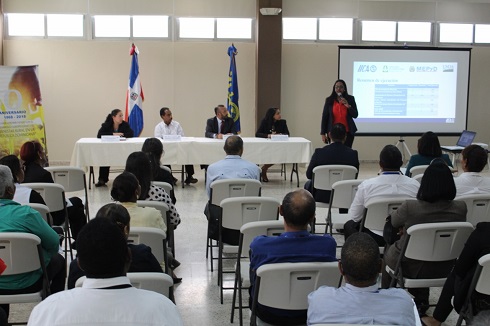
the results of the Moniliasis project.
 The project Strengthening of the Surveillance Capacity and Phytosanitary Emergency Response to the Introduction of the Moniliasis of Cocoa in the Dominican Republic aimed at strengthening the mechanism of phytosanitary surveillance and emergency response for Moniliasis in cocoa in the Dominican Republic, as well as to elaborate a Phytosanitary Emergency Response Plan for the potential introduction of Moniliasis of Cocoa (Moniliophthora roreri) in the Dominican Republic.
Some of the activities carried out in this project included the preparation of the aforementioned plan for detection and response to a possible Moniliasis outbreak, as well as the realization of two field simulations with institutions and producers in San Francisco de Macoris and Monte Planta, with a total participation of 140 producers.
The beneficiaries of this project were the Ministry of Agriculture, specifically the Departments related to production, extension and training, agro-food safety and pest control in cocoa crops, as well as cocoa producers and professionals from public and private institutions linked to this crop.
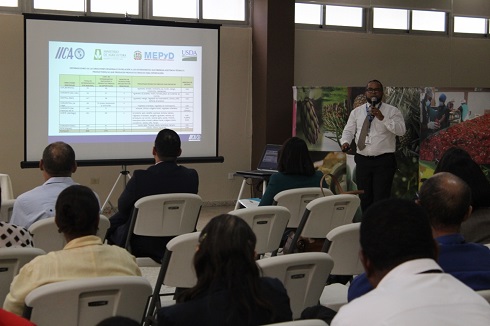
presenting the results of the project on exports of fresh
products to the United States.
 On the other hand, the project Updating the standards, processes, regulations and requirements for the export of fresh products to the United States of America aimed to update the technical personnel of public and private institutions about the standards, processes, regulations and current requirements for the export of fresh agricultural products to the United States of America.
A training program was developed in the framework of this project, focused on the standards and requirements for the export of fresh products to the United States, which was comprised of four workshops given to extension technicians linked to exports in the eight Regional Offices of the Ministry of Agriculture, and three workshops given to producers of specific export products, such as chayote (Sechium edule), pineapple (Ananas comosus) and cocoa (Theobroma cacao). A total of 226 beneficiaries were strengthened with knowledge of the processes to export fresh products to the United States.
The preparation of a guide to support the Dominican agricultural and export sector, both electronic and printed, was another result of this project. The guide is aimed to serve as a reference material for participating institutions when providing technical and commercial support and advice to producers and exporters.
More information: Hector Garibaldis Perez, Specialist in Agribusiness, hector.perez@iica.int