IICA and the Southern Agricultural Council brought together 6 LAC countries in an international workshop to promote the implementation of systems for the evaluation of public policies for agriculture.
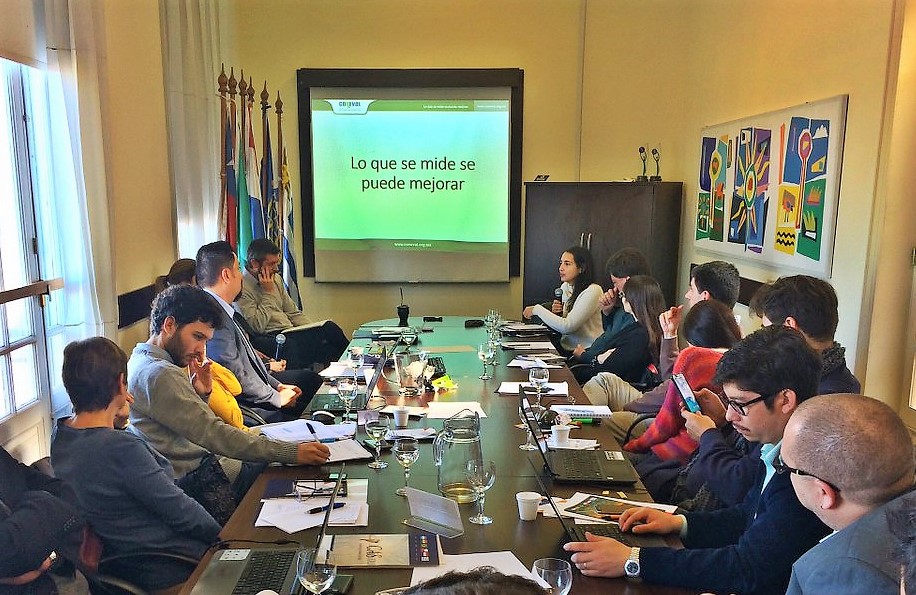
During an international technical workshop in Uruguay, directors and technicians from policy evaluation units from Argentina, Brazil, Chile, Uruguay, Paraguay and Costa Rica analyzed various methodologies used around the world to improve outcomes and uses of agricultural policy evaluations.
In the event, different methodologies and type of evaluations were analyzed to help:
- choose the agricultural policies or programs to be evaluated;
- decide which tools are more appropriate to use for each type of evaluation;
- ensure the results of evaluations are used in the management of public policies;
In addition, participants assessed how those methodologies can respond to the evaluation needs of their countries.
Efforts on this topic started in 2015, when IICA began work to identify and systematize best practices and lessons learned on tracking, monitoring and evaluating policies for agriculture, which is reflected in a publication launched earlier this year.
At the meeting, time was devoted to present the tools and processes used in Colombia and Mexico in order to select appropriate methodologies for each type of evaluation and ensure that evaluation findings are useful to the policy itself and to facilitate a results – based management.
According to IICA specialist in Quantitative and Sectorial Analysis, Hugo Chavarría, evaluation of policies has become more important in the agricultural sector in Latin America and the Caribbean, but still the vast majority of evaluation efforts are isolated and they are not part of a process.
Evaluation should be an integral part of the cycle of public policies for agriculture, so that it serves to:
- identify and analyze public problems that must be addressed by the policy;
- compare the effectiveness of different intervention alternatives;
- identify opportunities for improvement in the processes of implementation;
- allow policies to achieve maximum results, and;
- identify impacts attributable to the policy evaluated.
Meanwhile, IICA‘s Policy and Sector Analyst, Joaquín Arias, stressed the importance for countries to design their evaluation systems based on the institutional and existing regulatory context, taking into account their capabilities, availability of human and financial resources, and the policy evaluation priorities of each nation.
According to Chavarria, to continue capacity building in this area, the methodologies and tools discussed during the workshop will be used to develop an online course on policy evaluation for agriculture, which will be available by the end of 2017.
The international workshop was organized under IICA’s Flagship Project: Competitiveness and sustainability of agricultural chains, together with the Southern Agricultural Council (CAS).
More information: Hugo Chavarría hugo.chavarria@iica.int and Joaquín Arias joaquin.arias@iica.int
*This post appears in the IICA Delegation in the USA Newsletter – May – June 2017