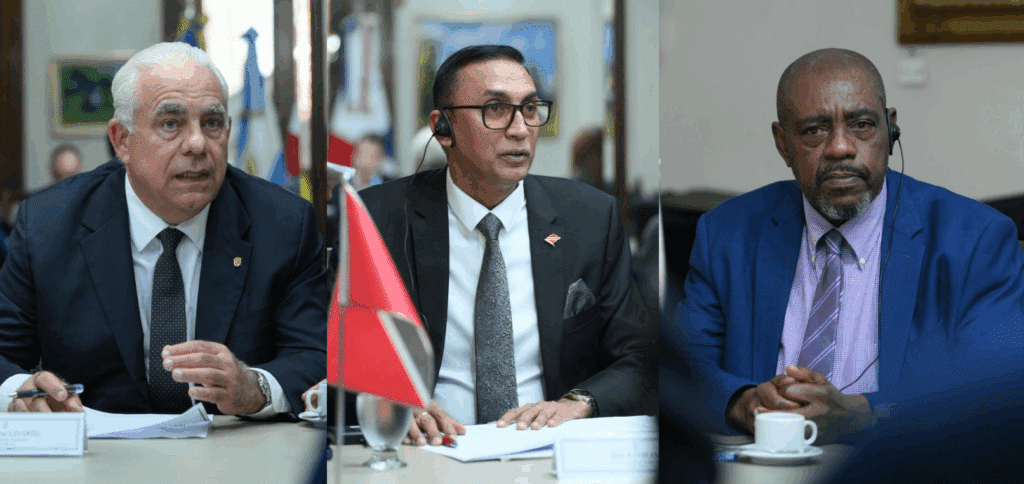
Buenos Aires, Argentina, 7 August 2025 (IICA) – At a meeting with senior officials of the Argentinian government, ministers of Panama, Trinidad and Tobago and Saint Vincent and the Grenadines explored new agribusiness and cooperation opportunities in the application of genetics in beef production, dairy farming and beekeeping, among other areas, with a view to expanding trade between Argentina and the Caribbean and Central America.
The Inter-American Institute for Cooperation on Agriculture (IICA) organized a visit to Argentina by Roberto José Linares, Minister of Agricultural Development of Panama; Ravi Ratiram, Senator and Minister of Agriculture, Land and Fisheries of Trinidad and Tobago; and Frederick Stephenson, Minister of Foreign Affairs, International Trade and Consumer Affairs of Saint Vincent and the Grenadines.
An intense schedule of activities has been planned for the officials’ weeklong stay in Buenos Aires, including working meetings with the private sector. They are accompanied by the IICA Director General, Manuel Otero.
Argentina’s Minister of Foreign Affairs, Gerardo Werthein, and the Secretary of Agriculture, Livestock and Fisheries, Jorge Iraeta, welcomed the three visiting ministers to the Ministry of Foreign Affairs, where they also participated in bilateral working meetings. Argentina, a global food production powerhouse, pledged to offer its technical expertise to the Central American and Caribbean countries in areas such as biotechnology, agricultural health and food safety and the application of genetics in livestock production.
Minister Werthein began the meeting by stating that, “Argentina has a keen interest in assisting and interacting with the countries of Central America and the Caribbean Community (CARICOM) in all areas, not only trade. We thank IICA for serving as a conduit between our countries”.
“The ministers’ visit to Argentina is an excellent initiative by IICA. We are eager to work together to promote greater collaboration between our countries. The interaction between the Argentinian agriculture sector and Central America and the Caribbean will facilitate increased food production and products of a higher quality. Argentina has extensive experience in technical matters and rural development that we are anxious to share; and we have internationally recognized public institutions”, noted Iraeta.
Ambassadors Fernando Brun, Secretary of International Economic Relations of Argentina, and Matero Estremé, Director General of International Cooperation, who led the bilateral meetings, discussed the key areas for joint work with the visitors and highlighted IICA’s role as an agent in identifying reciprocal opportunities.
Manuel Otero stressed that, “It is IICA’s mission to address the needs of the countries. We are building bridges of camaraderie and dialogue to assist these countries to achieve their objectives of enhancing productivity and exports. Intraregional agricultural trade accounts for only 14% of total trade and it should be increased. We are always here to help to implement the decisions taken by the countries”. The Director General was accompanied by Jorge Werthein, Special Advisor to IICA’s General Directorate and IICA Representative in Argentina, Fernando Camargo.
Livestock farming, dairy production and beekeeping
Ministers Linares, Stephenson and Ratiram participated in an extensive technical meeting at the Secretariat of Agriculture, Livestock and Fisheries, focusing mainly on cooperation opportunities for their countries with respect to livestock farming, dairy production and beekeeping.
The host delegation was led by the Undersecretary of Agricultural and Forestry Production, Manuel Chiappe, and the President of the National Institute of Agricultural Technology (INTA), Nicolás Bronzovich, who pledged Argentina’s cooperation in honey production, the improvement of phytosanitary controls, development of agrotechnical schools and many other areas, and also expressed Argentina’s interest in tropical agricultural products, such as mangoes.
Linares noted that, “Panama is a small country, which needs the technical assistance and experience of Argentina, for example in the area of embryo transfer in beef cattle. We can also work with IICA to identify other areas for cooperation. We are eager to move forward because this activity is extremely important for us: more than 40% of jobs in Panama are directly or indirectly linked to agriculture”.
On the other hand, Stephenson explained that Saint Vincent and the Grenadines is a young Caribbean country where tourism has still not developed on a mass scale, and thus it depends heavily on agriculture. He acknowledged that, “IICA’s assistance is vital for us. It has provided us with technical assistance during our most difficult moments, for example, in the aftermath of the La Soufrière Volcano eruptions in 2021, which compelled us to relocate close to 20% of our population, and in the wake of Hurricane Beryl”.
Ratiram indicated that Trinidad and Tobago is eager to receive the support of Argentina, which he described as an agrifood power: “Our farmers face many challenges, such as floods, rising sea levels and soil salinization. Another concern is our aging farming population. We hope that Argentina can infuse in us the spirit of its farmers, who are proud to live in the countryside and who produce enough food for a population ten times greater than that of their own country”.
More information:
Institutional Communication Division.
comunicacion.institucional@iica.int