An IFPRI-IICA-IISD event analyzed the pandemic’s impact on an industry that has demonstrated its resilience and discussed major challenges that must be tackled through extensive hemispheric coordination.
San Jose, 26 November 2020 (IICA) – Rising costs, the weakening of emerging currencies, imposition of trade barriers with no scientific justification and the flaws in the multilateral system may endanger the effective functioning of the agrifood chain and in turn the food supply of hundreds of millions of people.
These were the common denominators in a debate among leading members of the Latin American agricultural community, who were assessing the response of the sector to the various challenges arising from the pandemic, the approaches of the governments and the elements needed to satisfy the growing food demand, within the limitations of the planet.
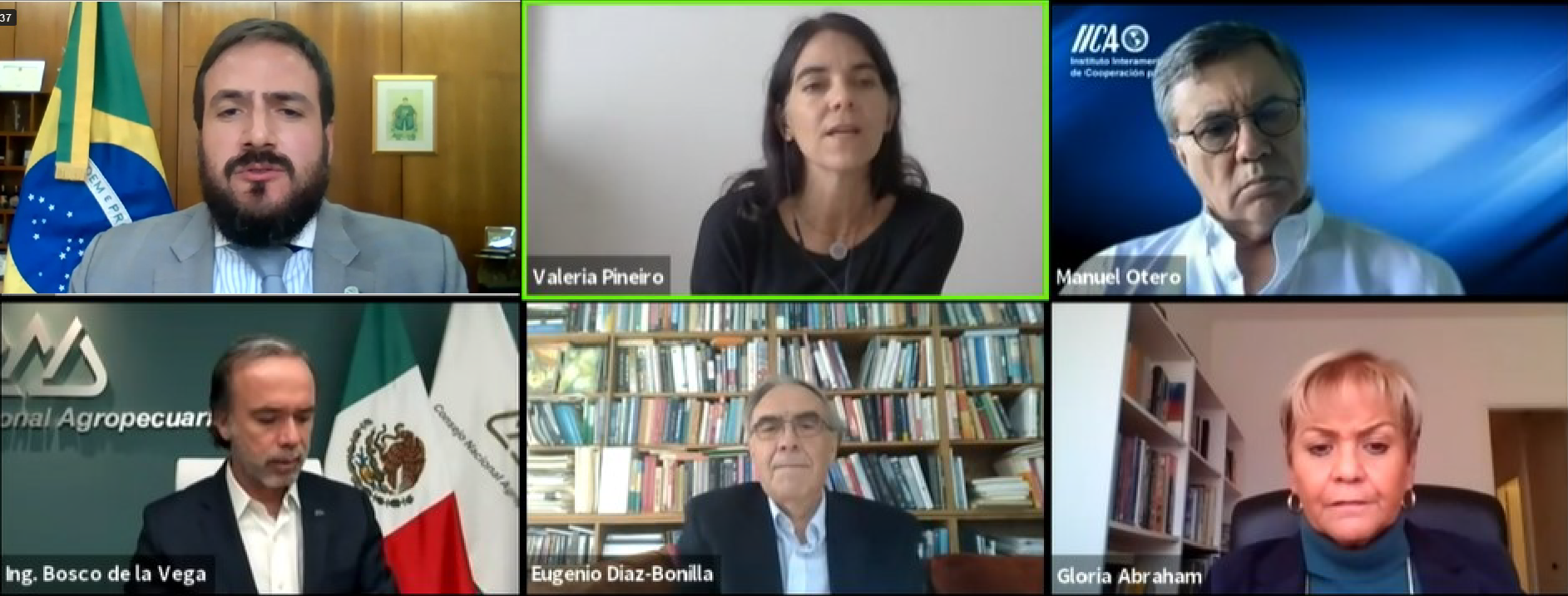
The participants in the debate included Gloria Abraham, Costa Rica’s Ambassador to the World Trade Organization (WTO); Flávio Bettarello, Deputy Secretary for Trade and International Relations at Brazil’s Ministry of Agriculture, Livestock and Food Supply; Eugenio Díaz Bonilla, Head of the Latin American and Caribbean Program at the International Food Policy Research Institute (IFPRI); Valeria Piñeiro, Senior Research Coordinator at IFPRI; Bosco de la Vega, President of Mexico’s National Agricultural Council; as well as Manuel Otero, Director General of the Inter-American Institute for Cooperation on Agriculture (IICA).
The experts agreed that the agrifood chain had performed remarkably well, as it had continued to operate at full tilt, despite trade barriers, sanitary restrictions and the instability of international trade.
Agricultural resilience
The CAN President remarked that, “There has been a slight deceleration in agricultural growth, but the overall impact has not been significant. In contrast, the Gross Domestic Product (GDP) of Mexico has contracted by almost 10% and 10 million people are suffering from food insecurity”.
According to de la Vega, “This positive performance by agriculture is thanks to the value network that Mexico has established, with the entire sector participating in a working session to determine how to cushion the supply chain. Technology has also played a dominant role”.
In Brazil, for example, growth in food exports was approximately 5%, whereas in Mexico, they increased 2.7%.
Flávio Bettarello felt that the region must “take advantage of positive conditions today to create fair trade conditions and to reproduce these benefits on a global scale, because the region will undoubtedly increase its food production but must do so in a sustainable manner”.
Costa Rica’s Ambassador to the WTO, Gloria Abraham, pointed out that although food has become increasingly available, “the pandemic has also increased food vulnerability and today we have more than 600 million people suffering from hunger in the world”.
“Agriculture has passed the test. It is holding its own and the food supply is increasing, notwithstanding the disturbing social context and the many daunting challenges”, reflected, IICA Director General, Manuel Otero.
Call for a hemispheric response
Latin America and the Caribbean has been called on to serve as the major global supplier of food, given its available land for agriculture. However, the specialists warned that there are still many pending challenges, which can only be addressed through a coordinated response involving all actors.
“The region’s countries accounted for one third of the signatories to the agreement to establish the WTO. Today, we are very divided and must revive the spirit of hemispheric collaboration that we enjoyed in the past. This will be critical to moving forward. Although agriculture has been extremely resilient, some simulations suggest that there will be a delayed response to the pandemic, given the decline in people’s income and the resulting falloff in demand”, said Eugenio Díaz Bonilla.
Part of this vital hemispheric response will depend heavily on creating the appropriate conditions to enable rural populations to increase their capacity to connect to markets; to clearly understand the rules of the game and to access new technologies.
Indeed, Otero stressed the need to boost the connectivity of rural areas, insisting that it was essential “to support harmonization of sanitary and phytosanitary measures; bolster the capacities of strategic partners; strengthen and streamline border trade; work on improving governance; and strengthen the capacities of strategic partners, such as Ministries of Agriculture and surveillance systems”.
The specialists remarked that the countries have many shared interests and should work to break down existing trade barriers and demonstrate to the world how to achieve food security with sustainability.
One of the challenges that concerns us the most are the reactive public policies that focus on addressing short-term problems, rather than identifying decisive structural responses.
Abraham reflected that, “In our hemisphere we have not focused on the medium- or long-term, because we concentrate on the moment. We must devise long-term public policies that promote sustainable growth in the sector. This will positively impact food security and development of the sector”.
More information:
Link to the event: https://www.ifpri.org/event/virtual-event-food-and-agricultural-trade-new-policy-environment-how-can-wto-members-support
Institutional Communication Division
comunicacion.institucional@iica.int
Online press release: https://iica.int/es/prensa/noticias/comercio-de-alimentos-requiere-de-transparencia-y-politicas-de-largo-plazo-para