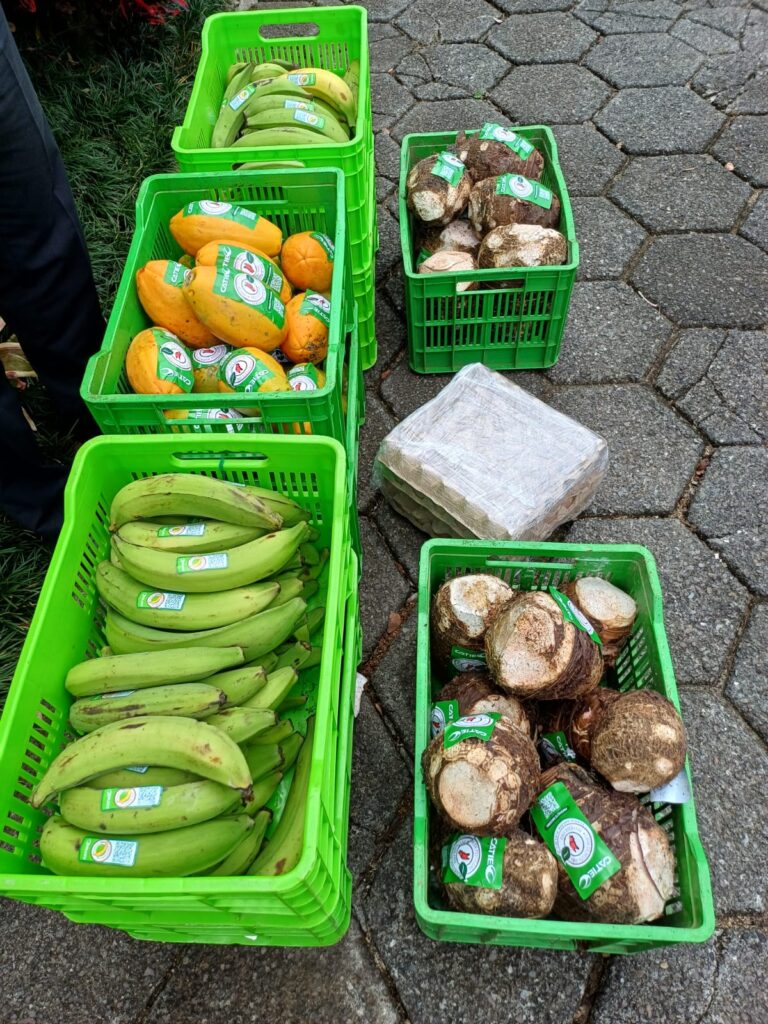
Agricultural products, including green plantains, papaya, taro, and eggs, were donated to the Monserrat, San Rafael, Manuel María Gutiérrez, José Ana Marín, and Dulce Nombre primary schools, as well as Coronado High School.
Coronado, Costa Rica, 2 June 2026 (IICA). A chain of collaboration from the farm to school cafeterias in the municipality of Vázquez de Coronado, Costa Rica, allowed children and adolescents from various schools to receive fresh, pesticide-free foodstuffs as part of a joint initiative by the Inter-American Institute for Cooperation on Agriculture (IICA) and the Tropical Agricultural Research and Higher Education Center (CATIE).
In the first step in the process, the Director of CATIE, Luis Pocasangre Enamorado, delivered a donation of certified pesticide-free agricultural products to IICA’s Headquarters in Vázquez de Coronado, which included green plantains, papaya, taro, and eggs from production systems that promote sustainable agricultural practices.
The foodstuffs were grown and produced on CATIE’s Sustainable Academic Farm (located in Turrialba, about 60 km from San José), a space dedicated to research, training, and the demonstration of agricultural systems that integrate environmental sustainability, productive innovation, and good agricultural practices. CATIE uses the farm to promote responsible production models that contribute to food security, people’s health, and the care of ecosystems.
IICA, through its Institutional Volunteering Program, channeled the donation to its final destination: the school cafeterias of several schools in the canton of Vázquez de Coronado. The supervisory advisor of the San José-Norte Regional Directorate of Education of the Ministry of Public Education (MEP), Ileana Arce Campos, delivered the foodstuffs.
IICA Director General Muhammad Ibrahim said the initiative reflects the Institute’s commitment to the local community.
“Community outreach actions are a concrete expression of the social responsibility that IICA assumes with the populations and territories with which it interacts. Through strategic partnerships ―in this case, with CATIE― we contribute not only to agricultural development, but also to the well-being of communities,” he explained.
CATIE Director General Luis Pocasangre stressed that the donation is part of a broader vision of cooperation and extension activities designed to demonstrate the benefits of sustainable agriculture.
“Our intention is that this initiative involving the donation of pesticide-free products continue on a regular basis, so that it can benefit more educational centers and social organizations, strengthening the link between responsible production and social well-being,” he commented.
The activity highlights how cooperation between institutions linked to agricultural and educational development can translate into tangible benefits for local communities in terms of food security, nutrition, and education, while also promoting more sustainable and health and environmentally conscious production models.
More information:
Institutional Communication Division.
comunicacion.institucional@iica.int