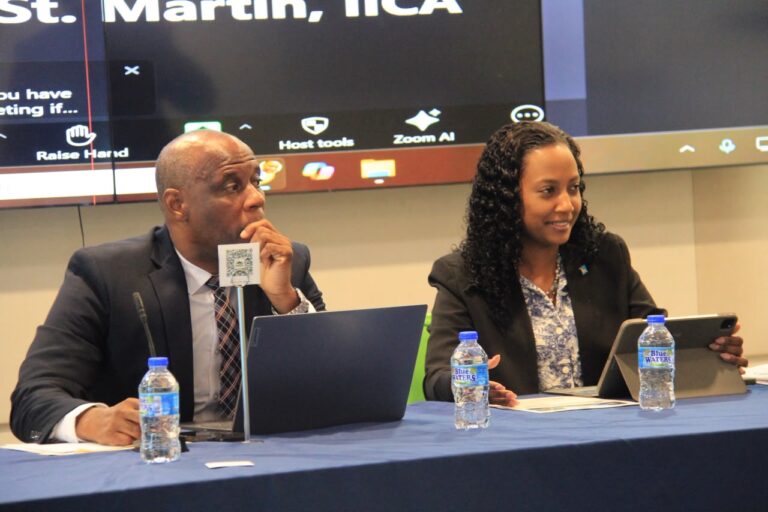
This was the warning made by specialists participating in a webinar organized by the IICA within the framework of the Caribbean Week of Agriculture 2021.
San Jose, 8 October 2021 (IICA) – Coordinated efforts in Latin America and the Caribbean are required to overcome African swine fever, given that its recent emergence in the Dominican Republic and Haiti poses a threat to food security throughout the region and to the livelihoods of small and medium-scale producers.
This was the warning made by specialists participating in a webinar organized by the Inter-American Institute for Cooperation on Agriculture (IICA) within the framework of the Caribbean Week of Agriculture 2021.
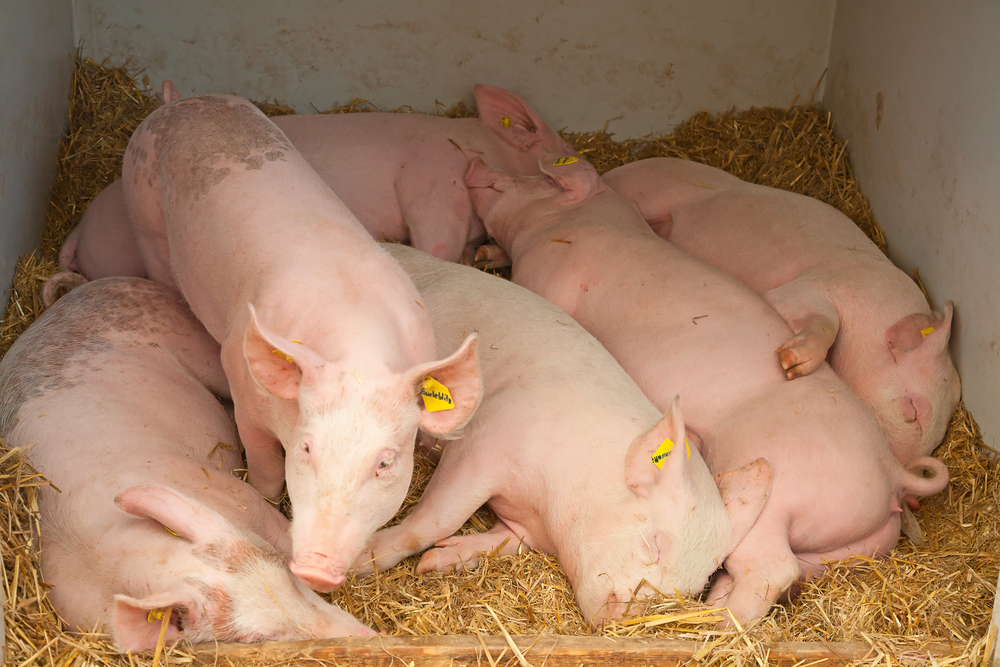
African swine fever is a highly infectious hemorrhagic disease that affects both domestic and wild pigs and is harmless to humans. The disease had not had any presence in the Western Hemisphere for decades and there is currently no vaccine to combat it.
The disease was last detected in Cuba in 1971 and 1980, in the Dominican Republic in 1978, and in Haiti in 1979. However, cases were confirmed in the Dominican Republic and in Haiti in July and September of this year, respectively. The two countries share the island of Hispaniola in the Caribbean Sea.
The webinar was organized with the aim of raising awareness in the public and private sectors of the importance of investing in surveillance and prevention programs as well as sharing experiences and information regarding how to recognize and prevent the spread of the disease.
The sixteenth edition of the Caribbean Week of Agriculture—inaugurated in Trinidad and Tobago in 1999—was convened to foster consensus-building among key stakeholders on the future of agricultural production and rural life in a subregion that is aiming to reduce its strong dependence on food imports. It is organized by the Caribbean Community (CARICOM), in collaboration with the Caribbean Agricultural Research and Development Institute (CARDI), IICA and FAO.
“African swine fever has spread across several continents in recent years and has now reached the Americas, which could cause severe losses to affected countries in our region, as has already occurred in China and other nations”, stated Gavin Peters of the Caribbean Agricultural Health and Food Safety Agency (CAHFSA).
“What must we do now that we know that the disease is already present in our region? We must work together at the regional level and in each country to implement the necessary surveillance measures. Only then will we succeed in curbing the spread of the disease on the island of Hispaniola and subsequently eradicating it”, he added.
Shaun Baugh, Manager of CARICOM’s Agricultural and Agro-Industrial Development Program, emphasized the “critical importance” of this issue for the food security of Caribbean countries, and called on those involved in swine production to be vigilant in the event of an outbreak.
“This is a past and present issue. We have already sent out communications to all farmers to make them aware of the importance of joining forces and remaining vigilant”, stated Baugh.
Specialist Monica Davis, veterinary officer of the Animal Production and Health Division of the Ministry of Agriculture of St. Vincent and the Grenadines, warned that this disease puts the livelihoods of producers at risk because it has strong consequences on international trade, as it triggers restrictions on affected countries.
Davis urged travelers not to transport pigs or pork products and also urged producers to adopt stricter biosecurity measures than usual to prevent the spread of the disease.
Confirmation, in September, of the presence of African swine fever in Haiti—which was also hit by an earthquake this year—has further aggravated the country’s health and social situation given the technical, financial and logistical resources required to combat the disease, explained Haim Joseph Corvil, Coordinator of the Health Protection Unit of Haiti’s Ministry of Agriculture, Natural Resources and Rural Development.
Corvil thanked IICA for its technical assistance and noted that the large number of measures that Haiti had been adopting to prevent the disease had proven insufficient due to its highly contagious nature. Among other actions, an inter-ministerial prevention commission had been set up, with support from the local IICA Delegation, and the importation of pigs and their by-products from the Dominican Republic had been banned. The expert revealed that the pig population in Haiti comprises about 1,100,000 animals.
The Deputy Director General of IICA, Lloyd Day, underscored the importance of early detection of the disease and, in that regard, reiterated the Institute’s continued commitment to providing countries throughout the region with technical cooperation to improve surveillance systems.
“Providing producers with education and training opportunities is crucial in order to develop the skills required to contain the disease. IICA will continue to work together with stakeholders in the countries to implement programs aimed at protecting food security and our fragile economies”.
Ana Marisa Cordero, Manager of IICA’s Agricultural Health, Safety and Food Quality Program, recalled that, during their meeting on September 1 and 2, the Ministers of Agriculture of the Americas had requested that the Director General of the Institute, Manuel Otero, support the development and execution of binational projects and actions, as well as the implementation of the work plans defined at the subregional level, aimed at eradicating outbreaks and preventing and containing the spread of the virus so that the hemisphere can regain its status as free of African swine fever.
In a joint resolution, the ministers of the Americas noted that the disease “could affect the stability of the pork industry in the Hemisphere, particularly for medium- and small-scale farmers, and therefore, collaboration between official veterinary services and the private sector is imperative”.
More information:
Institutional Communication Division.
comunicacion.institucional@iica.int