
São Paulo, 30 June 2026 (IICA). Closing productivity gaps and increasing yields in key crops would unleash the potential of agriculture in the Americas to play a decisive role in the development of sustainable aviation fuels (SAF) and the decarbonization of international air transport.
This was the argument advanced by the Inter-American Institute for Cooperation on Agriculture (IICA) and the Pan American Liquid Biofuels Coalition (CPBIO) at the 2026 Argus Biofuels & Feedstocks Latin America Conference, one of the region’s main meetings on biofuels, renewable raw materials, and energy transition, held this year in São Paulo, Brazil.
Agustín Torroba, IICA International Specialist in Biofuels and Renewable Energies and Executive Secretary of the CPBIO, took part in two panel discussions along with representatives of industry, international organizations, companies, and industry specialists that focused on the opportunities for scaling up the production of sustainable aviation fuels and the challenges involved.
Torroba stressed that agriculture should be understood as an environmental resource for decarbonization, and not as an obstacle to the energy transition.
“Closing the gaps in agricultural productivity is one of the most concrete ways of making SAF a reality. Improving yields for the six main crops used for biofuels – maize, sugarcane, wheat, soybeans, palm, and rapeseed – would make it possible to produce more than 512 million cubic meters of sustainable aviation fuels, more than the 449 million cubic meters that the IATA estimates will be needed by 2050 to meet the goal of net zero emissions. This would allow us to expand the supply of raw materials without incorporating more farmland, turning agriculture into a true environmental resource for the decarbonization of aviation,” he said.
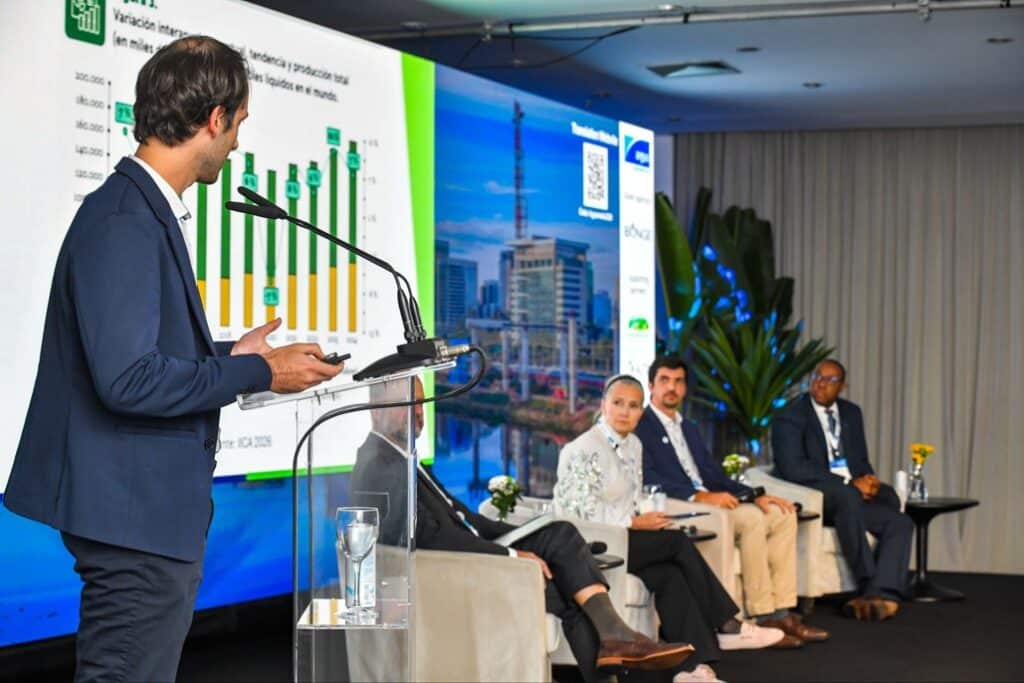
The panel members also discussed the need to adopt a pragmatic vision for the development of SAF, based on affordable, abundant, and sustainable raw materials. Attention was drawn to the potential of the agro-industrial chains already consolidated in the region, such as those of corn, sugarcane, vegetable oils, fats, and ethanol.
The experts also underscored the role that the HEFA and ATJ technological pathways, currently among the most advanced for the production of SAF, can play in allowing the integration of the oil, fat, and alcohol chains of the Americas into the new renewable aviation fuel markets.
For IICA and the CPBIO, the Americas offer unique structural advantages for contributing to the global energy transition. The availability of natural resources, the accumulated experience with liquid biofuels, the installed industrial capacity, and the technical expertise developed over decades position the region as a strategic player for the development of sustainable aviation.
However, transforming this potential into concrete investments calls for the development of clear rules, comparable methodologies for measuring the carbon footprint, and economic signals that would speed up the commercial deployment of SAF on a global scale.
Representatives of CPBIO member organizations, including Uruguay’s ALUR and Paraguay’s BIOCAP, also took part in the event, sharing experiences related to the development of sustainable raw materials, certification, competitiveness, and the regional integration of biofuel value chains.
More information:
Institutional Communication Division.
comunicacion.institucional@iica.int