On the heels of a mission to Brazil, Otero travelled to the Uruguay capital, where he met with Mattos, as well as with the Vice-President of the Republic, Beatriz Argimón, and with authorities from various institutions in the agriculture sector and in international trade.
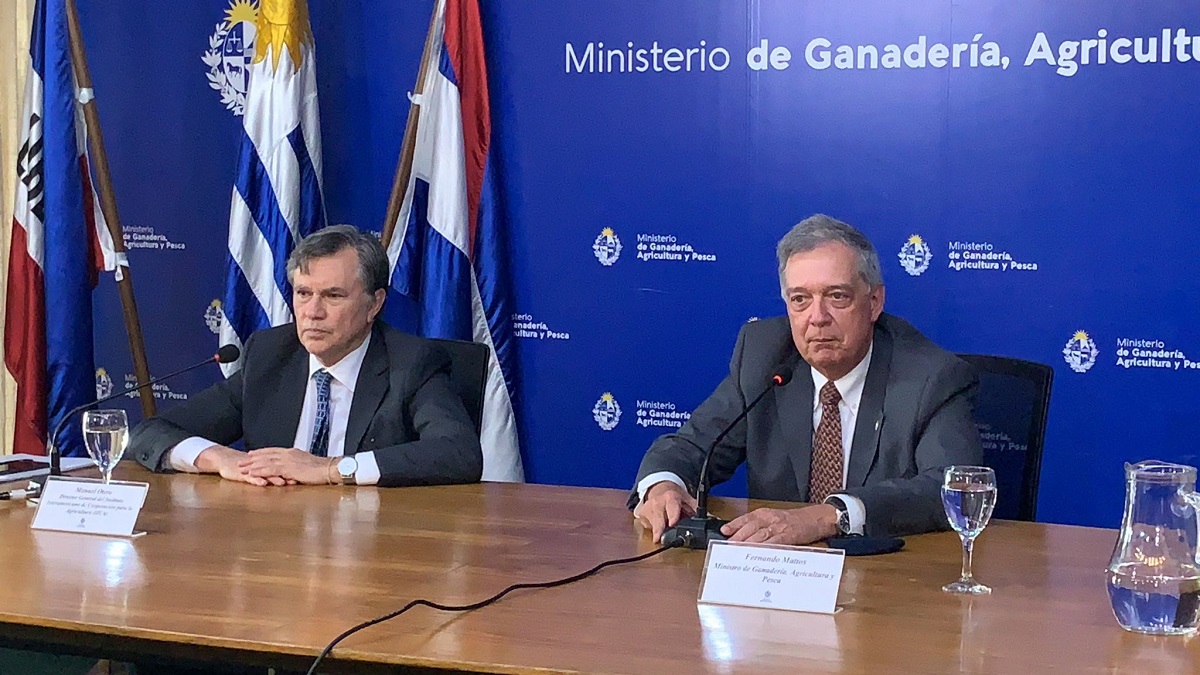
Montevideo, 6 December 2021 (IICA). The Inter-American Institute for Cooperation on Agriculture (IICA) agreed to support agriculture in the Oriental Republic of Uruguay, through the transfer of knowledge and new technology, geared at the capacity development of small farmers in the remote areas of the country and leaving no one behind.
The agreement was the outcome of a meeting in Montevideo between Fernando Mattos, Uruguay’s Minister of Livestock, Agriculture and Fisheries and Manuel Otero, IICA’s Director General.
On the heels of a mission to Brazil, Otero travelled to the Uruguay capital, where he met with Mattos, as well as with the Vice-President of the Republic, Beatriz Argimón, and with authorities from various institutions in the agriculture sector and in international trade.
Minister Mattos highlighted the support “of many decades” that IICA has provided to the region’s rural sector, underscoring the fact that the Institute is playing a vital role in the current development of Uruguay’s agricultural strategic plan. The plan will be opened up for public consultation with various sector stakeholders in the early months of 2022.
“We believe closer interaction with IICA will allow us to engage globally recognized technical expertise, which will provide us with other perspectives on the reality of the agriculture sector that we want for the future. IICA will help us to design a more modern agriculture sector that is more socially and environmentally responsible”, said Mattos.
The minister revealed that the main topics of his meeting with Otero were training, capacity development and technology transfer in the agriculture sector.
He said that, “We need new technology to be made available to the most remote corners of the Republic, to facilitate communication and knowledge transfer, enabling those with the fewest opportunities to access tools—remotely and on a large scale—so that they will be able to adopt a more modern style of production.
Moreover, he said that, “Large companies already have access to these tools, but we do not want any sector to lag behind. We intend to fuel their progress, using knowledge transfer”.
Mattos also highlighted the value of the Living Soils of the Americas program that IICA launched in December 2020 to coordinate public and private efforts in the fight against soil degradation.
“This perfect concurs with what Uruguay has adopted as a state policy – proper soil use. We can cooperate with IICA and transfer Uruguay’s experience in that topic, because the aim is to receive cooperation and also give back in return”.
“We are moving in that direction. We support IICA’s actions and we foresee many joint projects ahead”, he concluded.
On the other hand, Manuel Otero—who was accompanied by his Special Advisor, Jorge Werthein, and IICA Representative in the country, Rodrigo Saldías—thanked Uruguay for its support during the discussions among the 34 IICA Member States in preparation for the United Nations Food Systems Summit that took place in September.
The Americas was the only region that arrived at the global Summit with a consensus position that called attention to the role of farmers in food production; stressed the value of science and technology for agrifood system transformation and maintained that agriculture is part of the solution to the challenges facing humanity.
Otero stated that, “Through this philosophy we have reached a consensus in the hemisphere and we can’t stop now. We must move from a defensive to an offensive position, transforming threats into opportunities”.
“Our region is being called on to be a guarantor of the world’s food and nutritional security, as well as its environmental sustainability. The region produces one in every three kilos of food that is sold in the world and also possesses most of its natural resources. We must vigorously defend this”.
The IICA Director General revealed that he had spoken with Minister Mattos about the importance of agricultural institutions and he described Uruguay as a country that is advanced in issues such as soil use and sustainable production systems.
He also remarked that during the meeting, they had initiated discussions on the creation of innovation hubs.
“A tropical agriculture hub would be established at IICA Headquarters in Costa Rica”, he said, “and another one, focusing on new digital agriculture for temperate climate countries, would be in Uruguay”.
Otero pledged that, “IICA’s technical cooperation agenda is available to assist Uruguay – its ministry, institutions and agricultural producers”.
Prior to continuing on to Argentina, Otero met with President and Vice-President of the National Agricultural Research Institute (INIA), José Eduardo Bonica and Walter Baethgen Varela, and with the country’s Deputy Minister of Foreign Affairs, Carolina Ache Batlle.
He also had a lunch meeting with Sergio Abreu, the Secretary General of the Latin American Integration Association (ALADI), which is an organization in close collaboration with IICA, primarily in mechanisms related to trade facilitation.
Video in spanish
More information:
Institutional Communication Division.
comunicacion.institucional@iica.int