In Peru, approximately 100,000 families participate in cocoa production, which in 2021 generated exports worth USD 300 million.
Lima, 12 December 2022 (IICA). Peru’s cocoa sector has a new technical instrument to help ensure crop safety and drive the sustainability of exports of cocoa and its derivatives.
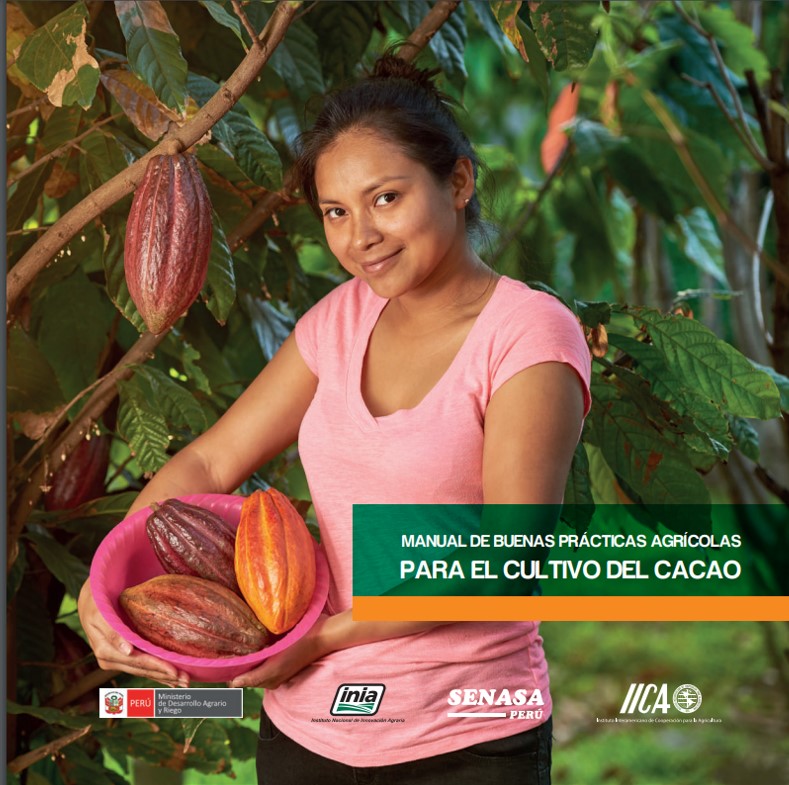
Specifically, the “Manual of Good Agricultural Practices for Cocoa” was developed by the National Agricultural Health Service (SENASA), the National Institute of Agricultural Innovation (INIA) and the Directorate General of Agricultural Development and Agroecology (DGDAA)—three entities under the Ministry of Agriculture and Irrigation—along with the technical coordination of the Inter-American Institute for Cooperation on Agriculture (IICA).
The handbook, available at https://repositorio.iica.int/handle/11324/21346, comprises 84 pages and addresses critical issues and compliance criteria with Good Agricultural Practices (GAP), which were developed as a strategy for the primary production of safe foods with respect for the environment and the health and safety of workers.
The document includes aspects to help improve knowledge of cocoa pests and their integrated management, and provides recommendations for mitigating cadmium in cocoa crops, as well as COVID-19 prevention measures.
It was developed in consultation with stakeholders across the cocoa chain, including the public and private sectors and cooperatives to validate training needs.
The new tool is intended for use by extension workers, technical assistants, farmers and other interested parties.
“We hope this public good contributes to the well-being of cocoa farmers, in addition to their families and communities in rural territories”, expressed Erika Soto, Technology, Innovation, Agricultural Health and Food Safety Specialist at the IICA Delegation in Peru.
The manual supplements a free online course offered last year with the participation of 26 technical assistants from the cocoa-producing regions of Junín, Pasco, Huánuco, Amazonas, San Martín, Piura and Cajamarca, from cocoa cooperatives, INIA, the National Commission for Development and Life without Drugs (DEVIDA) and the project Maximizing Opportunities in Coffee and Cocoa in the Americas (MOCCA).
Peru is internationally recognized as an exporter of fine-aroma cocoa. The crop is produced across 181,000 hectares in 16 of Peru’s 24 regions.
With a production of 160,000 tons, it was declared National Natural Heritage in 2010, and involves 100,000 families—mainly family farmers—and generates 13 million salaries per year and more than USD 300 million in exports, according to 2021 data from MINAGRI.
More information:
Erika Soto, Technology, Innovation, Agricultural Health and Food Safety Specialist at the IICA Delegation in Peru.
erika.soto@iica.int