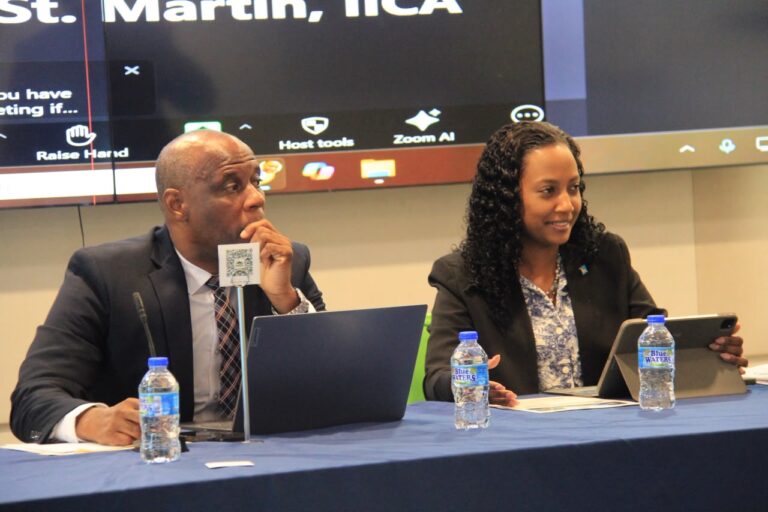
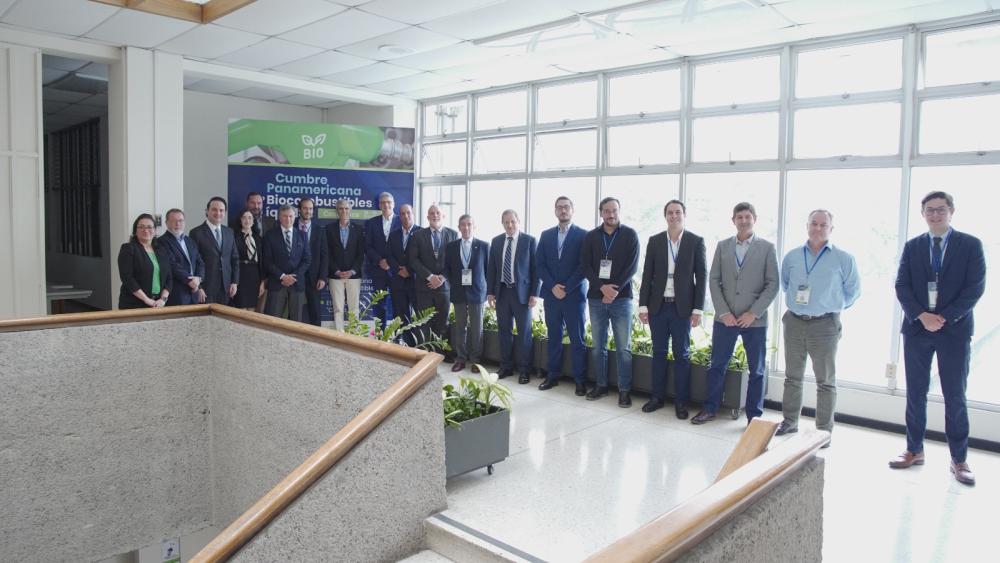
More than 150 participants attended the event, including officials, analysts, producers and professionals from different regions, who shared details of the most important biofuel experiences.
Guatemala City, Guatemala, February 2, 2024 (IICA). The Pan-American Liquid Biofuels Coalition (CPBIO) took advantage of an event held in Guatemala to present details of the most important biofuel initiatives implemented across the Americas to officials, analysts, producers and professionals from different regions.
The cases and experiences were presented at a conference entitled “Sustainable Mobility: The Opportunities for Ethanol in Guatemala”, held with support from the Inter-American Institute for Cooperation on Agriculture (IICA), Brazil’s Embassy in the Central American country, the United States Grain Council, the Renewable Fuels Association of Guatemala, and the Universidad del Valle de Guatemala.
The event was organized to support Guatemala and its new government, headed by President Bernardo Arévalo, as it begins to implement the Regulations of General Applicability of the Fuel Alcohol Act (Law No. AG-159-2023), which will promote sustainable mobility when the minimum use of 5% ethanol in gasoline becomes mandatory from January 1, 2025 onwards.
The event attracted more than 150 participants, including officials, analysts, producers and professionals from different regions, who shared details of the most important biofuel experiences.
The inaugural speakers were Fernando Conde, from the IICA Delegation in Guatemala; Marri Tejada, Regional Director for Latin America of the U.S. Grains Council; Henrique Da Silveira Sardinha Pinto, Brazil’s Ambassador to Guatemala; and Víctor Hugo Ventura, Minister of Energy and Mines of Guatemala.
“We will resume the discussions, analysis and technical roundtables to establish the economic benefits of the use of ethanol in gasoline for the country and for users”, explained Minister Ventura.
IICA Representative Fernando Conde said “we congratulate Guatemala for the major progress it has made on regulations governing ethanol, an important option for transforming the transportation sector’s use of energy. IICA has been heavily involved in the process in the country, providing technical assistance with the drafting of technical norms and standards in recent years. Training courses and activities have also been held for senior government technical personnel and policymakers, thus providing the country with useful technical cooperation”.
Leading one of the event’s panel discussions, Cary Sifferath, Vice President of the U.S. Grains Council, provided a global overview of comparative experiences with the use of fuel ethanol.
“Guatemala is engaged in a very interesting process, with the country having made strides with its program for the blending of ethanol with gasoline, based on legislation enacted several decades ago. Learning about successful international experiences, such as those of Vietnam, Japan, Canada, India and Nigeria, some of which the U.S. Grains Council has supported, will undoubtedly help Guatemala continue its transition to the use of ethanol to decarbonize the transportation sector”, Sifferath explained.
Aída Lorenzo, Manager of the Renewable Fuels Association, pointed out that “the blending of ethanol with gasoline will benefit the country in several ways, not least in terms of our energy security, as we import 100% of the gasoline we use. It will help us meet our environmental commitments to reduce emissions and improve the quality of the air that Guatemalans breathe. It will also help us save foreign currency, at least USD 200 million a year, and reactivate the economy”.
During the panel discussion on “The Context of Ethanol and Gasoline Blending Programs in the Americas”, Agustín Torroba, an IICA Specialist in Biofuels and Renewable Energies, pointed out that “the region produces 87% of the world’s ethanol. Being a net importer of oil and its byproducts, this region has comparative advantages as it is a net exporter of raw materials that can be converted into biofuels to replace fossil fuel imports, while contributing to the development of agriculture and agroindustry and mitigating greenhouse gas emissions”.
Finally, Álvaro Lorenzo, the Representative and General Manager of Alcoholes del Uruguay (ALUR), commented that “this conference is a high-level meeting that makes it possible for us to study the technical and scientific opportunities available that can help halt global warming”. He pointed out that gasoline in Uruguay now contains 9.8% ethanol, a figure that it is likely to increase even further to decarbonize the transportation sector.
The Pan-American Liquid Biofuels Coalition (CPBIO) is made up of the main business and industrial associations of the Americas dedicated to the production and processing of sugar, alcohol, corn, sorghum, soybeans, vegetable oil and grains, and other agricultural products.
The main objectives of this new regional entity include coordinating the sustainable development, promotion and consumption of clean energies throughout the hemisphere.
The group was created in 2023, during the Pan-American Liquid Biofuels Summit organized in San José by IICA, which serves as the coalition’s Technical Secretariat.
More information:
Institutional Communication Division.
comunicacion.institucional@iica.int