
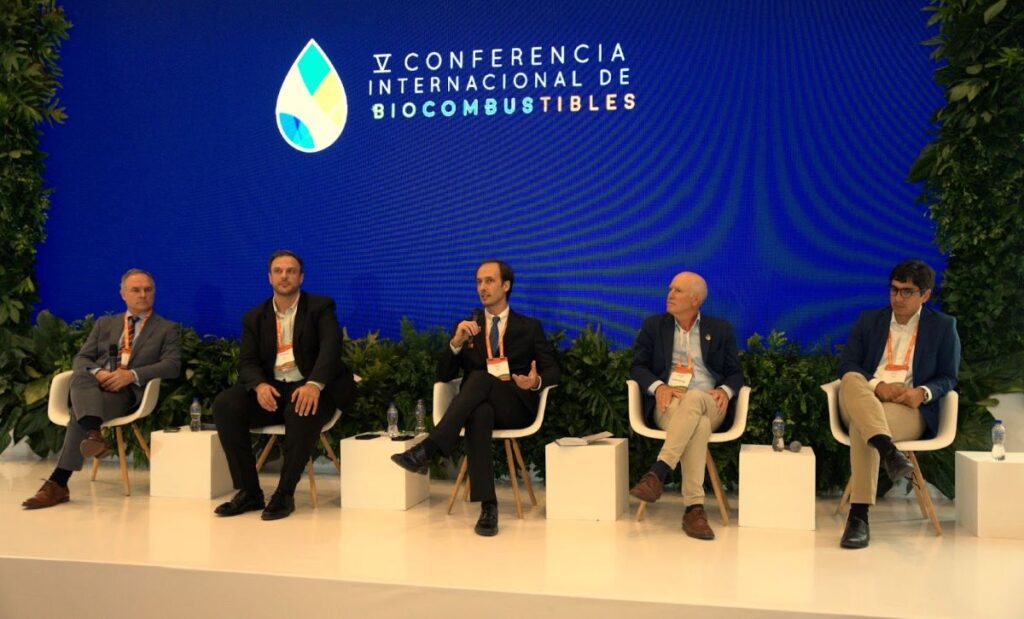
Santa Marta, Colombia, 19 May 2025 (IICA) – More than 500 key players from the agro-industry sector gathered at the 5th International Biofuels Conference, organized by the Colombian Federation of Biofuels (Fedebiocombustibles) in the city of Santa Marta. The event reinforced efforts to promote the sector’s expansion and the development of new opportunities.
The conference agenda included a vast range of topics such as the role of biofuels in the energy transition and the dynamics of the raw materials market.
What is Latin America’s outlook for achieving carbon neutrality by 2050? That was the question addressed by Andrés Rebolledo Smitmans, Executive Secretary of the Latin American Energy Organization (OLADE), who highlighted that renewable energy production must triple current levels—equivalent to a 200% expansion.
“Biofuels are much more than energy: they’re an opportunity to transform territories, generate rural employment, and move forward in the energy transition. Every drop counts on this path we are building as a country,” said Carolina Rojas, President of Fedebiocombustibles, summarizing the themes discussed at the conference.
The panel “Biofuels in Latin America” concluded that the region—as well as the continent as a whole—has made progress in developing ethanol and biodiesel to accelerate the decarbonization of land transport. New challenges are emerging with new biofuels: sustainable aviation fuels (SAF) and maritime fuels aimed at decarbonizing shipping.
Panelists agreed that developing these new biofuels will require strong coordination among organizations and countries, particularly to promote uniform, science-based sustainability criteria.
Agustín Torroba, international biofuels expert at the Inter-American Institute for Cooperation on Agriculture (IICA) and Executive Secretary of the Pan American Coalition on Liquid Biofuels (CPBIO), noted that many countries across the Americas have advanced in land-based biofuel development. Thanks to the region’s vast feedstock potential, the continent now produces 87% of global bioethanol and 44% of global biodiesel.
“The landscape has shifted, creating major opportunities and challenges for new biofuels, which—due to their cross-border nature—require regional and international coordination. These include SAF and sustainable maritime biofuels,” Torroba said.
This new context calls for intensified joint work between countries, the private sector, and international organizations, according to the CPBIO Executive Secretary, who stressed that the main challenge lies in ensuring that new regulations for emerging sectors reflect science-based sustainability standards with global application—rather than today’s fragmented, country- or region-specific standards for land-based biofuels.
“In addition to open, competitive markets to allow the region to seize this immense opportunity, we need clear and harmonized protocols to boost demand for biofuels across land, maritime, and air transport,” stated Luis Zubizarreta, President of the Argentine Chamber of Biofuels (CARBIO).
Massimiliano Corsi, President of the Paraguayan Chamber of Biofuels and Renewable Energies (BIOCAP), explained that Paraguay currently has the highest ethanol blend mandate in the world, at 30%, positioning the country as a regional benchmark in liquid biofuels.
“We’re now working toward a similar gradual advance with biodiesel, aiming to position Paraguay as a leader in energy sovereignty and deeply connected to the agricultural sector,” Corsi added.
According to Álvaro Lorenzo, Manager of ALUR – Alcoholes del Uruguay, the country has leveraged opportunities to develop new biofuels for export.
“The availability of raw materials and pilot projects with emerging feedstocks (camelina, carinata, pongamia), along with biomass and biogenic CO2, will allow us to pursue all technological pathways: hydroprocessed esters and fatty acids (HEFA), CO2-based fuels (eFuels), renewable fuels of non-biological origin (RFNBO), and alcohol-to-jet (AtJ),” Lorenzo added.
For the Uruguayan expert, SAF demand will be the key driver of these new developments, alongside biodiesel, ethanol, and e-methanol as alternatives for the transition in maritime transport.
Bruno Alves, Director of Public Affairs and Sustainability at Brazil’s National Corn Ethanol Union (UNEM), remarked that the future of biofuels lies in the diversity of feedstocks and the multiple uses of these products.
“The tropicalization of corn-based ethanol production technology has proven successful in Brazil, growing at an average annual rate of over 50% in the past seven years. This strong growth is crucial to meeting the scale required by rising demand for decarbonizing maritime transport. The countries that make up the International Maritime Organization recently agreed to cut emissions by 20% by 2030, which represents a major opportunity,” Alves concluded.
More information:
Institutional Communication Division.
comunicacion.institucional@iica.int