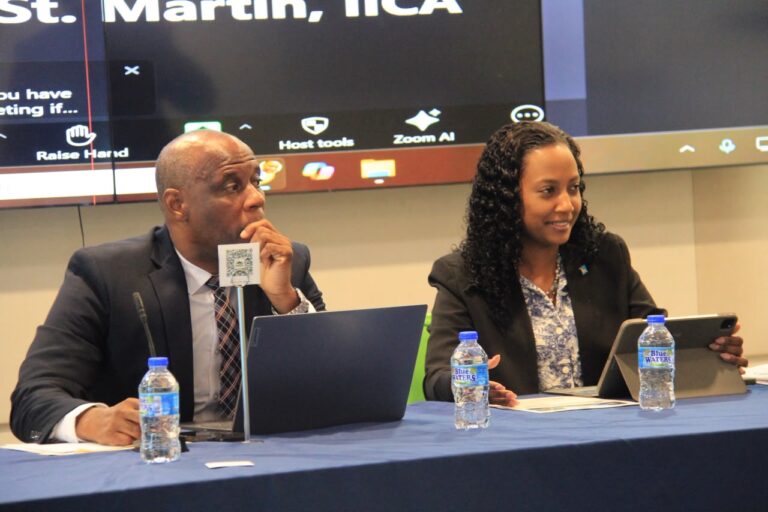

Brasilia, 9 March 2026 (IICA). In Brasilia, the Deputy Executive Secretary (Deputy Minister) of Brazil’s Ministry of Agriculture and Livestock (MAPA), Cleber Soares, hosted a meeting with the Director General of the Inter-American Institute for Cooperation on Agriculture (IICA), Muhammad Ibrahim, and ministers and other senior agricultural officials from Caribbean countries.
The meeting took place parallel to the 39th Session of the FAO Regional Conference for Latin America and the Caribbean, and was used to explore opportunities for cooperation, identify synergies and present strategic initiatives.
In his opening remarks to the meeting, Cleber Soares underlined the importance of Brazil’s closer tiesto the region through IICA, and emphasized the role of the Brazilian Agricultural Research Corporation (EMBRAPA) in the technological development of Brazil’s agriculture.
Soares also presented information about the ministry’s five secretariats and each one’s current initiatives. In response, the visiting ministers highlighted their countries’ needs and the opportunities for broadening and strengthening Brazil’s relationship with them.
The Director General of IICA, Muhammad Ibrahim, welcomed everyone and stressed the importance of the countries that make up the Caribbean Community (CARICOM).
He also informed the ministers of the process being made in drafting IICA’s new Medium-term Plan (MTP), the institutional roadmap of the specialized agency, which incorporates the areas in which the countries need and have requested cooperation.
“Strengthening links with Brazil will have a very positive impact and can help boost agriculture in each nation, contributing to global food security. These countries face climate challenges and other problems, and, working together, they can overcome these difficulties more easily”, Ibrahim observed.
During the meeting, Secretary Soares announced the creation of the Center for Innovation and Sustainable Agriculture in the Americas, in Guyana, designed to meet the needs mentioned by the ministers and improve relations with the entire Caribbean.
The decision to create the Center was taken by the Ministry of Agriculture, Livestock and Fisheries of Brazil (MAPA), the Ministry of Foreign Affairs of Brazil (MRE), the Brazilian Cooperation Agency (ABC), the Brazilian Agricultural Research Company (EMBRAPA) and IICA.
“Our aim in the coming days is to move forward in establishing a framework, so that in a short time the Foreign Ministry, working with IICA, the ABC and EMBRAPA, is able to kick off the process of creating the center. Brazil will share its technology, technical expertise and experience with our Caribbean brothers and sisters”, Soares remarked.
Brazil’s Deputy Minister also underscored the fact that his country has the potential to support these other nations that need cooperation. As a leader in tropical agriculture, Brazil possesses the technology, innovation and skilled producers needed to help strengthen crop and livestock farming.
Cooperation
During the meeting, representatives from the MAPA explained the role of each secretariat within the ministry and their importance to the work carried out in Brazil in support of crop and livestock farming.
Marcelo Fiadeiro, Secretary of Rural Development (SDR), highlighted the ministry’s sustainability policies. The Undersecretary for Agricultural Policy, Wilson Vaz, then explained its rural credit policies, support for marketing and rural insurance.

The Director of Planning and Strategy for the Unified Agricultural Health System, Judi Nóbrega, spoke about the role of the Agricultural Defense Secretariat, which is in charge of controls and inspections, and is also responsible for ensuring the sanitary credibility that certifications of Brazilian products enjoy in international markets.
Finally, the Undersecretary for Trade and International Relations (SCRI), Augusto Billi, explained his department’s responsibilities, which include opening markets, trade relations and agricultural exports. Billi also pointed out that the first shipment of Brazilian beef would be arriving in Saint Vincent and the Grenadines this week to fill local supermarket shelves—a concrete result of the strengthening of bilateral trade relations.
Vegetables are also being harvested from seeds donated by Brazil during last year’s mission.
The needs of the Caribbean
The ministers discussed strategies designed to make agriculture more attractive to the new generations, highlighting the potential of technologies such as drones and precision agriculture for modernizing the sector and reducing the migration of young people from rural areas to the city. They also emphasized the need to increase agricultural training and higher education programs.
During the discussions, the participants referred to the practical challenges faced by farmers, such as climate impacts, the vulnerability of islands and post-harvest handling problems that affect the quality and shelf life of products.
Another key point was the importance of ensuring reliable, stable markets to stimulate agricultural production.
Participants also discussed the security problems that exist in rural areas, particularly praedial larceny, considered a major challenge in some Caribbean countries.
The possible responses mentioned included the adoption of surveillance technologies and the creation of police units specializing in agricultural security.
Several countries shared specific experiences and challenges. The representatives from Saint Kitts and Nevis reported on the damage caused by animals invading crops, while the representatives from Haiti emphasized the severity of their country’s food insecurity, with more than half the population struggling to access food.
They all stressed their interest in strengthening regional cooperation to address challenges related to food security.
The meeting also reinforced the importance of cooperation between countries and international organizations, underlining IICA’s role in promoting agricultural development initiatives across the region. Overall, Brazil’s experience was presented as a benchmark for tropical countries.
Lastly, it was emphasized that strengthening agriculture inthe region depends on a combination of technological innovation, market access, security in rural areas and international cooperation, especially in developing solutions tailored to the conditions of tropical agriculture.
The participants from the Caribbean included the Minister of Agriculture, Food Security and New Growth Industries of Belize, Rodwell Ferguson; the Minister of Agriculture, Fisheries and Blue and Green Economy of Dominica, Roland Royer; the Minister of Agriculture of the Dominican Republic, Francisco Espaillat Bencosme; the Permanent Secretary for Agriculture and Fisheries at the Ministry in Antigua and Barbuda, Walter Christopher; the Minister of Agriculture, Forestry and Rural Transformation of Saint Vincent and the Grenadines, Israel Bruce; and the Representative of the Office for National Coordination of Food Security (CNSA) of Haiti , Harmel Cazeau.
Also involved in the meeting were the IICA Representativein Brazil, Gabriel Delgado; the IICA Representative in Argentina, Fernando Camargo; the IICA Projects Director, Fernando Schwanke; the IICA advisorfor the MERCOSUR region, Caio Rocha; and the MAPA’s Federal Agricultural Inspector, Luiz Eduardo Rangel.

More information:
Institutional Communication Division.
comunicacion.institucional@iica.int