
La Paz, Bolivia, 15 May 2026 (IICA). In the Bolivian Altiplano, where water defines life and production, small oases of pasture wetlands support llamas, alpacas, and vicuñas, on which hundreds of families depend for their livelihood. Against a backdrop of increasing climate variability, further work is underway to restore thesekey ecosystems and strengthen those who depend on them.
In the departments of La Paz, Oruro, and Potosí, Altiplano communities have begun implementing the Bofedal-Camélidos-Gente: Sistemas Resilientes (BCG) project, an initiative aimed at strengthening the climate resilience of the local ecosystems and of families dedicated to camelid production. The Inter-American Institute for Cooperation on Agriculture (IICA) in Bolivia is implementing the project with funding from the Spanish Agency for International Development Cooperation (AECID).
Drawing on the lessons learned from the Bofedal es Vida program, this new stage is designed to restore the balance between the high Andean systems and the communities that depend on them, faced as they are with changes in rainfall, temperatures, and water availability.
In municipalities of La Paz, Oruro, and Potosí, the project is being rolled out through joint work with communities, municipal governments, and local actors. The municipalities taking part include Achacachi, Batallas, Pucarani, Charaña, Pelechuco, Pampa Aullagas, Santiago de Andamarca, Belén de Andamarca, Turco, San Pablo de Lípez, Colcha K, and San Antonio de Esmoruco.
Through participatory monitoring and evaluation workshops and climate vulnerability analysis activities, producers began to conduct their own assessments. “The workshops allowed producers to identify the state of the systems on which they depend, and set concrete short- and medium-term goals,” explained Claudio Velasco, the project’s technical coordinator.
“This information is key for the implementation to be relevant and serve the needs of those who inhabit the territory,” he added.
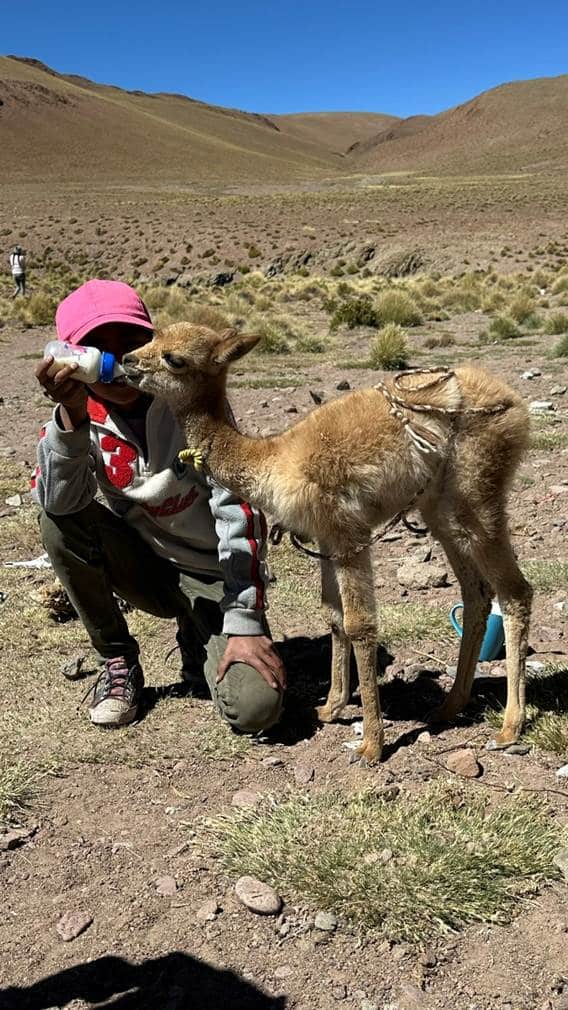
Girl feeding a wild vicuña in Quetena Chico.
Science and local knowledge on the ground
The bofedales (high-altitude wetlands in the Altiplano) play a key role in Andean ecosystems: they function as natural water reservoirs, regulate the water cycle, and sustain biodiversity adapted to extreme conditions. For Altiplano families, they are also the basis of production, since they provide the fodder needed to raise camelids, the main source of food and income in these regions.
The project adopts the “living laboratories” approach, which combines scientific knowledge with local knowledge and farmers’ experience. In these spaces, practices are tested under real conditions, generating learning that can be used in other territories.
“By working in real contexts, learning has a high potential for replication,” Velasco said. Technological innovation,applied research, and collective action are combined to tackle concrete problems.”
At the same time, the project is moving forward with technical studies on carbon in wetlands, water availability, biodiversity, and pasture productivity.

Community members collecting grass to calculate camelid food consumption. Collpani Community, Potosí, Bolivia.
Practices and results
In the border community of Río Chilenas, families are applying new practices to restore these ecosystems.
“If the project hadn’t arrived, nothing would have changed,” says Idonia Gutiérrez, a member of the Río Chilenas community. “We learned to transplant plants to restore the wetlands, plant new pasture, and care for the health of our llamas. Some seeds have already grown, and that encourages us to continue.”
In the south, in Quetena Chico, in the municipality of San Pablo de Lípez, the climatic conditions continue to be challenging, but also drive adaptation processes.
“I didn’t know about the use of the A-frame water level,” said Delia Berna, a member of the Quetena Chico community. “Now I know how to use it to capture water and improve our wetlands. If we can produce more food, we’ll be able to take better care of our llamas,” she said.
These experiences reflect the objective of the project: to reduce climate vulnerability through sustainable practices, capacity building, and better resource management.
To that end, the work is divided into five areas: the characterization of BCG systems, the validation of innovative practices, local capacity building, the improvement of institutional frameworks, and close coordination between different levels of government.
A key element of the work in these five areas is the promotion of the participation of women, men, and young people in decision-making and knowledge management processes.
What is happening in these territories is not an isolated activity, but rather the construction of an approach designed to position wetland-camelid-people systems as the basis of water security and productive sustainability in Bolivia.
In a landscape where every drop of water counts, recovering a wetland does not only mean restoring an ecosystem: it means sustaining life.
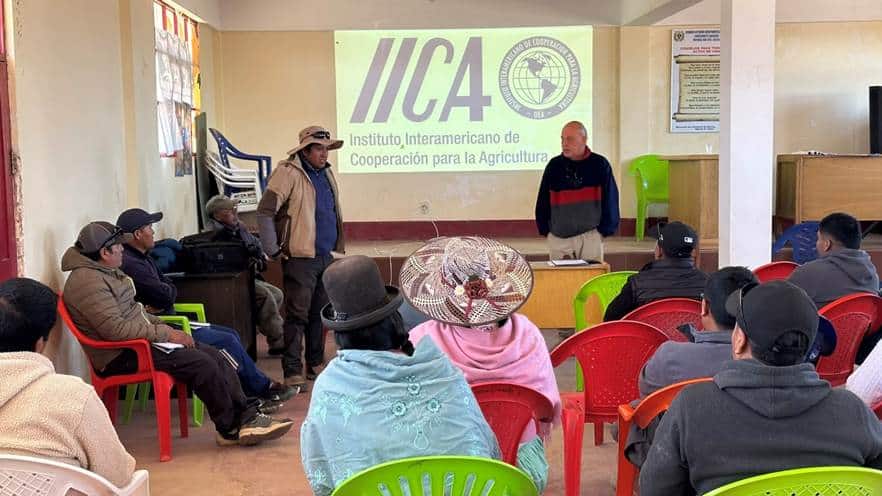
Theoretical workshop on the calculation of food consumption and the production schedule. Soniquera Community, Potosí, Bolivia.
More information:
Institutional Communication Division.
comunicacion.institucional@iica.int