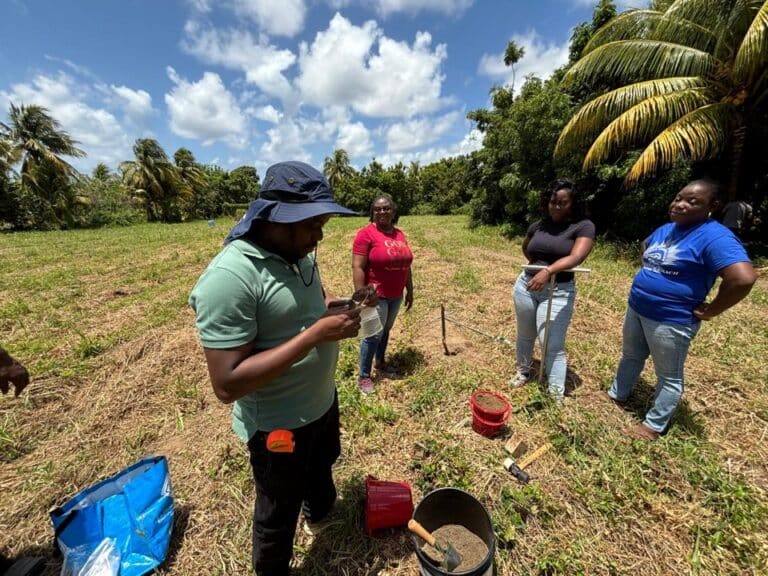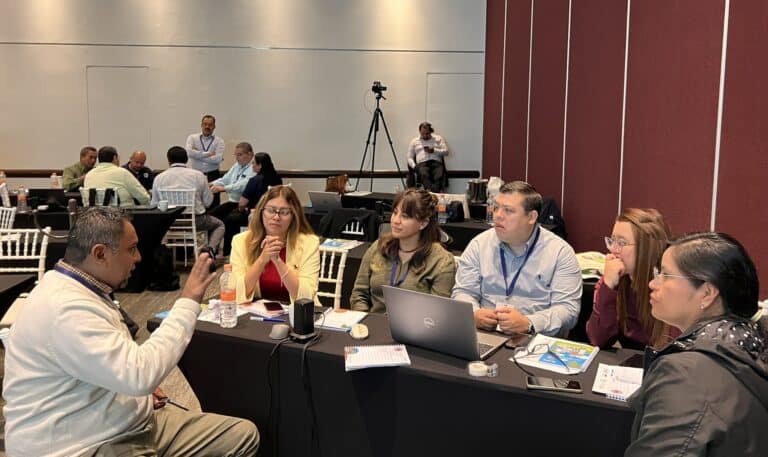
The participants in the different discussion panels held in the run-up to COP29 emphasized the importance of the bioeconomy as a strategy for strengthening agrifood systems, reversing biodiversity loss, addressing health challenges, and using innovation as a driver of new economic opportunities, especially the creation of jobs for young people.
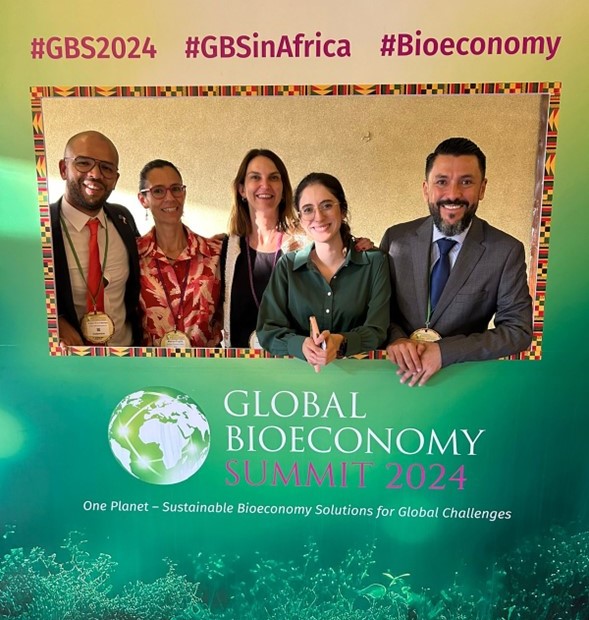
Nairobi, 7 November 2024 (IICA). Speeding up the development of the bioeconomy is an urgent necessity as a strategy for meeting the economic, social and environmental needs of humanity, while at the same time promoting natural ecosystems and biodiversity. This point was emphasized by experts, policymakers, scientists, business sector representatives, and other key actors who took part in the most important global meeting on the bioeconomy, in which the Inter-American Institute for Cooperation on Agriculture (IICA) played a leading role.
Held every two years, the Global Bioeconomy Summit is an international forum whose purpose is to foster the exchange of knowledge and experiences, and promote best practices for the development of a global sustainable bioeconomy. The theme of this year’s event, which for the first time took place outside Europe, in the Kenyan capital, Nairobi, was “One Planet – Sustainable Bioeconomy Solutions for Global Challenges.”
The participants in the different discussion panels held in the run-up to COP29 emphasized the importance of the bioeconomy as a strategy for strengthening agrifood systems, reversing biodiversity loss, tackling health challenges, and using innovation as a driver of new economic opportunities, especially the creation of jobs for young people.
More than 500 people attended the meeting in Nairobi, with a further 3000 participating virtually. The event was organized by the International Advisory Council on Global Bioeconomy (IACGB), the most influential body for the design of strategies and policies that countries have been implementing in this area.
On behalf of the Latin American Bioeconomy Network, a grouping of more than 60 institutions in ten countries, IICA supported the organization of the event and co-organized a main plenary session and three workshops. The Latin American Network is a space for the main leaders of the region’s bioeconomy to discuss, share and develop ideas together; IICA serves as its executive and technical secretariat.
During the event, the participants highlighted the fact that a sustainable bioeconomy is key to decarbonization and the transition towards green rural and urban economies that are less dependent on fossil fuels. Given the imperative need to join forces and create synergies, the decision was taken to create a global alliance of the main actors in the global bioeconomy, including IICA.
Realizing the potential
Renowned German scientist Joachim von Braun, who was appointed an IICA Goodwill Ambassador for his global work in favor of more sustainable and inclusive agrifood systems and in building bridges between Latin America and the rest of the world, made the following observation: “We must act with a renewed sense of urgency, recognizing that the bioeconomy can be the solution to the enormous global dilemma we face. The bioeconomy has enormous potential, but, as Nobel Peace Prize laureate Norman Borlaug, the creator of the Green Revolution, famously said, ‘You can’t eat potential.’ To transform that potential into reality, we need science and innovation, with an advisory platform that connects the bioeconomy with concrete actions.”
Young people also played a leading role in the Summit, and called for greater political will and collaborative work to speed up the development of the bioeconomy.
Ecuadorian Ana Del Hierro Calvachi, an IACGB Youth Champion, told the meeting: “As young people, we understand the challenges that lie ahead and feel the pressure because we often hear that youth are the future. But we are also the present. We need better access to education, training and opportunities to apply the innovations and scientific ideas we are developing. There is a lack of a real connection between industry and academia, and we need government support and infrastructure to turn our science-based solutions into impactful realities.”
During the sessions, participants gave details of the progress that countries and organizations in different continents have made in developing the bioeconomy as a pathway to sustainable development.
Hugo Chavarría, Manager of Innovation and Bioeconomy at IICA and Executive Secretary of the Latin American Bioeconomy Network, said that major progress had undoubtedly been made in recent years: “It is clear that there are very interesting bioeconomy developments in the areas of science, technology, innovation, knowledge, financing and business. This is very encouraging. Learning about and sharing experiences regarding all these efforts and results increases our faith in the bioeconomy as a paradigm for sustainable development.”
The lack of adequate training for farmers, the difficulty of applying available knowledge and the need to develop technologies adapted to local realities were some of the barriers identified in the work sessions. In this regard, the participants highlighted the importance of cooperation between the global South and North, with proposals such as the creation of international funds to support small and medium-sized enterprises, and the opening of markets through triangular collaboration.
In the discussions, participants also explored the bioeconomy’s potential to increase efficiency and sustainability in biomass production and utilization, particularly in tropical regions of Africa, Latin America and parts of Asia. They highlighted how the bioeconomy can transform tropical crop residues, which often represent 50-60 percent of biomass, into valuable bioproducts, promoting circularity and generating new opportunities in rural areas. Although there are isolated cases of companies that transform biomass into energy, bioinputs, textiles and biocosmetics, the failure to use biomass and add value continue to be common problems, as was underlined in a session in which Juan Fernando Martínez, Science, Technology and Innovation specialist with the Innovation and Bioeconomy Program took part and was recognized as an IACGB Bioeconomy Youth Champion.
A detailed analysis was also made of the state of the bioeconomy in different regions.
Chavarría explained that the bioeconomy is a work in progress in Latin America and the Caribbean.
“Costa Rica, Colombia, Uruguay, Ecuador and Brazil have national bioeconomy strategies and are working on their implementation. Other countries, such as Mexico, Argentina and Brazil, have developed strategies for their sectors with the greatest potential (agriculture, science and technology). In addition, at least 18 countries have regulations and rules for bioeconomy pathways such as biotechnology, bioinputs, biofuels and biodiversity,” Chavarría said.
“We have made significant efforts, but the progress we have achieved so far is insufficient. That is why IICA and the Latin American Bioeconomy Network aim to speed up the process and promote collective action,” he concluded.
The IACGB, a global network of which IICA is a member, has prepared a statement with recommendations on how to continue advocating and promoting the bioeconomy as a development model, with aspects related to strategies, policies, science and technology, and investments.
The text, which reflects IICA’s view on the subject, can be consulted at https://gbs2024.org/news/iacgb-communique/
More information:
Institutional Communication Division.
comunicacion.institucional@iica.int