At the meeting, Qu Dongyu, accompanied by FAO Chief Economist Máximo Torero and senior members of his team, and Otero, with his special advisors Jorge Werthein and Carlos Cherniak, reviewed IICA and FAO’s joint cooperation actions, which include the preparation of a report on the outlook for agricultural and rural development in Latin America and the Caribbean, and support for CELAC’s food security plan.
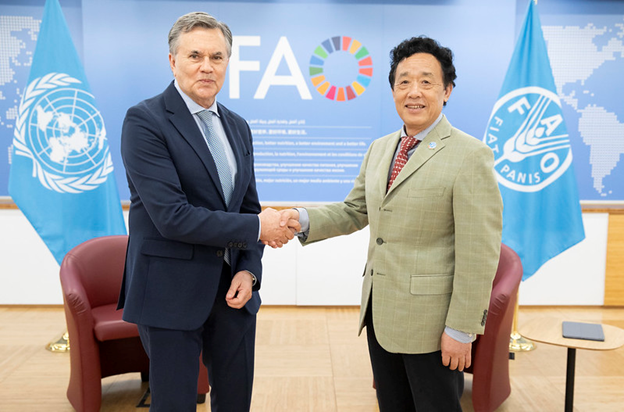
Rome, 9 October 2024 (IICA). The heads of the United Nations Food and Agriculture Organization (FAO) and the Inter-American Institute for Cooperation on Agriculture (IICA) have agreed to step up their joint efforts aimed at strengthening family farming and food security in two of the most vulnerable regions of the Americas: the Caribbean and the Central American Dry Corridor.
Qu Dongyu and Manuel Otero met in Rome, where the IICA Director General is on an official mission and where he will be taking part in a debate on food security as part of the Second Roundtable of African Farmers. The event, which will address access to technologies for regenerative agriculture and efforts to combat food insecurity, will be held at the Pontifical Institute Augustinianum, in Vatican City.
At the meeting, Qu Dongyu, accompanied by FAO Chief Economist Máximo Torero and senior members of his team, and Otero, with his special advisors Jorge Werthein and Carlos Cherniak, reviewed IICA and FAO’s joint cooperation actions, which include the preparation of a report on the outlook for agricultural and rural development in Latin America and the Caribbean, and support for CELAC’s food security plan.
“We can do much more, especially in regions where problems of extreme vulnerability need to be addressed, such as the Central American Dry Corridor and Caribbean countries, which are increasingly exposed to more frequent and more intense extreme weather events,” Otero said after the meeting with Qu. “We talked about reinforcing, stepping up that joint work and that’s what we’re going to do,” he added.
Qu expressed interest in strengthening FAO and IICA’s joint work, set out his vision for dealing with the situation in Haiti and in the Central American Dry Corridor, and underlined his determination to boost the synergies with IICA.
During his working visit to Rome, Otero will not only be taking part in the roundtable organized by the World Farmers’ Organization (WFO), the Global Farmer Network (GFN), the Bayer food company, the African Agricultural Technology Foundation (AATF) and IICA itself, but will also be meeting with Valerie Guarnieri, from the World Food Programme (WFP); Carmen Burbano, from the Executive Secretariat of the School Meals Coalition; and Roberto Colaminé, Deputy Director General of Development Cooperation at Italy’s Ministry of Foreign Affairs and International Cooperation.
More information:
Institutional Communication Division.
comunicacion.institucional@iica.int