Tapachula, Mexico, 8 May 2026 (IICA) – Tropical agriculture has a broad set of proven solutions, accumulated scientific knowledge, and successful experiences across different territories. However, the real challenge involves ensuring that these tools are adopted at scale and adapted to each context and, above all, translated into sustainable, profitable, and inclusive production systems.
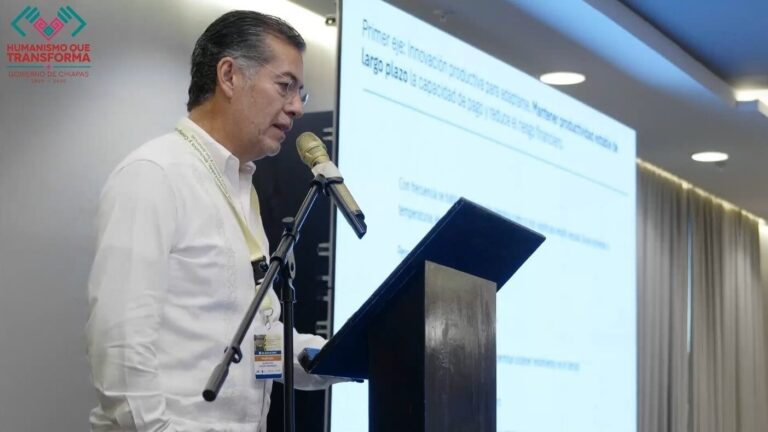
That was one of the conclusions of the recent meeting on tropical agriculture held in Tapachula, where, over the course of three days, specialists, officials, and producers discussed how to transform a sector that is key to food security.
Among the many ideas discussed during the meeting, one conclusion stood out clearly: the problem is no longer the lack of technology, but how to ensure that this technology reaches producers and works in practice.
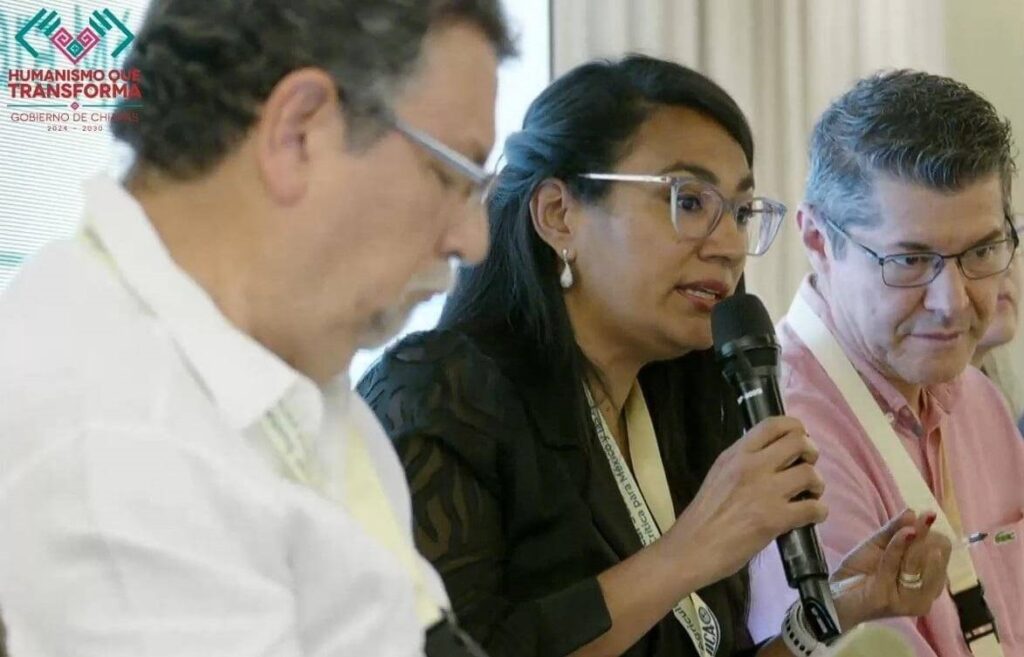
In a panel dedicated to cooperation and innovation, specialists from international organizations, research centers, and public institutions agreed that the gap is no longer in knowledge generation, but in implementation.
“Technologies already exist, they have already been tested, but they are not reaching producers,” warned Karen Montiel, a specialist at the Inter-American Institute for Cooperation on Agriculture (IICA), describing the starting point of the Hemispheric Platform for Tropical Agriculture. As she explained, the objective of this initiative is precisely to “foster inter-institutional collaboration” to scale up solutions, accelerate their adoption, and generate impact in the territories.
The platform, launched in 2025 together with institutions such as the Tropical Agricultural Research and Higher Education Center (CATIE) the Bioversity International-CIAT Alliance, the International Maize and Wheat Improvement Center (CIMMYT), and the Brazilian Agricultural Research Corporation (EMBRAPA), seeks to disrupt a long-standing dynamic: the fragmentation of efforts among organizations that generate knowledge but often work in isolation.
“We should no longer work alone,” Montiel proposed, underscoring the need to align capacities and leverage the comparative advantages of each institution depending on the crop, the territory, or the problem to be addressed.
The challenge, however, is not only about coordinating institutions. It also involves rethinking how interventions are designed and implemented in the territories. In this regard, several specialists agreed that it is not enough to “transfer technology” from research centers to the field.
“The solutions for that territory are not here,” said Jeimar Tapasco of the Bioversity-CIAT Alliance. “There are ideas and experiences here, but there must be a discussion with those who know the local context to determine what works and what doesn’t.”
This perspective introduces a significant shift: moving from a linear innovation model—where knowledge flows in one direction—to a more dynamic one, based on co-creation with producers, local organizations, and public institutions.
Along the same lines, the territorial approach emerged as a key element. From CATIE, for example, it was proposed to prioritize interventions based on watersheds, integrating variables such as water availability, productive systems, and environmental conditions. Thinking about the territory through water systems allows for more comprehensive prioritization, it was noted during the panel.
In addition, the importance of combining technologies—such as silvopastoral systems, soil management, or water harvesting—according to each context was highlighted, rather than promoting isolated solutions.
Another consensus was that technology adoption largely depends on factors that go beyond innovation itself. Rural extension, capacity building, and access to information are necessary conditions for solutions to reach scale.
From CIMMYT, the need to “tropicalize” available technologies was emphasized—that is, to adapt them to the specific conditions of the tropics—and to strengthen training at both the technical and field levels. “Not only at the academic level, but also among extension agents and producers,” it was noted.
At the same time, digitalization is emerging as a key tool to democratize access to knowledge. Data platforms, geographic information systems, and digital tools can facilitate decision-making, provided that the information is accessible and understandable for those working in the territories.
The effort is to bring information together and present it in a digestible way, avoiding a situation in which knowledge remains confined to scientific publications or specialized circles.
Although the panel focused on technical and institutional coordination, interventions from the audience and the specialists themselves raised an unavoidable issue: the sustainability of tropical agriculture also depends on its profitability.
“Agriculture is a business and must generate income to support families,” noted one participant, questioning the lack of emphasis on aspects such as commercialization and market access.
In response, panelists acknowledged that the agenda still has areas to strengthen, particularly with regard to financial innovation and mechanisms that connect sustainable production with concrete market opportunities.
Montiel agreed that this is a key aspect to be developed: “Perhaps within the prioritization of topics, financial innovation and market access have been lacking.” In this regard, she highlighted the need to move toward financing schemes that recognize the value of sustainable practices, including models that remunerate outcomes in biodiversity or ecosystem services.
Rather than offering definitive answers, the panel made it clear that building a pathway for tropical agriculture is an evolving process that requires coordination, learning, and continuous adaptation.
In this context, the Hemispheric Platform appears as an effort to organize that process, generate critical mass, and accelerate transformation. However, its success will ultimately depend on its ability to translate existing knowledge into concrete, viable, and scalable solutions.
The challenge is significant: connecting science, territory, financing, and markets in complex and diverse systems. But it is also, as participants agreed, a unique opportunity to reposition tropical agriculture as a driver of sustainable development in the Americas.
More information:
Institutional Communication Division.
comunicacion.institucional@iica.int