Dr. Maria Andrade of Cape Verde; Dr. Howarth Bouis of the United States; Dr. Jan Low of the United States, and Dr. Robert Mwanga of Uganda were announced as the winners of the World Food Prize. The four individuals are being honored for their work in biofortification that has helped to curb hunger and malnutrition for millions of people.
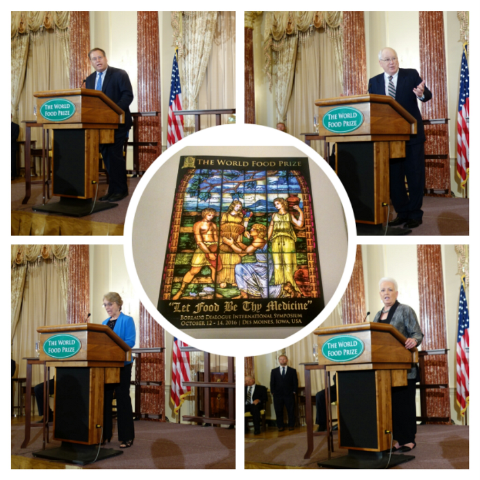
On June 28th, 2016, the 2016 World Food Prize announcement ceremony took place at the U.S. Department of State. This year represents the 30th anniversary of the establishment of the World Food Prize by the late Nobel Peace Prize Laureate Dr. Norman E. Borlaug. Principal Deputy Assistant Secretary of Economic and Business Bureau, Kurt Tong, served as host for the Ceremony and Nancy Stetson, Special Representative for Global Food Security delivered remarks on behalf of Secretary Kerry.
Dr. Maria Andrade of Cape Verde; Dr. Howarth Bouis of the United States; Dr. Jan Low of the United States, and Dr. Robert Mwanga of Uganda were announced as the winners of the World Food Prize for 2016. This was the first time four scientist have been announced as winners of this prize. The four individuals are being honored for their work in biofortification that has helped to curb hunger and malnutrition for millions of people.
During the ceremony, Ambassador Kenneth Quinn, President of the World Food Prize Foundation stated that “thanks to the combined efforts of the four Laureates, over 10 million persons were now positively impacted by biofortified crops, with a potential of several hundred million more in the coming decades.”
Ambassador Quinn shared that the four laureates represent two separate organizations. Three of the laureates from the International Potato Center (CIP) – Dr. Maria Andrade of Cape Verde, Dr. Robert Mwanga of Uganda, and Dr. Jan Low of the United States “are being honored for their achievement in developing the single most successful example of micronutrient and vitamin biofortification – the orange-fleshed sweet potato (OFSP). Dr. Andrade and Dr. Mwanga, plant scientists in Mozambique and Uganda, bred the Vitamin A enriched OFSP, while Dr. Low structured nutrition studies and programs that convinced almost two million households in 10 African countries to plant, purchase and consume this nutritionally fortified food. The fourth laureate, Dr. Howarth Bouis, founder of HarvestPlus at the International Food Policy Research Institute (IFPRI), pioneered the implementation of a multi-institutional approach to biofortification as a global plant breeding strategy. As a result of his leadership, crops such as iron and zinc fortified beans, rice, wheat and pearl millet, and Vitamin A-enriched cassava, maize and OFSP are being tested or released in over 40 countries.”
USAID’s Administrator Gayle Smith ended the ceremony by delivering the keynote remarks. Smith stated that the four laureates announced represented the very best of their field. She said that “We owe them a debt of gratitude for that. Especially because I’m sure it wasn’t an easy road to get here. Operating on shoestring budgets and always fighting for more funding… Keeping at it in the face of rejection and skepticism, trial after trial and error after error… Trying hard to convince others of the possibilities of what they were doing.” She reiterated the importance of science through continued support in research and development. She explained that, “When we invest in research and development, we can unlock force multipliers for our work – and identify solutions not just for today’s problems but for the problems of the future.”
The World Food Prize will be formally presented to the four winners in a ceremony to be held at the Iowa State Capitol in Des Moines, Iowa, on October 13th, 2016 during the 2016 Borlaug Dialogue. Drs. Andrade, Mwanga, Low and Bouis will share the $250,000 prize for improving the health of 10 million rural poor in Africa, Asia, and Latin America through biofortification. The 2016 Borlaug Dialogue will be held from October 12th- 15th, 2016 and the theme this year is: “Let Food Be Thy Medicine”.
More information: http://www.worldfoodprize.org
Read more about the winners
*This post appears in the IICA Delegation in the USA Newsletter – May- June 2016