Producers are by definition true innovators as demonstrated by the story of the Ramsaroop family in the Caribbean island of Trinidad.
By Dr. Priscila Henríquez, Specialist in the Management of Technological Innovation, IICA, priscila.henriquez@iica.int
The generation of innovations has traditionally been attributed to research organizations while the farmer’s own potential for the development of innovative solutions has largely been neglected. However, producers are by definition true innovators as demonstrated by the story of the Ramsaroop family in the Caribbean island of Trinidad.
Chemraj Ramsaroop and his wife Sita have achieved exceptional crop yields and improved their connections to markets, despite lacking formal education and without any external technical support. They have demonstrated their inventiveness and capacity for hard work facing their limitations in a creative way.
This couple farms a 6-hectare plot in the locality of Freeport, about 30 miles south of Port of Spain, the country’s capital. The Ramsaroop’s own a quarter hectare while the rest of the land is rented from the government. This makes agriculture a risky business because they need to ensure a good harvest to sell to be able to continuously afford their land.
The physical characteristics of their plot also pose severe limitations to crop production. Decades of intensive sugarcane cultivation without crop rotation and with substantial use of chemical fertilizers have exhausted the land. Also, the acidic soils made up of heavy and compact clays get flooded during the rainy season and become dry and cracked during the dry season.
Despite these limitations, the Ramsaroop’s farm is highly diversified. Besides several vegetable crops they also grow cassava, one of the main staple foods in the country and thus with a guaranteed market. Cassava demands a high quantity of manual labor, especially during planting and harvesting times. However, there is limited availability of labor in the rural areas of Trinidad and, when available, it is much too expensive to afford. In light of their circumstances, the Ramsaroop’s needed to invest in agricultural machinery to work the heavy soils.
Agriculture and farming equipment in general is unaffordable and frequently unsuitable for most smallholder farmers in the Caribbean. Mechanized systems for cassava have been developed in Brazil and Thailand, but these are hard to come by in Trinidad. Mechanical planter prototypes have been developed in Colombia by the research consortium CLAYUCA with promising results. However, their use is recommended for farms larger than 30 hectares to recover the costs of investing in the equipment.
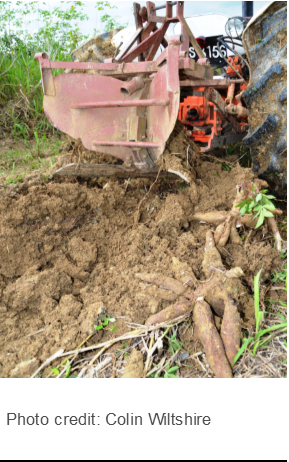
The Ramsaroop’s overcame the difficulties with their outstanding creativity, management skills, and hard work. Despite his limited formal education, Mr. Ramsaroop has become an expert in agriculture machinery having designed, adapted and modified the farm equipment to suit the conditions of his land. From recycled materials, he has developed a plough, a blower, a planter, a harvester, and a cane mill. His new cassava reaper is an original design. He is in the process of development an innovative tool that will facilitate planting cassava along with seed crops, while simultaneously applying the fertilizers. He indicates that his farming equipment is easy to maintain and repair, and above all, affordable.
Meanwhile, Mrs. Ramsaroop is also an innovator in the management of their family business, being in charge of the administrative and financial operations without any assistance. She organizes the vegetable production and sales that generate the important weekly income for the family needs. Earnings from monthly vegetable sales is used to supplement the annual income from selling cassava to the Trinidad and Tobago Agribusinesses Association (TTABA), where the tubers are processed.
On its own initiative, the Ramsaroop’s developed a technology package that sets them apart from other farmers. They are truly innovators when it comes to the use of agricultural machinery, an area that has very little support from the research and extension systems. The Ramsaroop operations generate US$2.14 for each dollar they invest, a good rate of return for small farmers producing under the conditions described.
The Ramsaroop’s acknowledge that their success is due to a combination of factors, including strong work ethics, good administrative skills, and team problem solving, as well as enthusiasm for their work. Success cases like the Ramsaroop’s demonstrate that inventiveness generates profitable business that provide income and contribute to food security.
Around the world, farmers are creating innovative, on-the-ground solutions for the problems they face each day: land degradation, resource depletion, crop loss, water scarcity, and weather volatility. Many of these ground-breaking ideas, such as the one featured, have great potential to be replicated and scaled out across the Caribbean region.
This story was adapted from the original published by FONTAGRO-IICA-BID in http://www.iica.int/sites/default/files/publications/files/2015/B3256i.pdf
For more information on successful stories of innovations in family farming in Latin America contact priscila.henriquez@iica.int
*The opinion expressed in this newsletter are those of the author and they do not reflect the position of the Institute on the topics presented.
*This post appears in the IICA Delegation in the USA Newsletter – July – August 2016