Inter-American Institute for Cooperation on Agriculture

Agriculture

IICA and FAO lead the Donors and Cooperation Agencies in the Dominican Republic

Tiempo de lectura: 3 mins.

In an effort to continue the planning and coordination of the technical cooperation activities of the different donors and cooperation agencies in the agricultural sector of the Dominican Republic, IICA and FAO have retaken the working meetings among the different agencies.

In the most recent meeting of this group, representatives of FAO, Spanish Agency for International Cooperation for Development (AECIED), United States Department of Agriculture (USDA) and the European Union Delegation (DUE) in the country discussed the operation and initial strategy of the group.

In an effort to continue the planning and coordination of the technical cooperation activities of the different donors and cooperation agencies in the agricultural sector of the Dominican Republic, IICA and FAO have retaken the working meetings among the different agencies.

In the most recent meeting of this group, representatives of FAO, Spanish Agency for International Cooperation for Development (AECIED), United States Department of Agriculture (USDA) and the European Union Delegation (DUE) in the country discussed the operation and initial strategy of the group.

During the meeting, topics like Family Agriculture, Food Security, Risk and Vulnerability Assessment and the Census of Agriculture of the Dominican Republic were shared.  Likewise, the most convenient way to insert the intervention and activities of the different donors and cooperation agencies within the Dominican Government agenda.

It was also the decision by consensus of the whole group that IICA and FAO are the international organizations that will lead the process and development of the Group of Donors and Agricultural Cooperation Agencies.
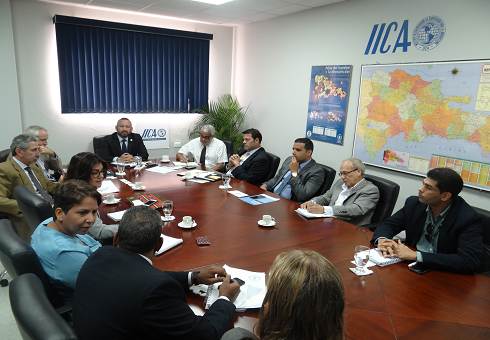
Donors and Cooperation Agencies meeting. It was facilitated and hosted by the IICA Delegation in the Dominican Republic with the participation of representatives of FAO, Spanish Agency for International Cooperation and Development (AECID), European Union Delegation (DUE) and the United States  Department of Agriculture (USDA).


Share

Related news​

Grupo de participantes del proyecto regional PIVOT reunidos en la sede del IICA, en una iniciativa que promueve la prevención y preparación frente a riesgos sanitarios con potencial epidémico y pandémico en América Latina y el Caribe, mediante el enfoque Una Salud, que integra la salud humana, animal y ambiental.

San José, Costa Rica

May 12, 2026

IICA and international partners activate the PIVOT project to strengthen preparedness for avian influenza and other diseases of animal origin in the region

The Inter-American Institute for Cooperation on Agriculture (IICA) is forging ahead with the planning of the regional project Prevention of Infections through Surveillance at the Source of Transmission in Latin America and the Caribbean (PIVOT), aimed at strengthening the prevention of health risks with epidemic and pandemic potential in Latin America and the Caribbean, adopting the One Health approach that integrates human, animal and environmental health.

Tiempo de lectura: 3mins

Valparaíso, Chile

May 12, 2026

From erosion to harvest: an experience in soil recovery and productive diversification in Chile’s coastal drylands

IICA is working together with the Cuncumén Peasant Agricultural Cooperative on a 17.3-hectare farm, with funding from the Foundation for Agricultural Innovation (FIA), in a project called “Silvoagricultural Diversification as a Productive Methodology and Strategy and Optimization of On-Farm Irrigation in the Dryland Conversion Area of Cuncumén, San Antonio Province”.

Tiempo de lectura: 3mins

Tapachula, México

May 8, 2026

Without smart financing, there is no transformation: the other side of tropical agriculture

Behind many of the current debates on tropical agriculture —regarding productivity, sustainability, innovation— there is a variable that is becoming increasingly important, although it does not always feature prominently in the discussions: financing. Factors such as the way in which it is allocated, and the incentives and conditions involved, are becoming crucial.

Tiempo de lectura: 3mins