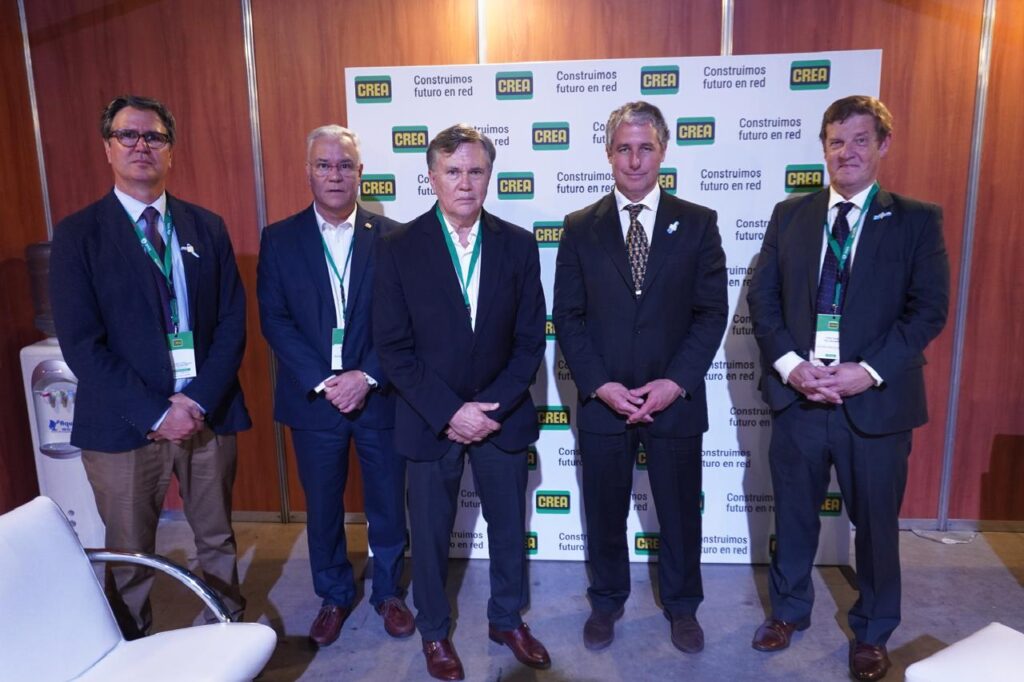
Sebastián Sabatini, Secretary of CREA; Fernando Camargo, IICA Representative in Argentina; Manuel Otero, IICA Director General; Fernando de Nevares, CREA President; and Christian Feldkamp, CREA Executive Director.
Buenos Aires, 19 September 2025 (IICA) – Agriculture is essential for global peace and plays a crucial role in stability at a time when the rules that have governed the international order in recent decades are undergoing a profound transformation, said Manuel Otero, Director General of the Inter-American Institute for Cooperation on Agriculture (IICA), at one of Argentina’s most important agricultural events.
Otero was one of the guest speakers at the CREA 2025 Congress, which brought together around 8,000 farmers, technical experts, entrepreneurs, researchers, students and young people from across the country over two days in the Argentine capital.
The event took place under the theme “Experience Transformative Energy” and the agenda included conferences on productivity, efficiency, technology and sustainability, as well as debates on the role of youth in the future of agriculture.
CREA is an Argentine non-profit association led by farmers, founded in 1960, that promotes collective action based on four key pillars: experimentation, training, knowledge transfer and community integration.
In Buenos Aires, Otero also took part in the opening of the International Congress of CONINAGRO, an organization with nearly 70 years of history that brings together Argentina’s cooperative sector, a key driver of national agricultural development. On that occasion, he shared the stage with the entity’s President, Lucas Magnano, and Argentina’s Chief of the Cabinet of Ministers, Guillermo Francos.
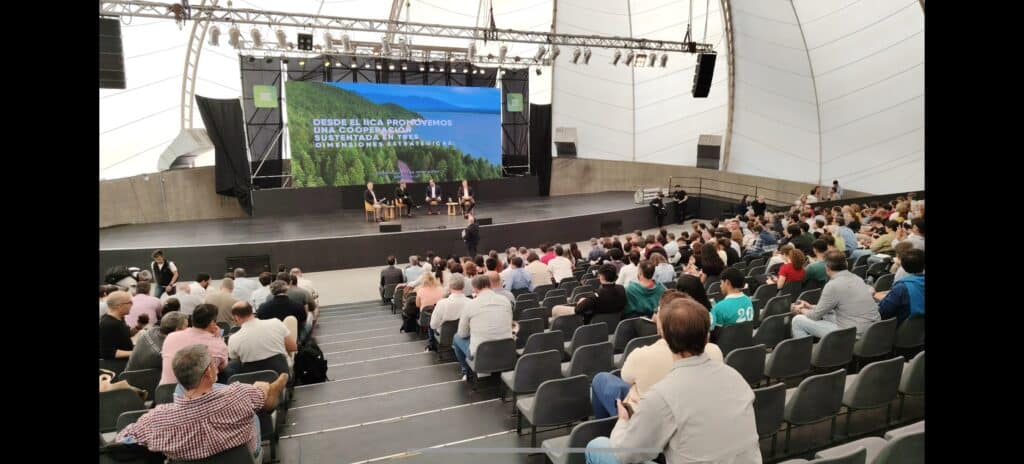
The CREA 2025 Congress brought together around 8,000 farmers, technical experts, entrepreneurs, researchers, students and young participants from across the country over two days in the Argentine capital.
Working together
The IICA Director General toured various work and exhibition areas of the CREA 2025 Congress alongside the President of the farmers’ movement, Fernando de Nevares, and its Executive Director, Christian Feldkamp.
The three also inaugurated the photo exhibition “Leaders of Rurality, guarantors of food security and guardians of the planet’s biodiversity,” which has been displayed in several countries and was presented this time in Buenos Aires.
The exhibition features images of rural women and men recognized by IICA for their efforts in advancing agricultural productivity and the well-being of their communities.
Otero also spoke at one of the congress’s most prominent panels, which addressed geopolitics and the positioning of Latin American agriculture in the world.
He was joined by Federico Merke, researcher and professor of International Relations at the University of San Andrés, and Fernando Porcel, Commercial Director of Apache, an Argentine agricultural machinery company with extensive experience in exports and technology transfer to the African continent. The moderator was Rodrigo Bosch, one of CREA’s regional coordinators.
The speakers agreed that the world is experiencing political and economic transformations that are occurring simultaneously with a technological revolution and the energy transition, creating enormous uncertainty and instability.
“We are living in a moment that I would describe as a polycrisis, which is the cross-impact of all these transformations, interwoven and producing non-linear effects. There is geopolitical and market fragmentation in a world that is changing profoundly. We are facing a more uncertain world, but one that will also create windows of opportunity,” said Professor Merke.
Otero recalled that IICA was founded in 1942, when the Second World War caused a major global food supply crisis, and since then has undergone multiple transformations.
“We are a hemispheric technical cooperation body. And cooperation is both the action and the result of working together. IICA is a continental space for innovation and collective action, because we are convinced that no country or sector can succeed alone,” he said.
The IICA Director General emphasized the integrative role of agriculture and its importance as an essential tool for peace, as the foundation of food security and the economic and social development of nations, a role that continues unabated under all circumstances.
“IICA supports Latin American integration mechanisms. We promote agricultural cooperation in Mercosur and integration in Central America and the Andean region, which is crucial in times of fragmented markets,” Otero stated.
“Agriculture,” he concluded, “is now at the top of the global agenda and a key player in the region’s development. IICA has transformed itself to fully play its role as a bridge-builder between countries, and between them and the private sector and the world of science and research. We are working to help build a new narrative that tells the world the reality of our agriculture. We also encourage countries to develop new public policies and to foster a new generation of leaders to spearhead a transformation of agriculture that is both necessary and irreversible.”
More information:
Institutional Communication Division.
comunicacion.institucional@iica.int