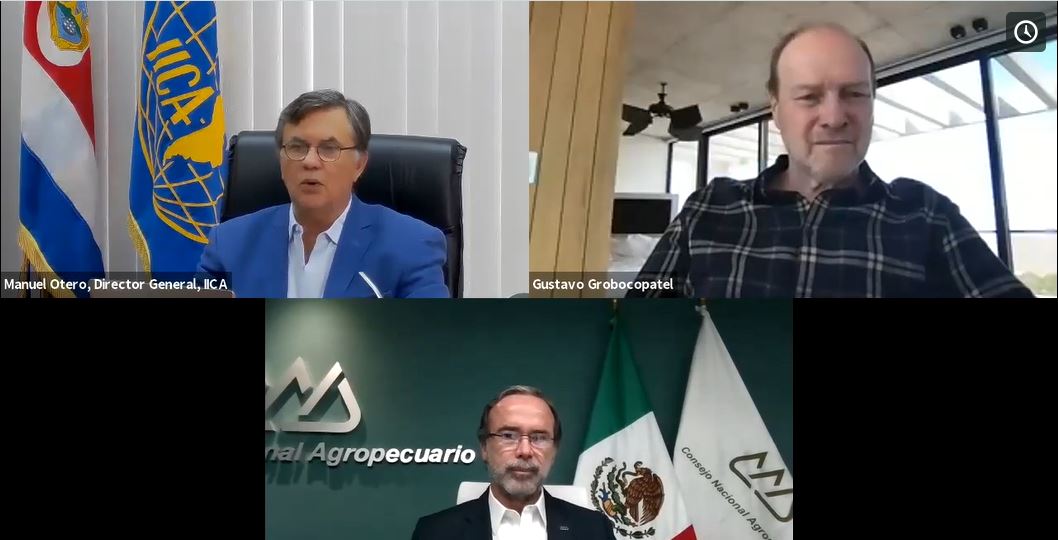
This was stated by businessmen Gustavo Grobocopatel, of Argentina, and Bosco de la Vega, of Mexico, during a call for strengthening multilateralism in the face of the enormous challenges caused by Covid-19.
San Jose, 2 October 2020 (IICA). Notable players in the private agrifood sector are agreed that the Latin American and Caribbean region needs greater collaboration between industry and government in order to deal with the challenges brought about by the health crisis.
Businessmen Gustavo Grobocopatel, president of the Argentine Grupo Los Grobo, and Bosco de la Vega, president of the National Agricultural Council of Mexico, in a meeting organized by the Inter-American Institute for Cooperation on Agriculture (IICA), expressed the need for a new, closer relationship between the public and private sectors to deal with the enormous challenges that Covid-19 has heaped on the food, trade, health employment and education sectors.
“We have to organize ourselves differently. The private sector is the one that is able to bring a level of innovation, transformation, creativity, that capacity to adapt itself to changes, which the State often does not have”, stated Grobocopatel during a discussion moderated by the Director General of IICA, Manual Otero.
The experts agreed that agriculture has become the bastion for economic recovery, but that it requires a renewed structure and generational continuity; for this reason, companies, international organizations and the States themselves have a lot of ground to cover.
The Mexican businessman indicated that “international organizations, based on the experience they have with the countries, have demonstrated that one of the characteristics of the most successful countries in terms of international integration, has been the manner in which the public and private sectors support each other in the search for new opportunities for growth”.
Therefore, “the public-private partnerships for agribusiness development, which must be strengthened in keeping with the recommendations of the international organizations such as IICA, constitute an important institutional mechanism to access additional resources, by sharing risks and confronting difficulties, all in favor of sustainable development” added De la Vega.
The businessmen agreed that only through multilateralism and cooperation between different sectors will it be possible to achieve progress in finding cross-border solutions to problems whose scope exceed the capacity for action by countries and local actors.
According to Manual Otero, “supranational public goods will progressively become more important because the topics, well, they affect us all, and it is under this premise that we must continue to work’’.
The discussion highlighted the efforts made in the construction of opportunities for work, business and well-being for the youth, which is one of the groups most affected in terms of employment during the pandemic.
The panelists agreed that the region requires more diversity in its portfolio of agricultural products, by shifting towards those that provide a higher yield, and incorporating a large amount of technological innovation because that is where the commercial niche exists for the new generations.
“The young and small farmers can be the great businessmen of tomorrow with high-value crops, and I believe that this is how the Americas will be able to conquer the world, and we can generate well-being in our region” stated De la Vega.
“By combining productivity, competitiveness and diversification of markets, innovation technology, environmental and social responsibility, we will have a better world” he added.
The participants agreed that technology will be a key player in guaranteeing sustainable development, food security and a stronger, more solid community of farmers.
“There is a coming-together of technology that is going to change the manner in which we do agriculture throughout the world, on the one hand; on the other hand, there will be a series of changes in the way we organize ourselves”, said Grobocopatel.
According to the Argentine businessman, during the post pandemic period, there has been a new and strengthened wave of associativity and inter-connectivity between the players to deal with common challenges and to participate more effectively in international markets, something in which the international organizations play a key, bridging role, by transferring visions, knowledge and the desires of people, sectors of interest and countries.
“If we could have more connectivity with the farmers, and a more dynamic flow of linkages, I am confident that there would be many more opportunities to create value together. Very often we businesspeople are very focused on on our own operating problems and we need institutions such as IICA that give us this opportunities, these spaces to build bridges”, stated the president of Los Globo.
Both panelists recognized the role that institutions such as IICA play in the search for solutions that deal with the challenges that extend beyond borders.
In the words of the Director General of IICA, “I am sure that the hemisphere will move quickly towards maturity, towards the essential responsibility that we have of being the custodians of nutritional food security, with very important inputs in the area of the environment for the entire planet”.
You can watch this and our upcoming seminars on the IICA Facebook and YouTube pages.
For more information:
Institutional Communication Division
comunicacion.institucional@iica.int