Countries aim to play a more active part in the approval of international standards on agricultural health and food safety.

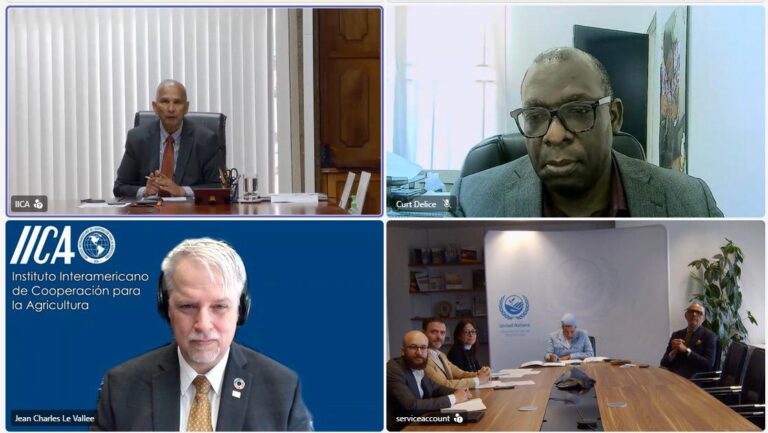
San Jose, Costa Rica, March 17, 2014 (IICA). With the support of the United States Department of Agriculture (USDA) and the Inter-American Institute for Cooperation on Agriculture (IICA), delegates from 14 Latin American and Caribbean countries reached agreement on joint regional positions for the next meetings of the Codex Alimentarius committees on general principles, pesticide residues and contaminants in food.
During a three-day meeting held at IICA’s Headquarters, in Costa Rica, the countries that make up the Codex Coordinating Committee for Latin America and the Caribbean (CCLAC) determined strategies and identified subjects of mutual interest in order to exert greater influence over the approval of international food standards
The Codex Alimentarius Commission (Codex’s highest-level decision-making body) will meet in Geneva, Switzerland in July, 2014 to approve, revoke or modify food standards. Before that, the committees will meet to reach agreements that will then be submitted to the Commission for approval.
The regional positions agreed upon by the CCLAC will be taken to the committee meetings, to serve as input for the negotiations.
The meeting in Geneva will take place at the headquarters of the World Health Organization.
The issues discussed in Costa Rica included the talks on maximum residue levels (MRLs) for pesticides and the levels of contaminants in products such as rice, grains, fish and maize, among others.
MRLs are the upper legal levels of a concentration for pesticide residues in or on food or feed (expressed in mg/kg). Official standards are required because the consumption of food containing pesticide residues could pose a threat to health.
“Having transparent international standards and complying with technical regulations is very important for the competitiveness of the countries in the region. Codex makes it possible to harmonize science-based and technically justified standards, in order for them to be included in legislation,” observed Costa Rica’s Deputy Minister for Economic Affairs, Industry and Trade, Marvin Rodríguez.
The manager of the USDA/FSIS Codex Alimentarius Program, Mary Frances Lowe, remarked that meetings like the one in San Jose demonstrated the value of working together, as they afforded an opportunity to discuss important scientific elements and to plan strategies.
The Manager of IICA’s Agricultural Health and Food Safety Program, Robert Ahern, seconded her comments. “It is a useful opportunity to strengthen the CCLAC and shape the future of the agrifood sector in Latin America and the Caribbean working as a team,” he commented.
The international food standards approved by the Codex Alimentarius are practices and directives that contribute to food safety and quality, and equity in international trade. That gives consumers, governments and commercial interests more confidence, said Erick Bolaños, an IICA specialist in agricultural health and food safety.
The recommendations are not binding but are normally used as the basis for national legislation.
The CCLAC meeting brought together around 50 representatives of Argentina, Chile, Brazil, Canada, Colombia, Costa Rica, Dominican Republic, Honduras, Jamaica, Mexico, Nicaragua, Paraguay, Peru and the US. IICA and USDA technical personnel were on hand to facilitate the discussions.
Other participants included IICA’s Deputy Director General, Lloyd Day, Codex Alimentarius Commission Vice-Chairperson Samuel Godefroy (Canada) and representatives of the US Food and Drug Administration (FDA).
For further information:
robert.ahern@iica.int
erick.bolanos@iica.int