IICA has already launched a hemispheric initiative called Mission ADA (Digital Agriculture in Action) to contribute to the digital transformation of agrifood systems. The initiative focuses on four areas of work, all of which are aimed at cooperating with the countries to foster the dynamic and inclusive digital transformation of agriculture.
Santo Domingo, 29 April 2022 (IICA) – The growing availability of digital solutions facilitates the positive transformation of agriculture through substantial improvements in the productivity, sustainability and resilience of producers. It also allows for building more efficient and accessible markets, producing safe and traceable food and generating better living and working conditions within the framework of appropriate and inclusive public policies.
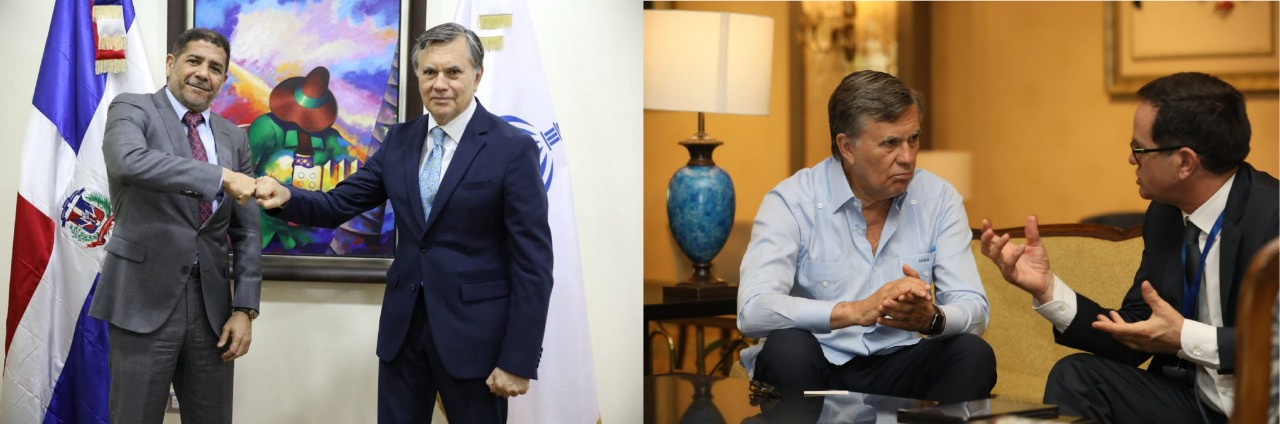
This was one of the ideas shared by the Director General of the Inter-American Institute for Cooperation on Agriculture (IICA), Manuel Otero, during a presentation on the “Digital Transformation of Agrifood Systems”, delivered at a meeting of Ministers of Agriculture of Ibero-American countries, held in the Dominican Republic.
During his visit to that country, and within the framework of the Ibero-American meeting, the Director General of IICA met with the Dominican Minister of Agriculture, Limber Cruz; the Portuguese Secretary of State for Agriculture and Rural Development, Rui Manuel Costa Martinho; the Ibero-American Secretary General, Andrés Allamand; former President of the Dominican Republic and IICA Goodwill Ambassador Hipólito Mejía; and the Mayor of Santo Domingo, Carolina Mejía, among other authorities.
“The availability of digital solutions is key to achieving smarter agriculture. The combination of connectivity, information technology, basic technologies, sensors, platforms, algorithms, autonomous vehicles, and others, allows for smarter monitoring and prediction, smarter planning and decisions, and smarter operation and control”, remarked Otero, emphasizing the importance – especially for the most disadvantaged producers – of having access to tools that increase efficiency and reduce information asymmetries and transactional costs.
He offered IICA’s cooperation to government authorities, while urging them to address what he described as “the pending agenda” for accelerating the digital transformation of agriculture. In this regard, he highlighted the need to adequately connect rural territories (77 million rural dwellers lack significant connectivity in Latin America and the Caribbean), build digital skills (less than 17.1% of the rural population has specific digital skills), and implement plans to foster digitization.
IICA has already launched a hemispheric initiative called Mission ADA (Digital Agriculture in Action) to contribute to the digital transformation of agrifood systems. The initiative focuses on four areas of work, all of which are aimed at cooperating with the countries to foster the dynamic and inclusive digital transformation of agriculture.
One such example, which relates to skills training and the creation of training bodies, is the upcoming Digital Agriculture Week, organized by IICA with support from the Inter-American Development Bank (IDB), the World Bank, Microsoft and Bayer. The event, which will be held in Costa Rica, will foster dialogue among stakeholders involved in agricultural digitization in the Americas – AgTechs, multilateral organizations, corporations and policymakers – with the aim of coordinating concrete actions to drive the digital transformation process.
More information:
Institutional Communication Division
comunicacion.institucional@iica.int