This joint work will also aim to promote the development of national regulations and public policies, as well as to establish channels for dialogue to build regional consensus on the issue.
San Jose, 2 November 2023 (IICA) – The Latin American and Caribbean Air Transport Association (ALTA) and the Inter-American Institute for Cooperation on Agriculture (IICA) will work together to promote sustainable aviation fuels through actions such as strengthening the sector’s value chain and the links between the agriculture sector and commercial aviation in the region.
This joint work will also aim to promote the development of national regulations and public policies, as well as to establish channels for dialogue to build regional consensus on the issue.
These objectives are set out in a joint declaration signed by IICA and ALTA on Sustainable Aviation Fuels (SAF), a major commitment made by the commercial aeronautical sector to achieve net zero CO2 emissions by 2050. This type of technology is expected to represent 65% of greenhouse gas emission reductions, given that biological and agricultural raw materials are the most widely utilized inputs to produce SAF.
Due to the importance of having sustainable, abundant and affordable raw materials available for the production of sustainable aviation biofuels, the aviation sector will build increasingly strong ties with agriculture, especially in the region of Latin America and the Caribbean, where agriculture produces the three major types of raw materials that can be used to produce SAF:
-Oils and fats
-Sugars and starches
-Lignocellulosic raw material
“The link between these sectors to produce sustainable aviation biofuels will not only decarbonize air transport, but will also enable the development of associated value chains, generate sustainable jobs, and add value to agricultural production”, said Agustín Torroba, international specialist in biofuels and renewable energies at IICA.
“The agriculture sector of the Americas currently has sufficient vegetable oils, animal fats, sugars and starches, alcohols and lignocellulosic raw materials, which are the main types of raw materials usable in the production of biojet. This puts the hemisphere in an ideal position to facilitate energy diversification by producing sustainable aviation fuels, thus supplying this new market”, Torroba said.
In the joint statement, the Executive Director and CEO of ALTA, José Ricardo Botelho, and the Director General of IICA, Manuel Otero, highlighted the importance of:
1. Encouraging the Ministers of Agriculture of the Americas to work in the primary stage of the SAF value chain.
2. Underscoring the importance of linking the agriculture sector with commercial aviation in the region for the development of the aforementioned biofuels.
3. Fostering the development of national regulations and public policies, as well as promoting channels for dialogue to build regional consensus on the issue.
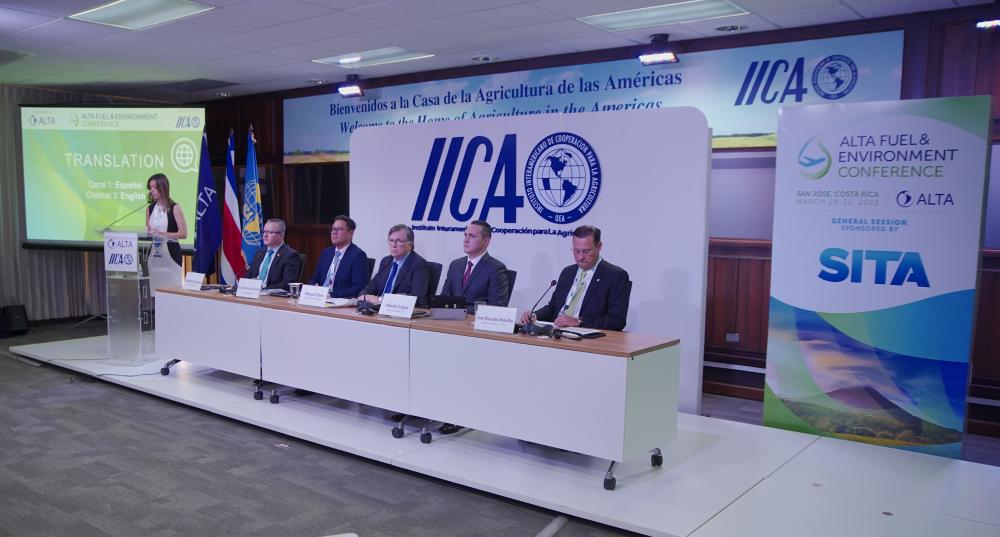
This statement was presented in the context of the efforts made by both institutions, which co-organized the ALTA Fuel and Environment Conference last March, where experts discussed issues related to local legal frameworks for the production, import and marketing of sustainable aviation fuels, sustainable airports and carbon offset mechanisms for airline passengers, and updates on aviation fuel markets, infrastructure, fares and taxes.
More information:
Institutional Communication Division.
comunicacion.institucional@iica.int