The 27th Annual Conference of the International Consortium on Applied Bioeconomy Research will attract eminent academics and the top technical experts and thought leaders on bioeconomy policy.
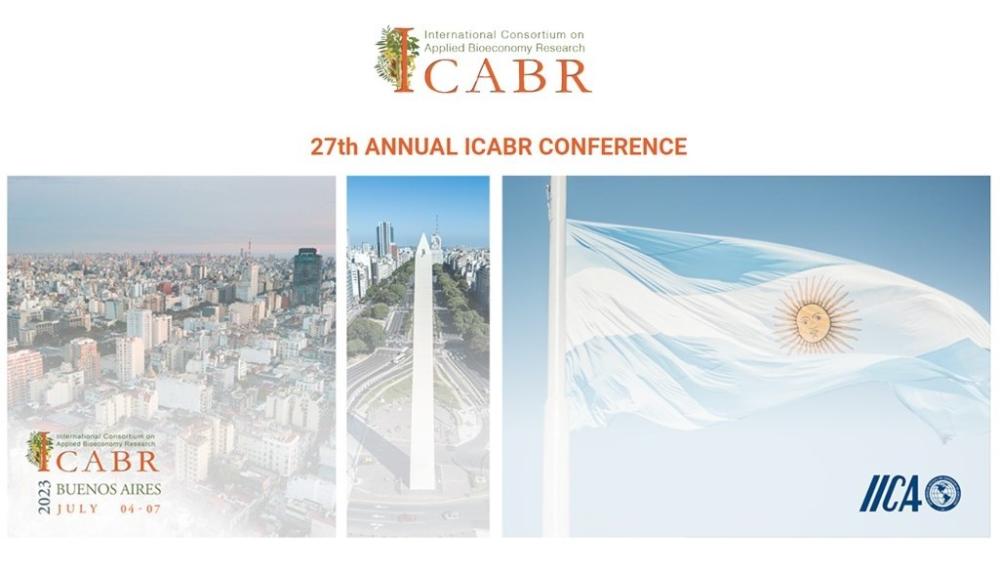
Buenos Aires, 30 June 2023 (IICA) – Some of the world’s most prestigious bioeconomy researchers and scientists will gather in Buenos Aires from 4 to 7 July, at the 27th Annual Conference of the International Consortium on Applied Bioeconomy Research (ICABR), a meeting co-organized by Argentina’s Secretariat of Agriculture, Livestock and Fisheries (SAGyP) and its Ministry of Science, Technology and Innovation (MinCyT), in collaboration with the Inter-American Institute for Cooperation on Agriculture (IICA).
For four days, the Conference will convert the Argentine capital into the world’s bioeconomy epicenter, bringing together eminent academics and the top technical experts and thought leaders on bioeconomy policy. The field represents a new development opportunity for Latin America and the Caribbean, harnessing and making use of its natural resources for industrial purposes in an efficient, sustainable and inclusive manner.
IICA Director General, Manuel Otero, will participate in the inauguration of the meeting, as will Eduardo Trigo, an advisor to the Innovation and Bioeconomy program of the specialized international agency for agricultural and rural development, who will be a keynote speaker.
Over the last six years, the IICA program has assisted countries to build awareness, strengthen capacities, improve policies and enhance business promotion in relation to the bioeconomy in the hemisphere’s agricultural value chains. As a result of this work, which has been undertaken in collaboration with key partners and allies of the Institute, today the region has advanced considerably in promoting and developing the bioeconomy in agriculture and rural areas.
IICA has created collaborative forums with ICABR, which is one most important academic consortiums in the global bioeconomy. ICABR was established in 1998 and has partnered with many of the world’s most prestigious universities, such as Tor Vergata, in Rome; California, Berkeley; Harvard; Wageningen; Campinas; Ohio State University and Washington University.
Leading role of Latin America and the Caribbean
The conference will address various issues, such as bioeconomy strategies around the world, value chains of new bio-based products and services, the international commodity trade of gene-edited products, the role of biofuels in decarbonization and methodologies to measure the bioeconomy.
Latin America and the Caribbean will play a leading role in three of the main plenary sessions, which will discuss bioeconomy policies, biofuels and bio-businesses in the region. The event will close on Saturday, July 8th with a demonstrational tour, allowing visitors to get a first-hand view of Argentina’s bioeconomy practices in action.
Hugo Chavarría, Manager of IICA’s Innovation and Bioeconomy Program, remarked that, “Given the biological, production and commercial potential of Latin America and the Caribbean, our region should be at the forefront of the world’s major bioeconomy forums. There we will be able to build networks to share bioeconomy knowledge, technologies and innovations and also to sign off on projects and investments to promote and fund this sector. That is why IICA is striving to improve our countries’ participation and prominence in these forums”.
IICA worked with the ICABR Executive Committee to develop the content for the Conference and has also organized a closed workshop on the Latin American and Caribbean bioeconomy.
Bioeconomy decisionmakers from Mexico, Costa Rica, Ecuador, Colombia, Argentina, Guatemala, Brazil, Uruguay and Paraguay will attend the workshop, along with representatives of international, regional and national organizations. The event will enable participants to discuss challenges and opportunities for the region’s countries with respect to bioeconomy policies, strategies and support services and to identify synergies and opportunities for collaboration.
More information:
Institutional Communication Division.
comunicacion.institucional@iica.int